| TL;DR: Hiring the wrong patent attorney is expensive and not just in hourly fees. You’re signing up for a commitment that typically runs $30–40K end-to-end, with multiple rounds of back-and-forth with the patent office before you even get an allowance. The worst-case scenario is that you can lose your patent itself. Excessive churn, weak drafts, and patents that won’t hold up. Before you hire, confirm three things: they deeply understand your technology, they build a strategy around your business goals, not your budget, and they have a track record of getting patents allowed efficiently, not just drafted cheaply. |
So, you want to hire a patent attorney to protect your innovation. It could be for AI, Blockchain, Machine learning, IoT, or another cutting edge technology that you are developing.
You have already met an attorney, but had no clue whether you were receiving the right advice. Lawyers are expensive, and IP attorneys tend to have hourly rates that are 50% more than others.
It takes around 3 years for a patent to be granted, with hot technology generally being slower.
By the end of April, the USPTO recorded 773,601 unexamined patent applications. While this inventory fluctuates, it reflects strong filing momentum, and historically, roughly two-thirds of filings mature into granted patents.
But the likelihood of success varies wildly by technology and the Group Art Unit, with some areas seeing only a 10% chance of allowance.
Although it might be impossible to find one who will admit it, not all patent attorneys are equal.
No one can predict exactly how difficult it will be to get your application allowed after filing, and each round of argument is expensive. Depending on the technology area, it can take 2-4 rounds of argument on average, but there are some who take far more or less, with you paying for each round.
So you should hire the best attorney who understands your innovation, business needs, and looks out for your best interests.
But how do you know which patent attorney or firm is right to hire for your innovation?
Can you hire an attorney with any kind of background for your technology?
Well, for starters, you need to hire a patent attorney who is registered to practice before the US Patent and Trademark Office by having passed the patent bar exam. To do so, they need to have a technical background demonstrated by a degree in science, engineering, or equivalent to even qualify to take the patent bar exam.
You can also hire a patent agent who is authorized to represent inventors pursuing their patents before the Patent Office by taking the same patent bar exam and having a technical degree without also being a lawyer. Patent agents can administratively pursue your patent, but cannot represent you on appeal or in front of a judge, so their help is somewhat limited.
But more often than not, hiring just any random patent attorney leaves too much to chance. There are a host of other important factors that you need to consider in prosecutor analysis, such as
- Appropriate technology background
- Strategic guidance
- Experience with patents
- Success rates
- Speed of patent prosecution
- Value is measured in overall cost
Until recently, most of these factors were guesswork. The USPTO publishes plenty of data, but it doesn’t tell you how a particular attorney or firm actually performs. Like, their real allowance rate, how many rounds of argument they average, or how quickly they get cases to grant. That is starting to change. Tools like Triangle IP’s Prosecutor Analysis now surface this performance data directly. So the factors below are no longer things you simply hope to judge; they are things you can look up before you sign an engagement letter.
Let’s begin!
Never hire an attorney without an end-to-end cost estimate
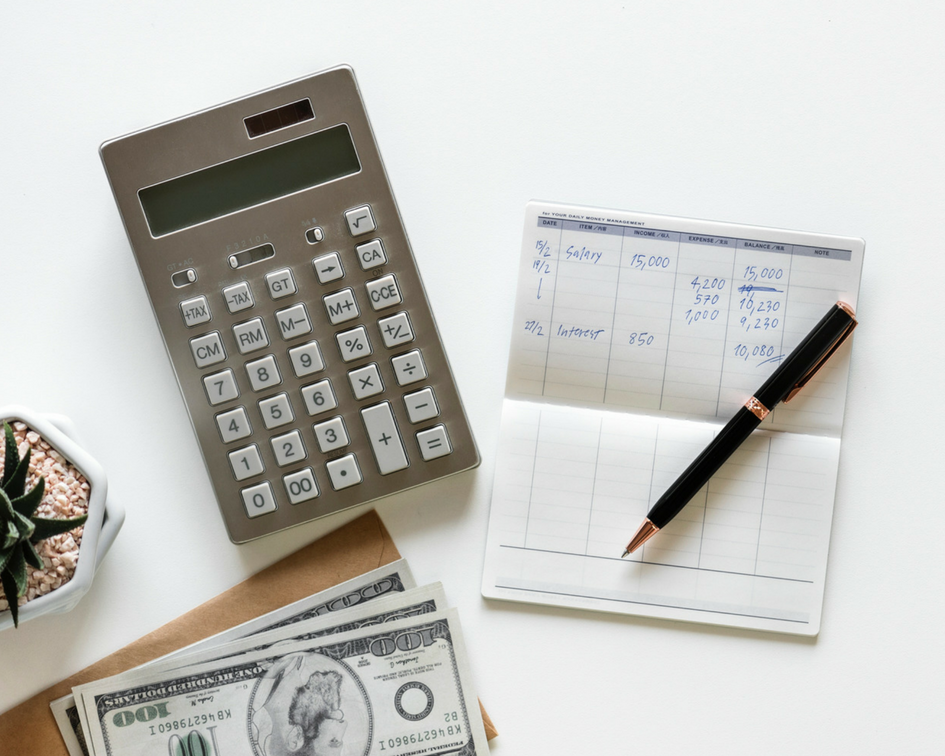
Patent rights last for up to 20 years from the date the idea was first filed. And it could be 3 or more years before a patent is granted. Given such long time frames, it is in your best interests to ask your patent attorney to give a ballpark estimate of the costs that you would incur during this entire period.
Often, attorneys simply quote the cost for drafting the application without the argument costs, government fees, etc. It is typical for an attorney to say it will be $10K for your patent, but they are forgetting the $2K government fee for filing, $4K per round of argument, annuity fees of $7-13K, etc.
A more honest answer is $30-40K spread over the 20-year period of the patent term.
These are the questions you should be asking your patent attorney before engaging their services.
- How much do they charge to obtain a patent on my type of innovation on average?
- What techniques are used to minimize or avoid churn in the argument phase?
- What’s the cost curve over the lifetime of the process?
- Can you give me an estimate for this year and through expiration of the patent?
Inventors have no idea what innovation tends to be expensive to obtain a patent and you would be surprised to find that simple technology is often more expensive to patent.
Typically your end-to-end costs would include:
#1. Any patentability searching which is optional before drafting
#2. Legal fees for drafting your application
#3. Government filing fees
#4. Legal fees for each round of argument along with an estimate on the number of rounds
#5. Government fees for more than two rounds of argument
#6. Miscellaneous attorney and government fees throughout the process
#7. Government issue fees
#8. Government maintenance fees after issuance
Moreover, all these costs, including the attorney fees, would vary depending upon
- How complex or simple the invention is
- The type of patent application (provisional or non provisional)
- Technology area with some requiring twice the writing budget over others
The patent office favors complexity over simplicity, so easy to understand innovation often requires a deeper explanation of the underlying technology which leads to the counter intuitive notion that simple innovation is more expensive to patent.
Similarly, utility patent fees (non provisional) differs from provisional patent fees as seen below.
| Patent Application Filing Fees (2025) | Large Entity | Small Entity | Micro Entity |
| Provisional Filing Fee | $325 | $130 | $65 |
| Utility — Basic Filing Fee | $350 | $140 | $70 |
| Utility — Search Fee | $770 | $308 | $154 |
| Utility — Examination Fee | $880 | $352 | $176 |
| Utility — Combined (filing + search + exam) | $2,000 | $800 | $400 |
| Design — Basic Filing Fee | $300 | $120 | $60 |
Also Read: Foreign Patent Filing: 5 Strategies to Develop an International Patent Portfolio
| Note: A non-provisional (utility) application isn’t a single fee. The USPTO charges a basic filing fee, a search fee, and an examination fee together, which is why the real upfront government cost is closer to $2,000 for a large entity than the headline filing fee suggests. Fees rose across the board on January 19, 2025; see our 2025 USPTO Fee Schedule guide for the full breakdown. |
Not listed above are the maintenance government fees to keep the patent in force after allowance that accrue at 3.5, 7.5, and 11.5 years into the patent term and total to $12,600 for a large entity, half that for a small entity, and half again for a micro entity.
A good attorney can provide you with a complete breakdown of the estimated costs over the life cycle of your patent so that you can plan your finances before diving into the patent process.
Don’t fall for cheap hourly rates
Many inventors and tech companies hire attorneys who charge low hourly fees, but the real analysis is more complex.
Let’s say you have two attorneys: one charges $250 an hour, while a more experienced attorney charges $500 an hour. Often, the higher rate comes with better efficiency, such that a better draft might be done in far less time. Both options typically will promise a similar writing cost of $8K-15K, depending on the technology area and complexity, or lack thereof.
While the lower billing rate may seem beneficial, this is a fatal mistake.
Your patent application draft is often the most important part of the process, so it is not the place to cut corners.
Most attorneys charge within 20% plus or minus to draft a patent application for each other, regardless of hourly rates.
The better draft from the more experienced attorney will typically have less difficulty gaining allowance at the patent office.
That initial savings from a less experienced attorney will cost you as the patent application is excessively churned at the patent office. Alternatively, the flaws in your patent drafting could make assertion difficult or impossible, such that the strategy may result in a worthless patent.
Billing rate is a factor, but total drafting costs, minimizing churn, and an enforceable patent are equally important in making a decision.
Hiring a better patent attorney, while expensive hourly, is in your best interests and should be seen as an investment in your IP assets.
Similarly, don’t just hire a patent attorney who picks up your phone when you call a law firm. Usually, these are the least busy ones and may not be the right fit as your patent counsel.
Instead, seek a personal recommendation from a trusted mentor or colleague who has successfully patented similar technology. Referrals from people who have seen the attorney’s work product firsthand are more reliable than firm reputation or online profiles.
In addition to this, validate the referral with objective data. Review their actual prosecution track record, allowance rates, and time-to-allowance for cases in your technology area. Never rely on title, firm prestige, or self-reported expertise alone.
Better still, don’t rely on referrals alone; pull the firm’s actual numbers first. Triangle IP’s Prosecutor Analysis lets you start at the law firm level and drill down to individual attorneys, so a “least busy” attorney with a thin or weak track record is easy to spot before you ever pick up the phone.
| Tip: Another way to find the best patent attorney in your field of invention is to look for people who are most active in the tech scene. Experienced and respectable attorneys often write papers, publish articles, conduct seminars, and speak at important events. |
Look for innovation attorney fit
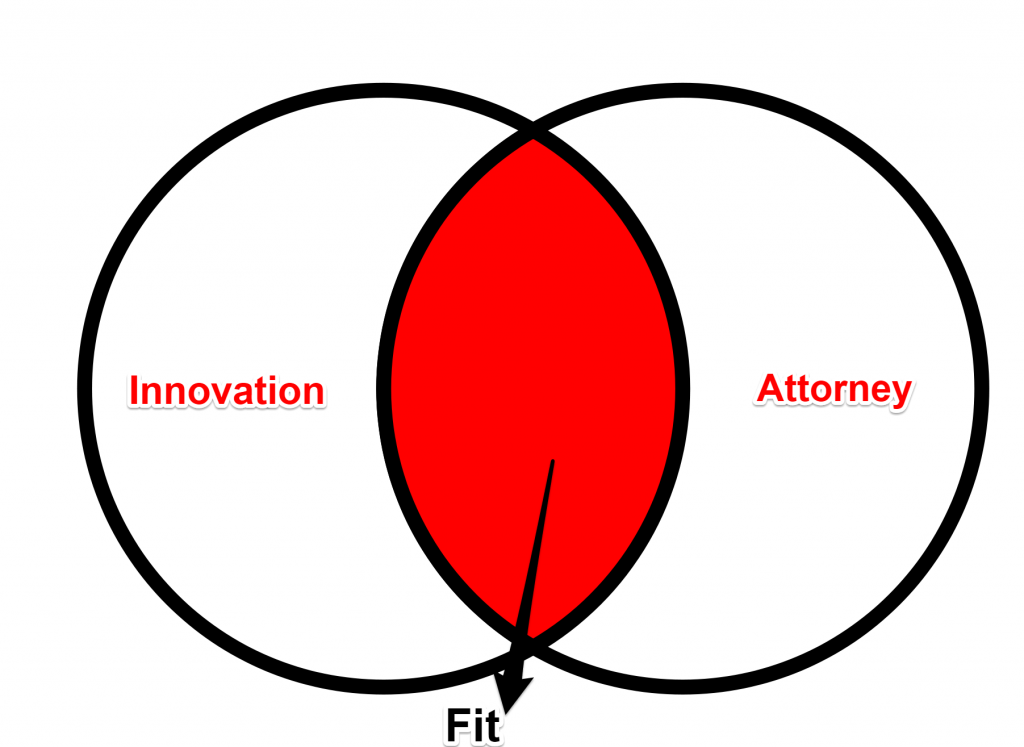
You know how important it is to find a product-market fit before scaling up the business.
Similarly, you should find an innovation-attorney fit before allocating the low five figures for the patent filing.
For example, you are an AI startup that is revolutionizing health care by reducing drug discovery times by predicting how molecules are likely to react with each other. That’s cutting edge AI.
So, you would want to hire a patent attorney who has expertise in AI & healthcare that understands the technology you are developing and can draft a winning patent application.
Because attorneys charge hourly, a patent attorney who is slow to learn your technology is costly and probably results in poorer work product.
Let’s take another example.
You are a company working on developing a blockchain based securities platform that connects issuers and investors in a peer-to-peer network with settlement times a fraction of the conventional wait times.
Now, you would want a patent attorney who has experience dealing with blockchain & financial services to quickly understand your innovation over what the big financial firms have already filed in this space, and, if so, what should your filing strategy be?
Point being, hiring an experienced, reputable patent attorney is just not enough. Finding an attorney who can quickly understand your innovation is key to efficiency.
Therefore, a rule of thumb is to ask yourself the following questions when vetting a patent attorney.
- Does the patent attorney has expertise in the technology you are developing?
- How familiar are they with the part of the patent office examining your cases?
- How many patents have they filed in your technology area and what results are typical?
- If you lack inside legal counsel, can they describe the process using terminology you understand?
- Are they experienced working with companies of your size or funding cycle such that they can explain the strategies?
| Tip: Many law firms share their attorney profiles which includes their technical background and the areas of expertise. Additionally, you can look up their LinkedIn profile to get a sense of their technical background and experience along with the articles they have published. |
You can also verify fit with data rather than taking a bio at face value. Triangle IP’s Prosecutor Analysis shows the specific Group Art Units an attorney actually works in and how active they’ve been there recently, so you can confirm their experience is concentrated in your technology, not just claimed on a profile.
It also lists the applicants they most often represent, which doubles as a quick conflict check: if a prosecutor regularly files for a direct competitor, that’s worth knowing before you reach out. (To narrow the view to just your art unit or the last couple of years, see how to do an advanced search in Prosecutor Analysis.)
Know your attorney’s strategy

You would be surprised to know how many enterprises do not have a well thought-out patent strategy, impacting the success of their businesses.
More budget is lost in the pursuit of the wrong patent strategy than in any hiring choice.
The strategy joke in the patent industry is “If you are going to ask your attorney how many patents you should file, your attorney would ask how many you can afford.” Seriously.
Meaning, they are biased toward a gold-plated approach only throttled by your ability to afford it. (Patent attorneys tend to be risk-averse).
Plus, there is the obvious moral hazard with any vendor that realizes more profit in an aggressive approach.
For example, an attorney may file patents in areas that the patent office rarely rewards with a patent. Also, they may not invest the time and effort to draft a patent application that will fly through the process.
Impossible patent odds with very determined effort will quickly zap your legal budget.
There are tools available to empirically predict the likelihood of allowance for different technologies.
Triangle IP, for instance, can predict the likelihood of allowance, which will help you know your odds of getting a patent issued. Its Art Unit Predictor shows where your application is likely to land. And since some art units allow under 10% of cases while others exceed 90%, that single insight can reshape your filing strategy before a dollar is spent.
So, make sure your attorney understands
- Why you need a patent (attract funding or exit, licensing revenue, competitor threat, etc.)
- Ask what the different options are to best utilize your budget this year, while understanding the costs through completion of the process.
- The competitive landscape for your industry to scale your patent portfolio
A good attorney would listen to all of the above, ask questions about your business model, review the landscape to find out what your competitors are doing, what kind of patents they are filing, and then come up with a pragmatic patent strategy to provide the most value for the least cost.
Find the one who is empathetic to your success.
For example, today AI and Machine Learning are being taken very seriously all over the world and are on the way to becoming mainstream adoption in the years to come.
No wonder that startups dealing with AI technology in different domains are working fast to get patents to capture a lion’s share of their respective products in the market.
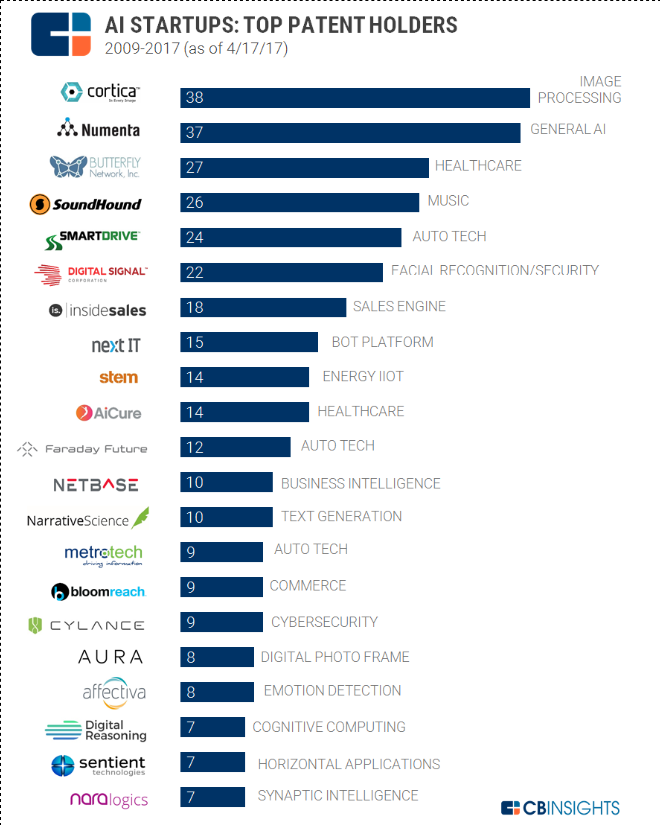
Image Source: CBINSIGHTS
If you are a startup in the AI field, reviewing the above list for familiar competitors will provide a guidepost for how aggressively you might invest in capturing your innovation with patents. For example, if you are entering the cognitive computing space, knowing that Digital Reasoning has 6 patents will signal that you may also want that many or even more if they continue to file patents.
Therefore, knowing how many patents to file and the likelihood of success, along with a strategy focused on achieving your goals inexpensively, will provide the most value from your patent attorney.
Here is our video resource to evaluate your patent attorney.
Choose an attorney who success rate is greater than industry average

Patent attorneys are abundant, and most perform within industry norms, but attorneys with high success rates are scarce.
In difficult technology areas, it is not uncommon to find attorneys with substantially higher allowance rates with far fewer rounds of argument with the patent office.
For instance, for a business method client, we were getting patents granted over 90% of the time when the industry average was a mere 10%. Which means, from a yield perspective, others had to file 10 patents to get one granted, whereas we had to file 1.1 patents to achieve the same.
In terms of costs, most counsel are within 20% of each other when writing a patent and doing each round of argument, but the better performing attorneys will always cost less when yield is taken into account.
Therefore, the success rate matters.
While a good patent counsel would transparently share success rates, few clients will even ask since they presume that all patent attorneys achieve the same outcomes. But that is not the reality.
There’s a catch, though: a success rate on its own can mislead you. A 90% allowance rate looks excellent, right? But if that attorney works with lenient examiners in art units that already grant 90% of the time, it’s merely average. The same 90% against tough examiners who allow only 70% signals genuinely exceptional skill.
This is exactly what Triangle IP’s Prosecutor Analysis is built to show: it benchmarks an attorney’s allowance rate against both the examiners they’ve worked with and their art-unit averages, so you’re always reading the number in context rather than being impressed by it in isolation. The step-by-step guide to reading that data walks through every prosecutor’s stats that the tool presents.
Or, you can watch the exact interpretation of the prosecutor’s analysis data in this video:
Since the success rate can swallow all other factors in choosing a counsel, find a patent attorney who has a track record of winning.
Say no to attorneys who excessively churn during the argument phase
Half a million patent applications are waiting for examination, and even more if you count those being actively argued.
Some patents are approved quickly, while others take much longer. It depends upon many factors, such as how simple or complex your innovation is, the quality of your patent draft, the advocacy skill of your attorney, the patent office stats for that type of technology, the scope of your innovation, etc.
Having said that, the skill of your patent attorney plays a far more important role in deciding how quickly you can get a patent, with the best counsel averaging one round of argument until allowance.
A genuine, skilled attorney can estimate the number of rounds to patent allowance and will see that your innovation is in condition for allowance within the estimated number of rounds.
With each round costing $3-5K on average, saving one round results in substantial cost savings as well.
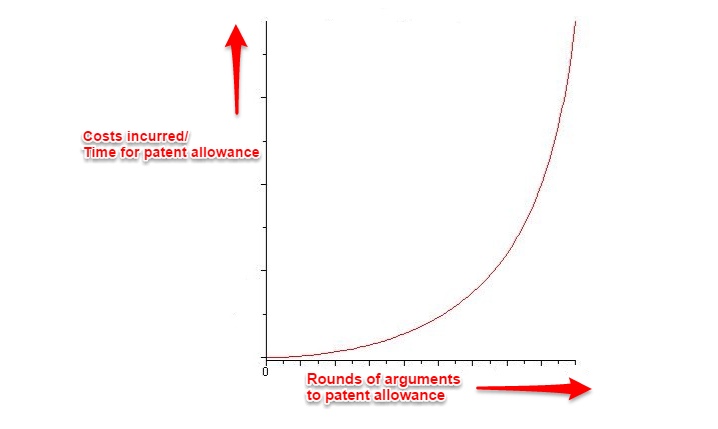
For example, my patent practice involves taking over a prosecution gone bad. In a recent case, prior counsel was still unsuccessful after 14 rounds of argument with the patent office, costing the client over $50K in legal and government fees.
For that same client, we averaged a little more than one round of argument and were able to resolve that over-churned case in just one more interaction with the patent office.
The best attorneys understand the real issues quickly so that they can be fixed for quick results. Meeting with the examiner, for example, is extremely helpful, but rarely done with a paper argument being favored by those with worse statistics.
But how do you know if your attorney is a skilled negotiator when arguing your cases?
After all, the patent office doesn’t publish attorney-level statistics, but Triangle IP’s Prosecutor Analysis reconstructs them from prosecution records.
You can see the average number of office actions an attorney needs before allowance (benchmarked against their art unit), how often their cases require a Request for Continued Examination (RCE), and, just as importantly, how often those RCEs actually succeed. An attorney who resolves most cases in a single round, rarely needs an RCE, and wins the ones they do file is managing your budget well. One who churns is spending it.
Prefer to see it in action? Get a guided demo walkthrough of the Triangle IP’s Prosecutor Analysis.
Frequently Asked Questions
1. Should I Hire a Patent Agent Instead of a Patent Attorney?
For the core work of drafting and prosecuting patent applications, experienced patent agents frequently perform on par with attorneys and often at a lower cost structure. Both attorneys and agents must pass the same patent bar exam and hold a technical degree. However, the difference is that agents cannot represent you on appeal or in front of a judge. If your strategy centers on obtaining patent allowance rather than litigation, an agent with deep technical expertise in your field may deliver better value than a generalist attorney
2. What Red Flags Should I Watch for That Aren’t Obvious?
Attorneys near retirement, or those who have shifted to management or advisory roles, may lack current familiarity with cutting-edge technologies and recent USPTO procedure changes. Confirm they have filed and prosecuted patents in your field within the last 12–18 months.
3. What Does ‘Good’ Work Product Look Like When I Review a Sample?
Look for three things in a redacted, recently allowed application:
- Claims: Are they precisely scoped to the invention without overbreadth that invites rejection, yet broad enough to capture value?
- Specification: Does it teach the invention clearly enough that a person skilled in the art could implement it without undue experimentation?
- Prosecution history: Does the file show efficient advocacy, targeted amendments, and arguments that resolved issues in minimal rounds, rather than reactive, scattershot responses?
If the attorney cannot or will not provide a sample, that is itself a signal.
4. Should I Build an In-house Patent Team?
It depends on volume and stage. Early-stage companies with a low number of filings usually get better value from external counsel; you pay for what you need, when you need it. Once you’re filing 15–20+ applications annually, an in-house attorney or agent can reduce per-matter costs and align IP strategy closer to product roadmaps.
5. How Much Does it Actually Cost to Hire a Patent Attorney?
Most attorneys quote $8–15K for drafting, but that’s only the starting point. A full patent lifecycle cost estimate typically runs $30–40K spread over 20 years, covering filing fees ($2K+), argument rounds ($3–5K each), issue fees, and maintenance fees at 3.5, 7.5, and 11.5 years that total $12,600 for large entities.