
| TL;DR: Most people find patent attorneys the wrong way. They rely on reputation, referrals, and rankings that measure the wrong things. Eventually, end up with someone who looks good on paper but does not perform. A good patent attorney is the one who understands your technology fast, works efficiently through the patent office, and can prove it with their performance data. This guide covers the six stages that’ll help you find a good patent attorney. |
Finding a patent attorney is easy. Finding the right one is not.
There are over 53,000+ active patent practitioners listed with the USPTO, and every one of them is qualified to be on that list.
Then you hear stories like this: an inventor hired an attorney who looked fine, but the application was abandoned twice. When the inventor needed answers, the attorney stopped returning his calls. The cost and delay hurt, but the bigger loss was the invention, which had already been disclosed.
That is the catch. You cannot make this selection based only on credentials or reputation.
This 2026 guide walks you through what to look for before making that hiring call, and why patent prosecutor analytics tools are now one of the most useful ways to evaluate fit and performance.
Let’s begin!
First, Understand Why the Obvious Approaches Are Not Enough
Most people start with the same obvious routes: they ask for referrals, search attorney directories, look at firm rankings, compare filing volume, or trust broad “patent quality” labels. These methods are not useless. They can help you build an initial list of qualified names.
But they do not answer the real hiring question: Is this prosecutor the right fit for your invention, your technology area, your budget, and the specific USPTO path your application is likely to face?
That is where most searches fall short. The sections below explain why each common shortcut can mislead you if you treat it as proof of quality.
1. Relying on Referrals Without Verifying the Outcome
A referral tells you someone else was happy, not that this attorney will perform well for your specific technology and art unit. The flaw in the thinking is treating someone else’s satisfaction as a proxy for future performance on your patents.
We strongly agree with the fact that referrals are still the most useful way for building a starting list, but using them to make the final decision is outsourcing your judgment to someone with different needs.
2. Trusting Prestige Rankings and Awards
Patent prosecutor leaderboards and industry press releases list active practitioners and top firms.
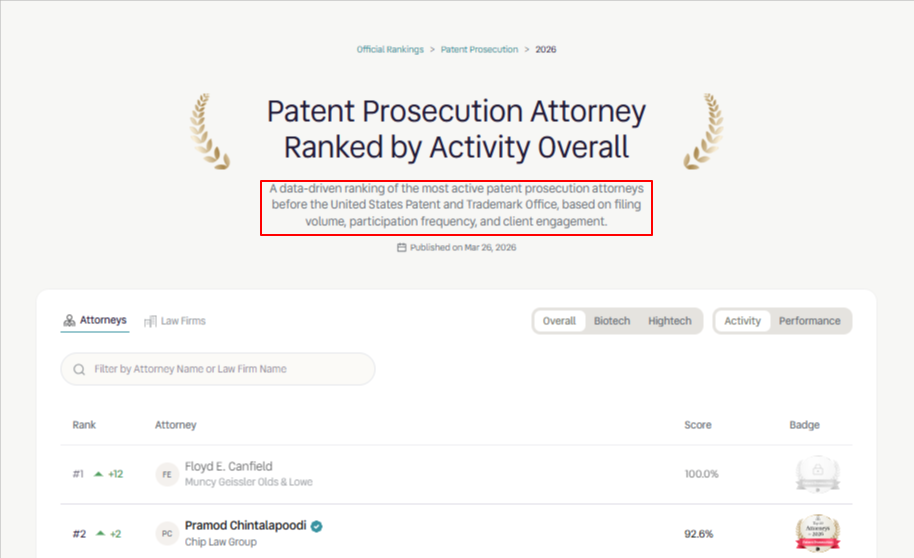
Source: Lexdana
However, as in the above image, it is clearly mentioned that the rankings are based on filing volume, participation frequency, and client engagement. It does not reveal the quality of the prosecution.
3. Treating Volume as a Signal of Quality
Filing volume tells you how busy a firm is, not how well it performs. A high-volume firm may still have below-average allowance rates. The mistake is treating activity as proof of results.
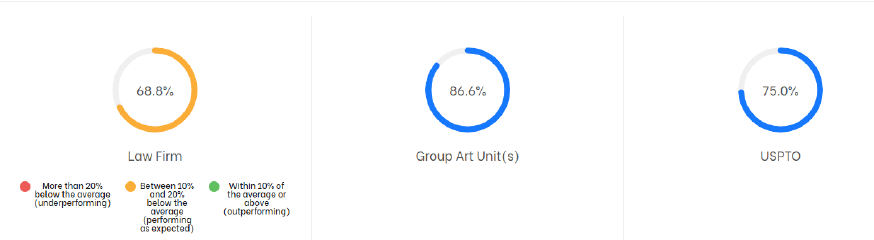
The example above, pulled from Triangle IP’s Prosecutor Analysis tool, shows why context matters. The firm has a 68.8% allowance rate, while its group art unit average is 86.6% and the USPTO average is 75.0%. So even though the firm handles a high volume of applications, it underperforms against both its art unit peers and the broader USPTO average.
This is not about naming or shaming. It is about seeing what filing counts hide. Volume can create the impression of quality, but prosecution data shows whether that impression holds up.
4. Using Attorney Ranking Tools as a Performance Measure
Not all tools evaluate prosecutors fairly or measure what they claim to measure.
Tom Franklin, founder of Triangle IP and a patent attorney with 25+ years of IP experience, puts it this way:
“Some tools rank attorneys based on who uses their software and corrects ministerial errors. That is dressed up as a quality signal. But it is really a measure of their own customer base. Fixing typos is not the same as getting patents allowed.”
The only fair measure is performance relative to the examiners the attorney prosecutes cases with. An attorney winning 92% against easy examiners is fundamentally different from one winning 92% against tough ones.
The difficulty of the assignment also matters, just like the number. This reframes how you should evaluate every candidate from here forward. That is why most searches lead to the wrong person. The next section shows you the right way.
How to Find a Good Patent Attorney: The Right Judgment Process
Now that you know what does not work, here is what does. The right hiring process has six stages. Each stage acts as a filter and helps narrow your options before moving to the next step.
- Rule out the wrong candidates early.
- Filter for relevance.
- Evaluate performance with data.
- Calculate the cost estimate
- Compare your shortlist side by side.
- Confirm your choice in conversation.
Skip one, and you increase the chances of selecting the wrong attorney.
Stage 1: Rule Out Anyone Who Cannot Legally Practice
The first judgment is eligibility, not quality. Instead of risking your innovation being exposed, you can use the USPTO to find an attorney who can legally practice.
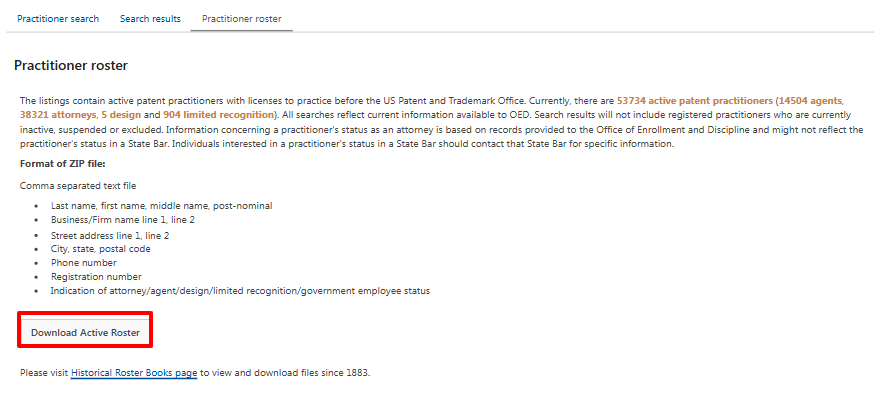
The USPTO maintains a public roster of active patent practitioners. The roster currently lists over 53,000 active practitioners. This includes patent agents, patent attorneys, and those with limited recognition status.
A zip file of the full active roster is available for download in the portal. This is useful if you want to analyze the data offline or cross-reference it with other tools.
Source: USPTO Practitioner Roster
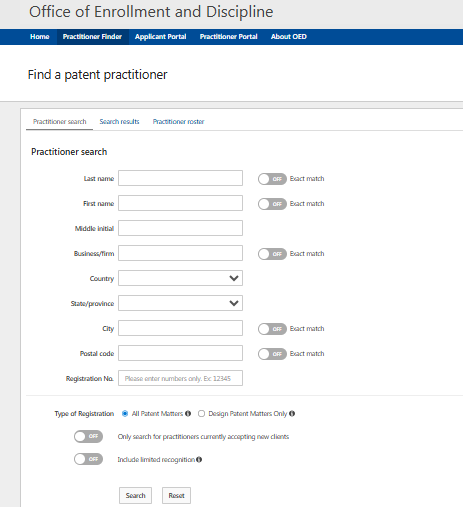
Go to the Office of Enrollment and Discipline portal. Search by name or registration number and check for these three things.
- The registration status is active.
- The registration date is current.
- There is no disciplinary history.
Source: USPTO OED Portal
This step eliminates fraud and retirees. It tells you if they are legally allowed to practice. Do this for every candidate on your shortlist before you move to deeper checks.
Stage 2: Filter for Relevant Experience Before Evaluating Performance
The second judgment is relevance. A strong attorney who is not familiar with your technology area is the wrong attorney for your patents.
A patent attorney needs to understand your invention at the technical level. If they cannot quickly grasp the core innovation, they will bill you while they learn.
In fact, Tom Franklin, founder of Triangle IP and a patent attorney himself with 25+ years of experience, puts it this way: Paying an attorney to learn your technology and produce poor drafts is the most expensive outcome for a client.”
So, how do you check technical background alignment before you hire a patent attorney?
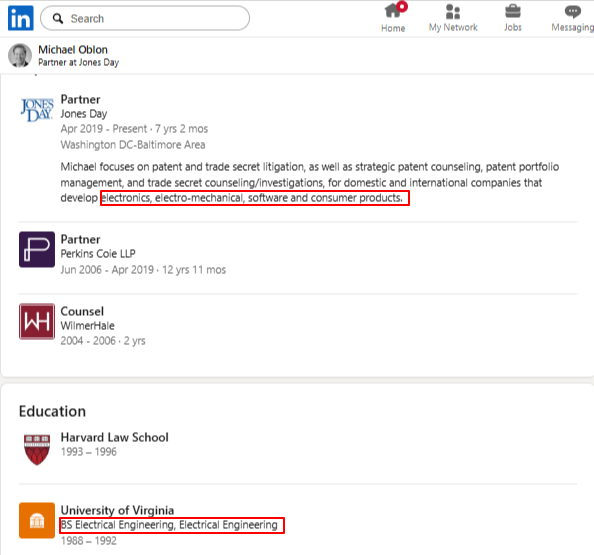
You can use the TIP Tool™’s Prosecutor Analysis tool for free to find their basic details, like their LinkedIn profile, and look at their degree and work experience. Check if it matches your technology field.
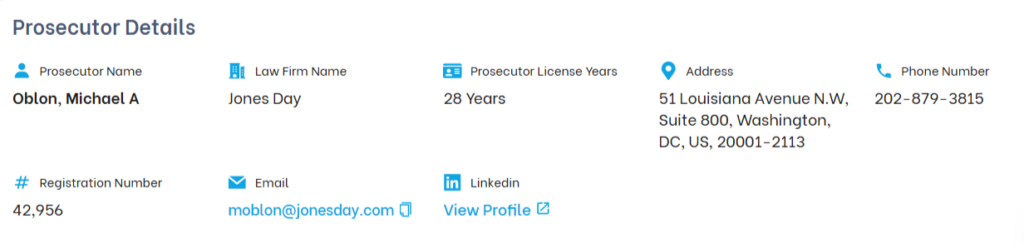
For instance, an electrical engineering degree is relevant for electronics and innovations in the electrical field. It is less relevant for fintech. Ask for work product samples in your field. Read the claims. Assess whether the scope matches the invention.
Source: LinkedIn
In this stage, patent agents who specialize in your technology area are worth considering for drafting. They cannot litigate or handle appeals. But for prosecution, they often match attorney performance at a lower cost.
| Patent Agent A patent agent is a professional who has passed the USPTO patent bar exam. They can draft patent applications, prosecute patents before the USPTO, and respond to office actions. However, they cannot litigate or handle appeals. |
Download the patent hiring guide to match with the right attorney who understands your innovation and protects your patent assets.
Stage 3: Evaluate Performance the Way a Hiring Manager Would, With Data
No patent attorney can guarantee success. But hiring a good patent attorney increases your chance of getting the patent.
The risk is hiring an attorney whose metrics sit below the art unit average. That attorney has a lower allowance rate. They take longer to get a grant. They rack up more office actions. That is not a gamble worth taking.
You can filter out such patent prosecutors and find their performance metrics using a standalone tool like Prosecutor Analysis from Triangle IP.
In Prosecutor Analysis, you can look up either individual attorneys or law firms. If you are analyzing a law firm, you can see the firm’s metrics and the associated prosecutors’ details. If you are looking at an individual prosecutor, you can find their specific performance metrics.
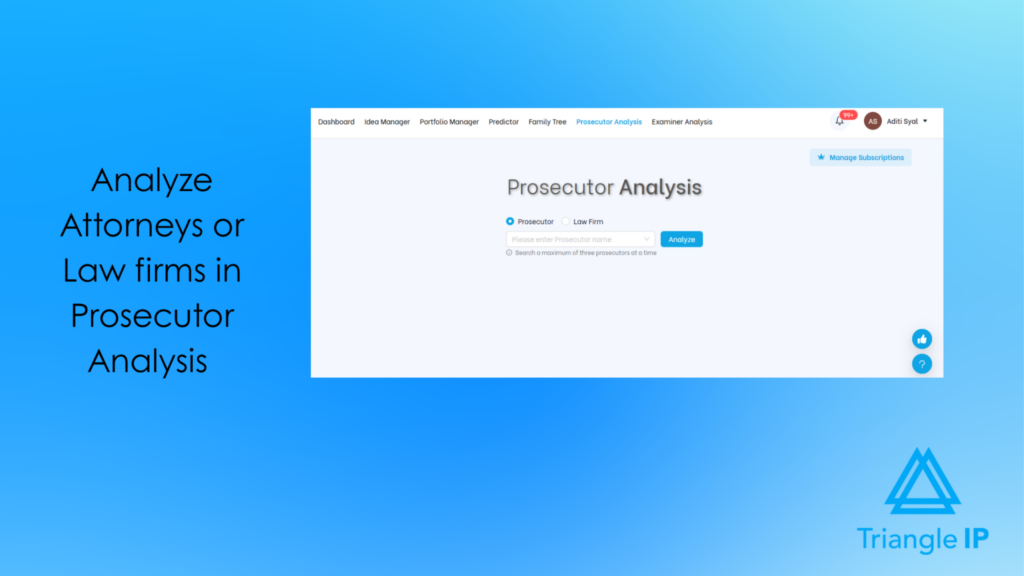
Here are the core prosecutor performance metrics to evaluate your patent attorney:
- Allowance Rate in Context
- Time to Allowance
- RCE and Rounds of Arguments
- Recent Activity
1. Allowance Rate in Context.
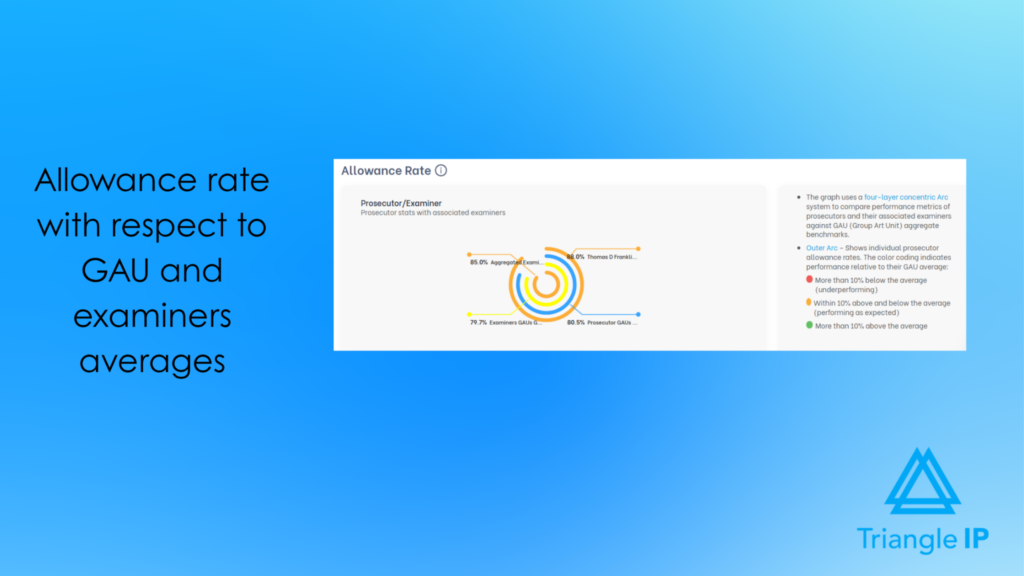
Allowance rate is the headline number. But a raw percentage means little without context. Difficult examiners or the difficult group art unit is where skill shows. You need to see it against the art unit average and the examiner’s averages.
The Prosecutor Analysis dashboard shows four layers in the allowance rate section:
- Prosecutor rate.
- Group art unit rate.
- Aggregate examiner rate.
- Aggregate examiner group art unit rate.
A prosecutor at 89% allowance against a 75% average allowance rate is outperforming. Whereas a prosecutor at 89% against a 95% art unit average is lagging. The same number tells two different stories when you include the context.
2. Time to Allowance
Earlier protection means earlier commercial advantage. But speed only matters in context.
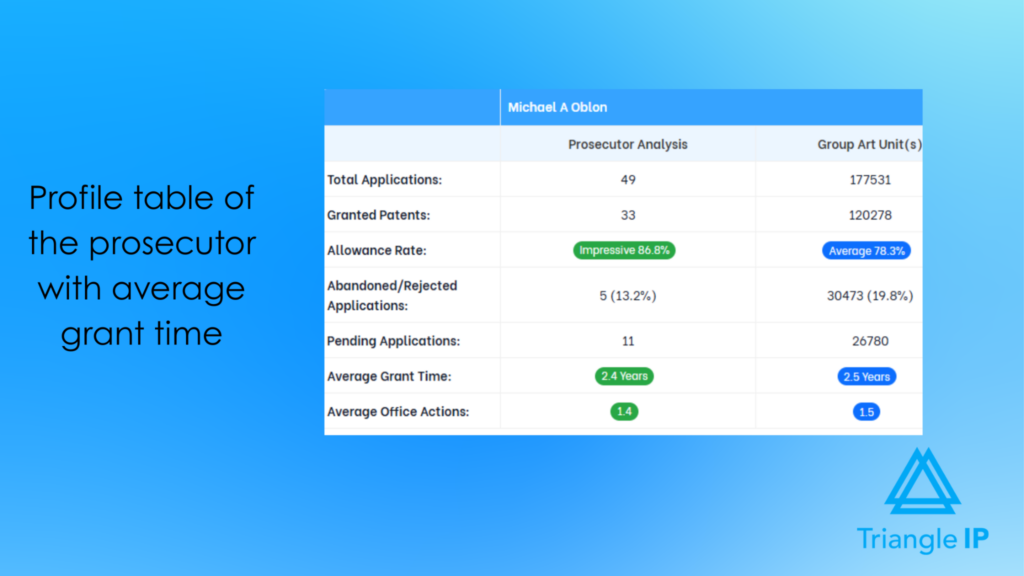
For example, a prosecutor with 1.5 years average grant time and 0.8 average office actions against a group art unit average of 2.1 years and 1.1 office actions signals strong efficiency. A prosecutor at 2.5 years against a 2.3-year average is lagging.
The Profile table makes this visible instantly. It shows total applications, granted patents, allowance rate, abandoned or rejected applications, pending applications, average grant time, and average office actions.
Use this to compare candidates side by side. Look at grant time and office actions together to benchmark if the prosecutor is lagging or outperforming their peers in the Group Art Unit.
3. RCE rate and rounds of argument.
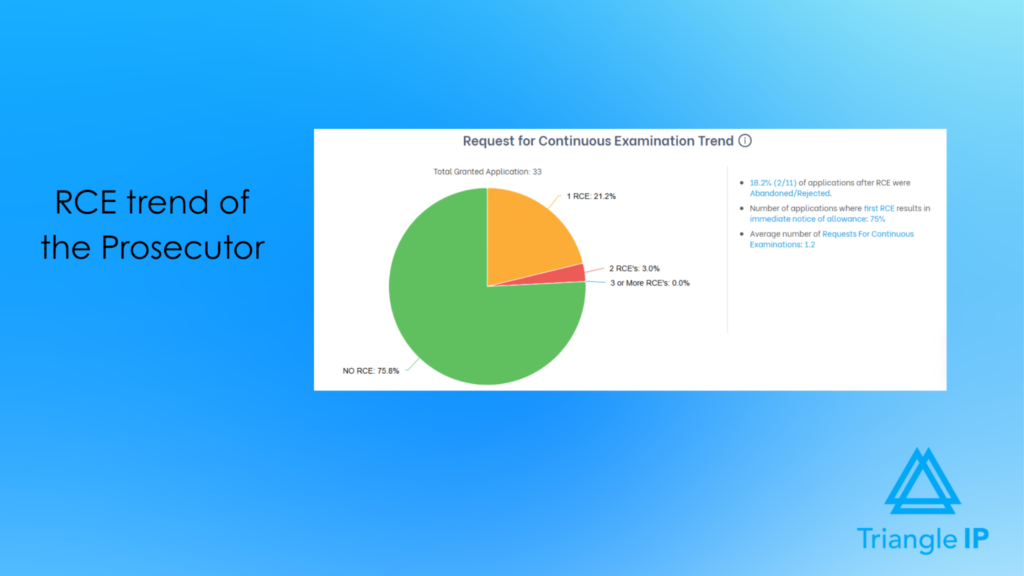
Each request for continued examination adds cost and delay in getting your patent granted. A practitioner who triggers unnecessary RCEs burns your budget twice. You pay for the RCE filing. You pay for the extended prosecution. Strong initial drafts prevent this.
But not all RCEs are equal. A prosecutor who gets 92.3% of cases granted without ever needing an RCE is handling prosecution efficiently upfront.
One more stat to look out for is what happens when the prosecutor files the RCE.A high percentage of RCEs resulting in immediate allowance means the attorney knew when to push and had the right arguments ready.
Compare this to a prosecutor, where most RCEs lead to abandonment. That is a very different risk profile.
4. Recent Activity
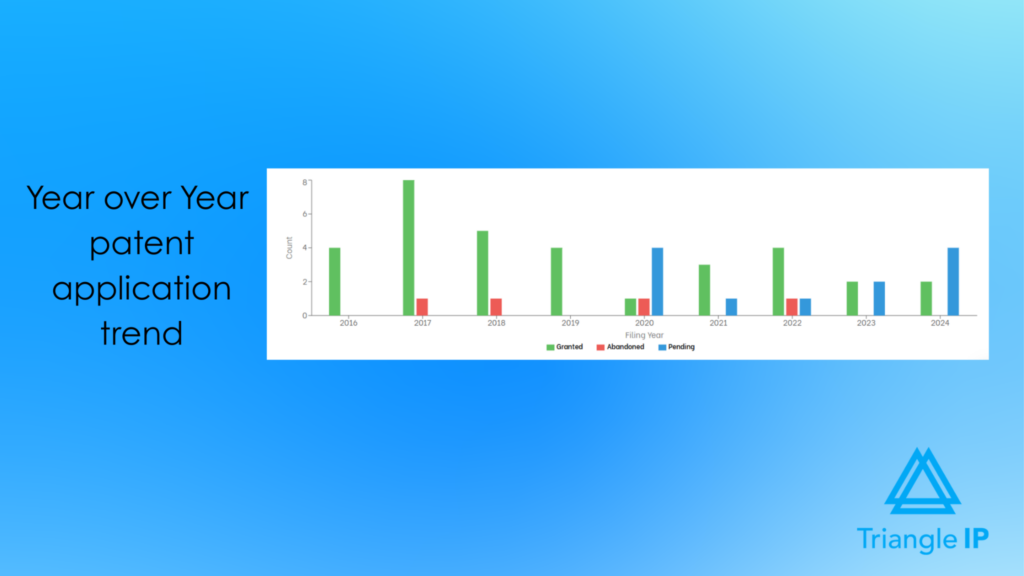
A practitioner who averaged 85% allowance five years ago but dropped to 60% last year is slipping. Trends matter more than single-year snapshots. The dashboard shows year-over-year allowance data. Look at the pattern, not the peak.
This way, you can rule out candidates who may have excellent stats from years ago. Those old numbers push their overall average up. Meanwhile, their recent activity has stalled and no longer contributes to real performance.
A prosecutor with a 90% career average but only 2 filings in the last 3 years is not the same as one with a 90% average and 20 filings last year.
Check if they are still actively filing. A five-year gap in prosecution work means they are out of practice with current USPTO trends and your technology
Stage 4: Calculate the Cost Estimate Before Hiring
The question is not whose hourly rate is lower. It is whose prosecution record means fewer filings are needed to get the same number of patents allowed.
End-to-end prosecution costs include these eight items.
- Patentability searching, which is optional before drafting.
- Legal fees for drafting your application.
- Government filing fees.
- Legal fees for each round of argument, plus an estimate of the number of rounds.
- Government fees for more than two rounds of argument.
- Miscellaneous attorney and government fees throughout the process.
- The government issues fees.
- And government maintenance fees after issuance.
A prosecutor with a low allowance rate inflates costs across multiple categories. You pay for more rounds of argument.
For example, you hire prosecutor A at a higher hourly rate and file 10 applications, get 9 granted. You hire prosecutor B at a lower hourly rate and file 10 applications, get 7 granted. In the latter case, those 2 extra applications cost you filing fees, attorney time, and months of delay, which is a lost investment.
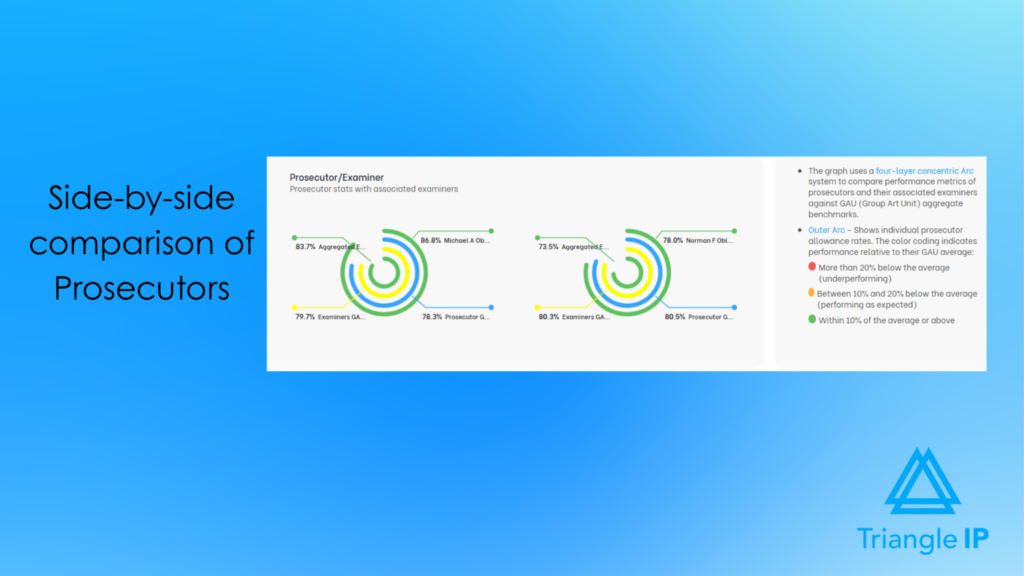
Use the side-by-side comparison in Prosecutor Analysis to run this math. Compare allowance rates, RCE trends, and office action counts for your shortlist. Multiply the difference by your average filing cost.
This reframes your hiring decision. Stop comparing sticker prices. Start comparing expected outcomes.
Stage 5: Compare Your Shortlist, Not in Your Head but Side by Side
Once you have two or three candidates who pass the performance filter, the judgment shifts to comparison. Now, the best part is, the Prosecutor Analysis tool by Triangle IP lets you place them side by side in a single view.
For instance, we have compared Michael A Oblon and Norman F Oblon. Both work at related firms. But the performance profiles differ. Michael outperforms his examiner pool by a wider margin. Norman is closer to his group average. The side-by-side view makes this visible instantly.
Stage 6: Confirm Your Judgment in the Actual Conversation
The data has pointed you to a strong candidate. Now confirm it in person. This stage is about stress-testing what the numbers showed.
Here are the 6 mandatory questions to ask your patent attorney before hiring:
- What is your allowance rate in my technology area, and how does it compare to the art unit average? You already know the answer from the data. A strong attorney will confirm it confidently and specifically.
- How do you approach examiner analysis before filing and during prosecution? You want to hear a specific process. A vague answer about experience is a red flag.
- How do you handle a tough first office action? You want a strategy, not reassurance. Listen for whether they talk about examiner behavior, interview tactics, and claim amendments, or just say they fight hard.
- What does your typical timeline look like from filing to allowance? Compare against the 2.84-year industry average you already know.
- How do you structure your fees, and what does your flat fee cover? You are confirming the total prosecution cost, not just the hourly rate.
- Can you share examples of cases you have prosecuted in my technology area? Work samples confirm that the track record in the data translates to real claim quality.
If the answers match the data, you have found your prosecutor. If they do not, go back to your shortlist. However, even the best data cannot save you if you don’t look out for the warning signs.
Red Flags That Should Stop the Process at Any Stage
Some warning signs appear before you sign the retainer. Others show up in the first conversation. Watch for these.
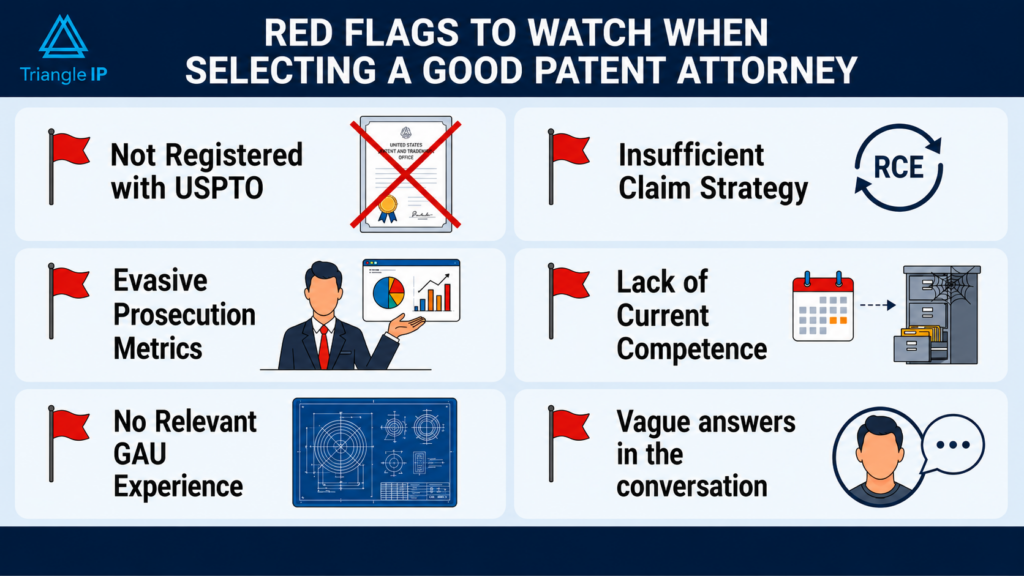
Several prosecutor analysis tools can help you in evaluating your attorney or the law firm. Some tools show you leaderboards.
But the Prosecutor Analysis by Triangle IP gives you the complete performance data in context to make an informed decision in hiring the right fit.
Here is the video resource explaining how to evaluate your patent counsel.
TIP Tool™: A Smart Prosecution Package for Hiring Prosecutors and Managing Complete Patent Lifecycle
Finding the right prosecutor is only the first decision. Managing prosecution after you hire them is where most teams lose visibility.
The TIP Tool connects both stages. Prosecutor Analysis is the standalone tool that this article covered. Compare attorneys side by side. Make hiring decisions with data, not referrals.
Three additional tools help you prosecute smarter.
- Art Unit Predictor forecasts where your application will likely land before you file. This shapes prosecutor selection and claim strategy. A predicted hard art unit means you need a specialist with proven wins in that group.
- Patent Family Visualization maps parent, continuation, and divisional relationships. See coverage gaps and expansion opportunities. Make sure your prosecutor builds a portfolio, not just files one-off applications.
- Examiner Analysis shows how specific examiners behave. Review their allowance rates, objections, and response patterns before your attorney drafts a single claim. Brief your prosecutor on what works.
These tools close the loop between attorney selection and prosecution execution.
For innovation-driven companies with multiple patents, distributed R&D teams, and external counsel, the TIP Tool™ adds enterprise-wide patent management capabilities.
- Capture invention ideas early through simple disclosure forms.
- Collaborate in one place with secure Azure SSO login.
- Track USPTO updates automatically.
- Manage the full patent portfolio and align IP strategy with business goals.
Together, these capabilities connect stakeholders, inventors, and IP teams with every decision that affects prosecution success. From first idea to final grant, the platform gives you visibility that spreadsheets and email cannot match.
If these solutions fit your workflow, book a demo with the founder. Get a guided walkthrough tailored to your use case.
Disclaimer: The statistics in this article were fetched from the TIP Tool at the time of publishing. These numbers reflect historical USPTO prosecution data and are subject to change as prosecutors continue to work additional patent applications. For the most current prosecutor metrics, consult the TIP Tool directly.
Frequently Asked Questions
1. What is the Difference Between a Patent Attorney and a Patent Agent?
The simplest explanation can be: A patent attorney has a law degree and has passed a state bar exam. They can represent you in court, handle appeals, and manage litigation. A patent agent has passed the patent bar but not the state bar. They can draft applications, prosecute patents before the USPTO, and handle most patent office matters. They cannot litigate or represent you in court. For example, Kate Gaudry and Usman Mughal are patent attorneys, whereas Ayan Paul and Scott Gilbert are patent agents in the same law firm, Mughal Gaudry & Franklin PC.
2. Does Location Matter When Hiring a Patent Attorney?
Patent prosecution is a federal practice. Any registered attorney or agent can represent you before the USPTO regardless of state. Most communication happens by email and phone. For litigation or licensing negotiations, local counsel may help. For prosecution, focus on technical fit and performance metrics over geography.
3. Should I do a Patentability Search Before Hiring an Attorney?
It helps, but is not required. A search gives you confidence that your invention is novel and reduces the risk of filing a weak application. Some attorneys include the search in their initial fee. Others recommend a separate search firm for objectivity. If you skip the search, your attorney may find prior art during prosecution that forces claim narrowing or abandonment. Either way, discuss the search strategy with your attorney before filing. Do not assume they will do one automatically.
4. Should I Ask for Work Product Samples Before Hiring?
Yes. This is the strongest vetting step. Ask for anonymized patents they have prosecuted in your field. Read the claims. Assess whether the scope matches the invention. Check the prosecution history. Did they face excessive office actions? Did they preserve broad claims or narrow repeatedly? Strong attorneys will share this. Those who refuse or offer only marketing materials are hiding something.