
| TL;DR – Chatbots are no longer simple support bots. Innovation is happening in multilingual farm assistants, oncology-trained medical bots, privacy-first encrypted AI, autonomous phone-answering systems, avatar-based agents, and enterprise guardrails. We shortlisted 12 innovative chatbots based on TIME Best Inventions, patent publications, global finance and AI awards, and verified large-scale deployments. Each example highlights a clear architectural, regulatory, or deployment breakthrough. |
“AI is one of the most profound technologies humanity is working on,” says Sundar Pichai, CEO of Google.
That might sound broad, until you look at what’s happening in conversational AI. Today’s innovative chatbots are no longer basic FAQ responders tucked into websites. They’re being designed for privacy, reliability, multimodal interaction (the ability to understand and respond using text, voice, images, or documents), and regulatory compliance. And deployed inside banks, hospitals, enterprise systems, and even low-bandwidth rural communities.
The real breakthrough isn’t more complex models. It’s smarter architecture built for real-world constraints. To identify meaningful progress, we reviewed TIME Best Inventions (2024-2025), U.S. patent publications, major AI and finance awards, and large-scale deployments.
Here are the systems turning conversational AI into something far more powerful than a chat window.
1. Darli AI
Darli AI is an AI-powered agricultural chatbot developed by Farmerline Group, a Ghana-based agritech company focused on supporting smallholder farmers with digital tools and insights. The chatbot operates through WhatsApp, text, and voice. It allows farmers to interact in more than 27 local languages. With Darli, farmers receive tailored guidance on crop management, pest and disease detection, weather updates, and regenerative farming practices.
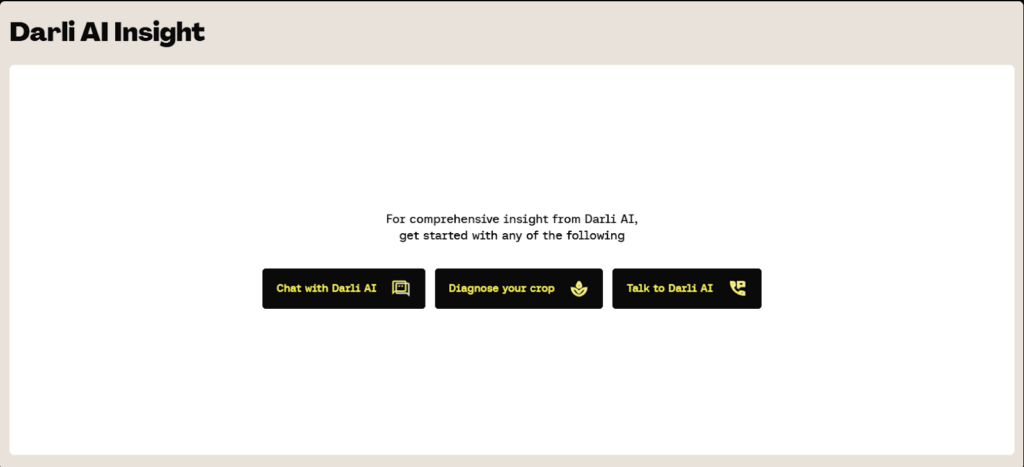
Source: Darli AI Homepage
Unlike generic conversational agents, Darli AI is designed specifically for low-resource, low-bandwidth environments common in rural agricultural communities. It helps bridge language and literacy gaps that many traditional digital tools fail to address. It combines multilingual natural language interfaces, interactive voice response (IVR), and multimodal inputs (text, voice, and images) to make agronomic knowledge more accessible.
Key Details of the Innovation
- Company: Farmerline Group, a digital agriculture and agritech solution provider based in Accra, Ghana.
- Year Introduced: March 2024 (commercial launch).
- Location: Ghana (with deployment across Africa, Asia, and South America).
- Patent Status: Proprietary AI agricultural assistant and multilingual conversational architecture; specific public patents not cited.
- Funding: Developed internally within Farmerline’s agritech ecosystem; the company also partners with organizations and funders to scale impact.
- Market Deployment: Trusted by over 1 million farmers and used in 60+ countries, with 110,000+ direct users since launch and millions of total interactions.
- Award/Recognition: Named by TIME as one of the Best Inventions of 2024 for its real-world impact in agricultural accessibility.
2. Dave– Cancer Support Chatbot
Dave is a specialized conversational AI called the AI Cancer Mentor, created by a health technology company Belong.Life. It provides personalized support and guidance to people living with cancer and their caregivers. Unlike general-purpose assistants, Dave is designed specifically for oncology-related conversations. It delivers precise, empathetic answers to patient questions. It also simplifies complex medical terms and helps users interpret clinical documents. Users can interact with Dave 24/7 through the BelongAI platform or the BelongAI Dave – Cancer Mentor app.
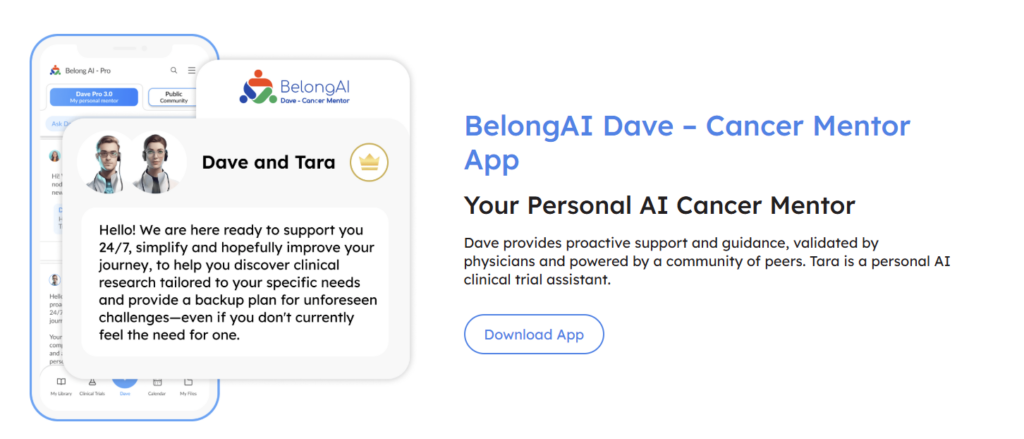
Source: Belong AI Apps Page
What sets Dave apart is its foundation in real-world patient-centric data. The system was trained on billions of anonymized patient-physician and patient-peer interactions. These were collected over more than seven years on Belong.Life’s Beating Cancer Together community platform. This training gives the AI a deep contextual understanding of the lived cancer experience. Dave also retains conversational memory to support ongoing, personalized dialogues.
Key Details of the Innovation
- Company: Belong.Life, a global health technology and patient support platform headquartered in the United States with operations reaching international users.
- Location: United States / global deployment via digital app and SaaS offerings.
- Patent Status: Proprietary AI trained on longitudinal oncology datasets and conversational architectures; no public patent filing identified.
- Funding: Venture-backed health AI and digital patient support company focused on AI-driven care navigation and community engagement.
- Market Deployment: Integrated into the BelongAI platform and BelongAI Dave – Cancer Mentor mobile app with hundreds of thousands of users globally; available free to patients and as a SaaS solution for health systems.
- Award/Recognition: Named by TIME as one of the Best Inventions of 2024 in the oncology chatbot category.
3. Acrobat AI Assistant
Adobe Acrobat AI Assistant is an AI-driven conversational assistant built into Adobe Acrobat that turns static PDF documents into interactive, question-responsive conversations. Users can ask natural-language questions about contracts, reports, or manuals and receive answers tied directly to specific passages in the document. This grounding in the original text helps reduce hallucinations by linking responses to source content on the page.

Source: Adobe Acrobat
The underlying innovation is document-grounded AI with attribution, which embeds verification into conversational outputs rather than relying solely on generic language generation.
Key Details of the Innovation
- Company: Adobe Inc., a leading software company known for PDF and creative tools.
- Location: United States (product deployed globally).
Patent Status: Adobe holds multiple patents related to document analysis, contextual search, and AI-powered workflows; the Acrobat AI Assistant reflects this proprietary tech base. - Funding: Built internally as part of Adobe’s broader investment in AI features across Document Cloud and Creative Cloud products.
- Market Deployment: Integrated into Adobe Acrobat and Acrobat Pro, used globally by individuals and enterprises for document review and automation.
- Award/Recognition: Named by TIME as one of the Best Inventions of 2024 for its “Smarter PDFs.”
4. Lumo Private AI Assistant
Lumo is a privacy-first conversational AI assistant developed by Proton AG, the Swiss company known for Proton Mail, Proton VPN, Proton Drive, and other privacy-centric services. It is designed to keep user conversations confidential. It uses zero-access encryption, ensuring that chat data can only be decrypted by the user. The data is never logged, shared, or used to train AI models.
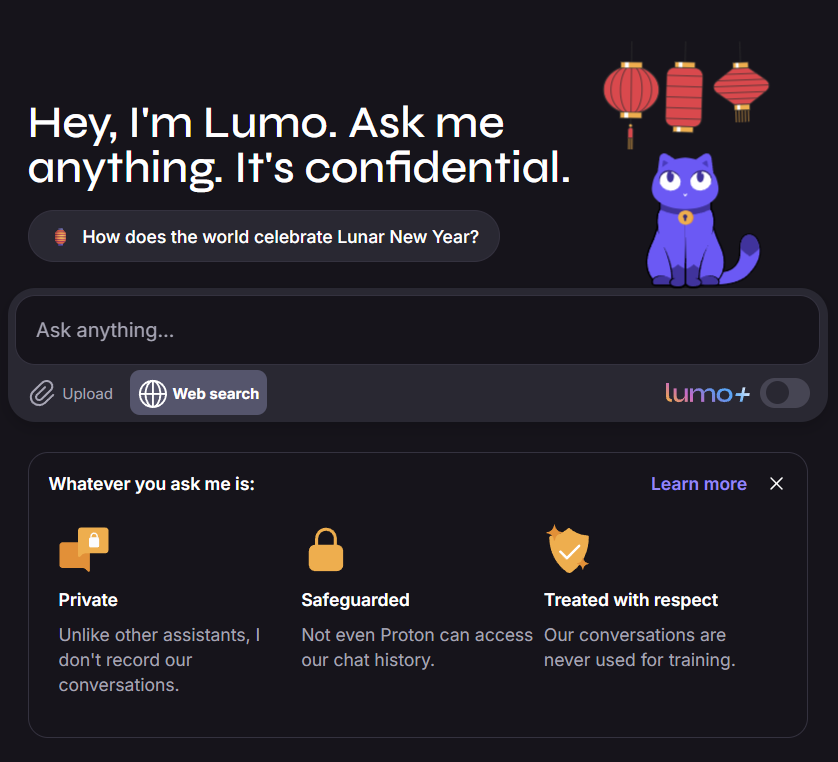
Source: Lumo
Lumo primarily uses open-source language models such as Mistral, OpenHands, and others. These models are hosted on European servers. The system is built around a no-logs, zero-access encryption architecture. This design prevents Proton or any third party from accessing conversation content, even when the data is at rest. Conversations and metadata are encrypted such that only the user’s device holds the decryption keys.
Key Details of the Innovation
- Company: Proton AG, a Swiss privacy-focused technology company best known for secure email, VPN, password management, and cloud storage services.
- Location: Switzerland (global deployment, with infrastructure in European data centers).
- Patent Status: Built not on a specific public patent but on a proprietary zero-access encrypted AI architecture and privacy-first design principles that extend Proton’s existing security ecosystem.
- Funding: Internal development within Proton’s privacy platform ecosystem; supported by Proton’s broader secure-tech infrastructure and ecosystem.
- Market Deployment: Available as a consumer-facing AI assistant via web and mobile apps on iOS and Android, with free access and premium plans (e.g., Lumo Plus) for expanded usage.
- Award/Recognition: Featured in TIME’s Best Inventions 2025: Special Mentions as a standout privacy-focused AI assistant. It is described as a private AI assistant that “does not track or record your conversations and stores data locally on each user’s device.”
5. Erica
Erica is an AI-driven virtual financial assistant embedded within the Bank of America mobile app. Launched in 2018, Erica helps customers check balances, track spending, review recurring charges, monitor subscriptions, receive credit insights, and complete transactions through natural-language conversations.
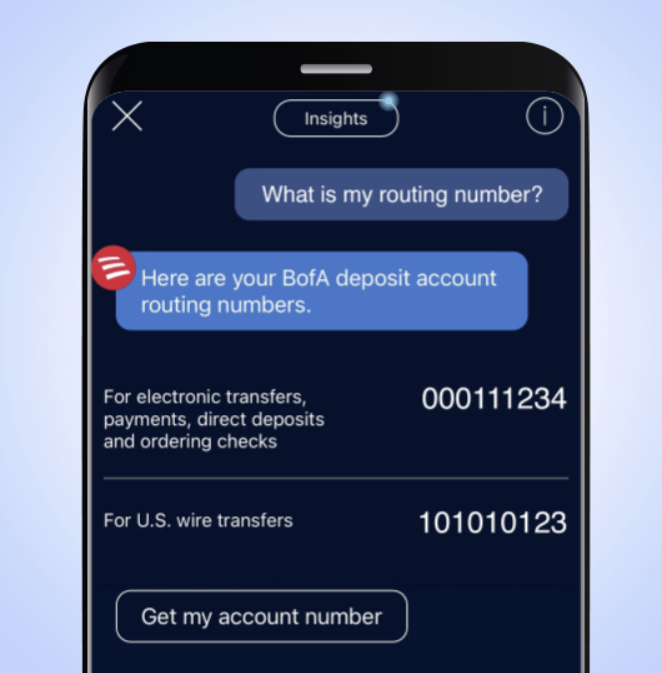
Source: Bank of America
What makes Erica significant is not simply its conversational interface, but its deployment at regulatory scale. It operates within a heavily regulated financial environment, integrating fraud monitoring, secure authentication, and compliance safeguards directly into conversational workflows.
Key Details of the Innovation
- Company: Bank of America
- Location: United States (global digital banking reach)
- Patent Status: Bank of America holds numerous patents related to AI, natural language processing, digital assistants, and predictive financial analytics supporting Erica’s architecture.
- Funding: Developed internally as part of Bank of America’s multibillion-dollar annual technology investment program.
- Market Deployment: Integrated into the Bank of America mobile banking app with tens of millions of active users and over a billion interactions.
- Award/Recognition: Erica has received industry recognition, including Global Finance’s Best Consumer Digital Bank awards and recognition from Celent for digital innovation in banking.
6. Google – AI Phone-Answering Chatbot
A 2025 U.S. patent publication by Google describes an AI-powered system that can autonomously answer incoming phone calls. The system interprets the caller’s intent and decides whether to respond directly or escalate the call to a human user.
The patent outlines a conversational agent that can:
- Screen calls in real time
- Generate contextual responses
- Ask clarifying questions
- Summarize calls
- Route or escalate based on predefined thresholds
This innovation moves conversational AI beyond text interfaces and app-based chat into live telephony infrastructure, where latency, intent recognition accuracy, and escalation logic are mission-critical.
Unlike earlier call-screening tools, this system is designed to function as an active conversational intermediary, not merely a transcription layer. It represents a structural shift toward autonomous AI agents capable of handling synchronous voice communication.
Key Details of the Innovation
- Company: Google
- Location: United States
- Patent Status: U.S. patent publication (2025) describing an autonomous AI phone-answering and call-handling system filed by Google LLC.
- Funding: Developed through internal AI research and product engineering within Google’s broader AI ecosystem.
- Market Deployment: Patent-stage disclosure; not confirmed as a fully released consumer product at time of publication.
7. D-ID Agents
D-ID Agents transform traditional chatbots into photorealistic, speaking AI avatars capable of real-time facial animation and voice interaction. Instead of responding with text alone, D-ID’s platform generates lifelike digital presenters that can deliver scripted or AI-generated responses through synchronized speech and facial expressions.
The company builds on its proprietary Creative Reality™ Studio technology, which uses deep learning models to animate still images and generate talking head videos from text or audio input. This enables enterprises to deploy embodied conversational agents for marketing, training, customer support, and digital experiences.
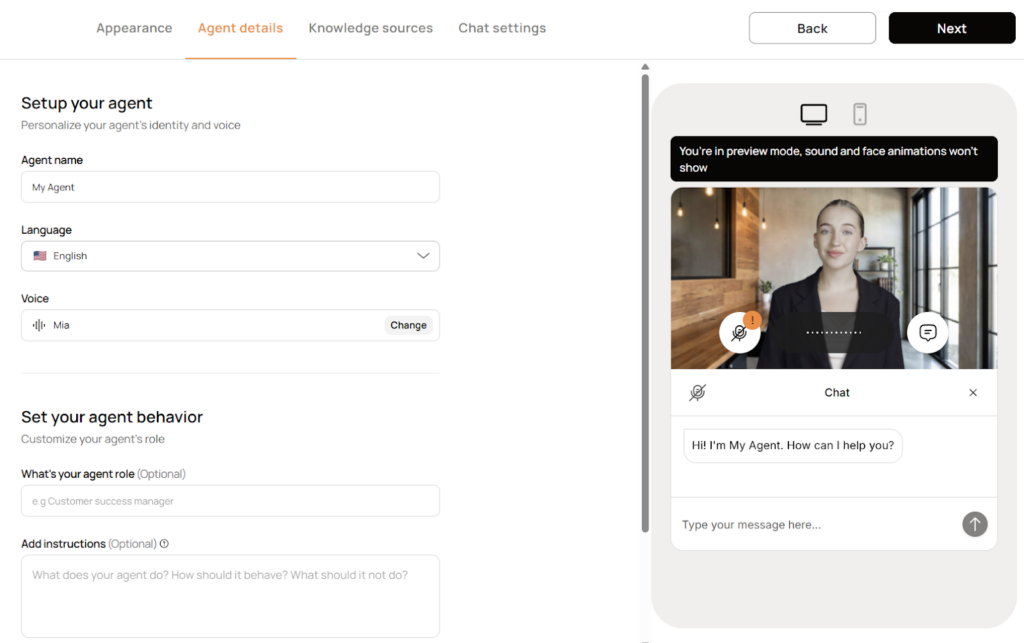
Source: D-ID studio
D-ID has positioned its agents as enterprise-ready solutions, integrating large language models with real-time avatar rendering to create interactive digital humans.
The innovation here is not just conversational AI, but embodied AI interfaces. D-ID combines generative video, facial reenactment, and speech synthesis to move chatbots beyond text-based systems. The result is visually expressive digital agents that increase engagement. At the same time, the technology raises important discussions around digital identity, consent, and responsible AI deployment.
Key Details of the Innovation
- Company: D-ID
- Location: Israel (headquartered in Tel Aviv)
- Patent Status: D-ID holds multiple patents related to facial reenactment, image animation, and AI-driven video synthesis technology.
- Funding: Venture-backed AI company with funding from investors including Pitango, AXA Venture Partners, and others.
- Market Deployment: Used by enterprise clients in marketing, e-learning, corporate communications, and digital media production.
8. Aporia – Guardrails
Aporia Guardrails is an AI reliability and monitoring layer designed to sit between a large language model and the end user. Instead of relying solely on a single LLM to generate safe responses, Aporia introduces additional monitoring models and rule-based systems that evaluate prompts and outputs in real time.
The platform enables enterprises to detect hallucinations, policy violations, sensitive data leakage, bias, and unsafe outputs before responses reach users. This reframes chatbot safety as a pipeline architecture challenge, not just a model training issue.
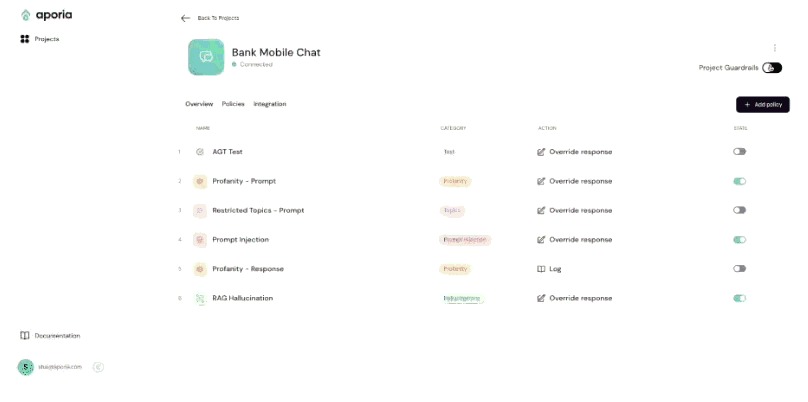
Source: Aporia Blog
Aporia’s broader platform focuses on ML observability and LLM governance, providing monitoring dashboards, performance analytics, and risk detection tools for AI systems deployed in production.
Rather than attempting to solve all reliability concerns at the model level, Guardrails introduces modular safety layers that can be updated, configured, and tuned independently of the core chatbot model.
Key Details of the Innovation
- Company: Aporia
- Location: Israel (headquartered in Tel Aviv)
- Patent Status: Proprietary AI monitoring and layered guardrail architecture; no specific public patent publication cited.
- Funding: Venture-backed AI monitoring platform supported by investors including Tiger Global, TLV Partners, and others.
- Market Deployment: Integrated into enterprise AI and LLM systems to monitor, validate, and filter chatbot outputs in production environments.
9. Character.AI – Voice Calls Feature
Character.AI introduced two-way voice conversations, allowing users to speak directly with AI-generated characters instead of typing messages. The feature enables real-time, back-and-forth spoken dialogue, adding tone, pacing, and personality to interactions.
Unlike traditional text-based chatbot interfaces, the Voice Calls feature combines speech recognition, real-time response generation, and text-to-speech synthesis to create immersive conversational experiences.
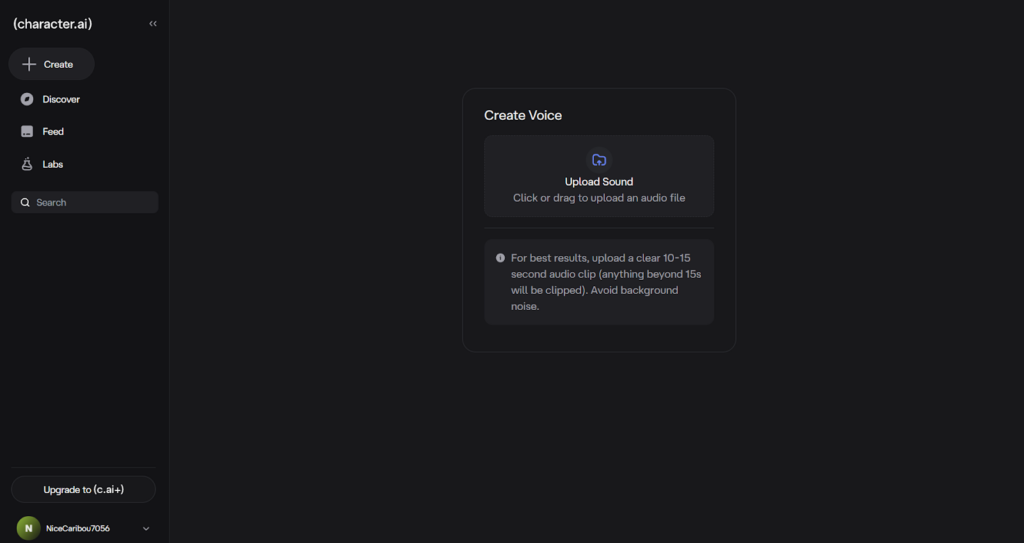
Source: character.ai
Character.AI’s broader platform allows users to create and interact with custom AI personas across entertainment, role-play, and creative storytelling use cases. The addition of voice expands the product from a text-first environment into a more embodied and emotionally engaging interface.
By introducing voice at scale within a consumer AI ecosystem, Character.AI extends conversational AI beyond productivity and support use cases into interactive entertainment and social engagement.
Key Details of the Innovation
- Company: Character.AI
- Location: United States
- Patent Status: Platform-level voice integration built on proprietary conversational AI infrastructure; no specific public patent filing identified for the voice feature.
- Funding: Venture-backed consumer AI company, with investment from firms such as Andreessen Horowitz (a16z).
Market Deployment: Millions of global users interacting with AI characters; voice mode integrated within the main app experience.
10. Grok 4
Grok 4 is a conversational AI model developed by xAI and integrated directly into X. Unlike standalone chatbot applications, Grok operates within a live social media environment, allowing it to respond using real-time information from posts and trending discussions on the platform.
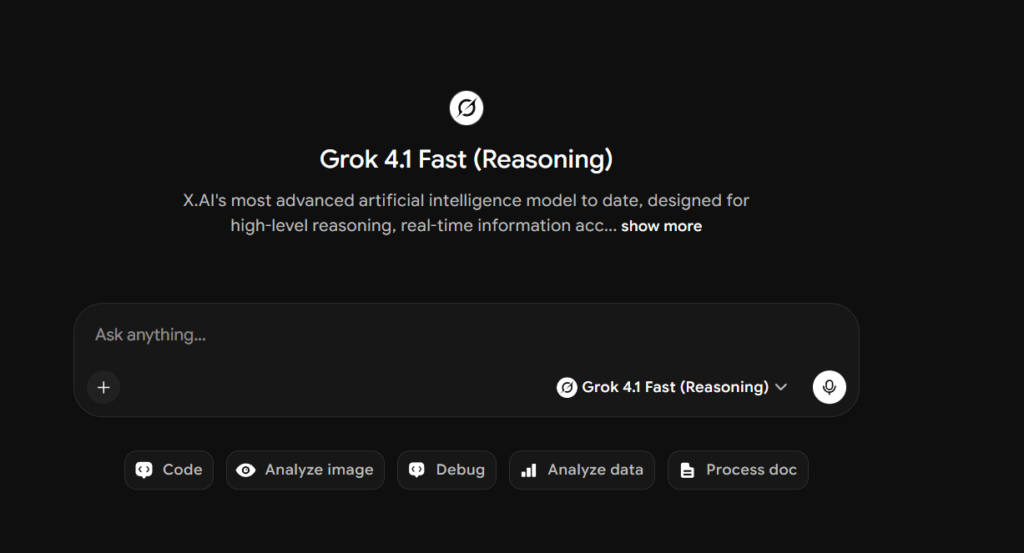
Source: AI chat
Positioned as a high-reasoning model, Grok is designed to handle complex queries while drawing contextual awareness from ongoing digital discourse. Its integration into X transforms conversational AI from an isolated assistant into an embedded layer within a social network.
Grok’s differentiator lies in its real-time social data integration, which allows it to reference current posts and trends, something many AI systems cannot access due to data latency or closed training pipelines.
Key Details of the Innovation
- Company: xAI
- Location: United States
- Patent Status: Proprietary large language model development; no specific public patent publication identified for Grok 4.
- Funding: Developed by xAI, which has raised significant funding to build frontier AI systems.
- Market Deployment: Embedded within the X platform and available to eligible subscribers directly inside the social media interface.
11. IntelliAssistant Platform
The IntelliAssistant Platform by Intellias is an enterprise-focused conversational AI framework designed to integrate chatbots directly into business workflows. Rather than functioning purely as a front-end conversational layer, IntelliAssistant operates as a workflow automation engine. It connects AI interactions with backend enterprise systems, APIs, and operational processes.
IntelliAssistant is positioned for industries such as mobility, fintech, retail, and telecom. It enables organizations to deploy domain-specific AI assistants that automate tasks, retrieve structured data, and integrate with enterprise software ecosystems.
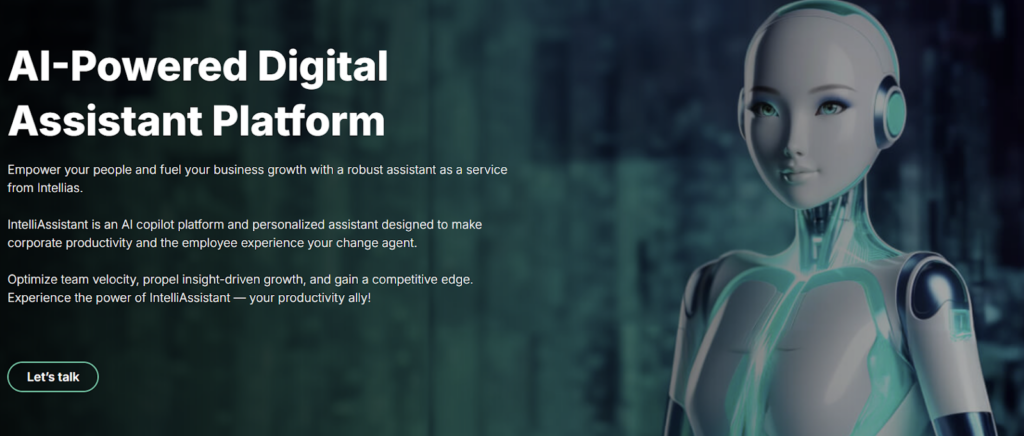
Source: IntelliAssistant Page
Unlike consumer chatbots that prioritize engagement, IntelliAssistant focuses on enterprise integration, compliance alignment, and operational efficiency. It positions chatbots as system-level automation components rather than standalone conversational tools.
Key Details of the Innovation
- Company: Intellias
- Location: Ukraine (headquartered in Lviv) with global delivery centers and enterprise clients worldwide
- Patent Status: Proprietary enterprise chatbot and workflow automation platform; no specific public patent filings cited.
- Funding: Corporate-developed platform within Intellias, a privately held global technology consulting company.
- Market Deployment: Deployed across enterprise client environments in industries including fintech, mobility, and retail, supporting workflow automation and AI-enabled business processes.
- Award/Recognition: The platform was recognized in the AI Breakthrough Awards, which highlight innovation in artificial intelligence technologies and enterprise AI solutions.
12. GigaChat
GigaChat is a generative AI chatbot developed by Sber’s AI division, Sber AI, and positioned as a domestic alternative to Western large language models. It supports multimodal capabilities, including text generation, image creation, code assistance, and music composition within a unified conversational interface.
Originally launched in beta access in 2023 and later expanded for broader public availability in Russia, GigaChat integrates with Sber’s broader digital ecosystem, including banking and enterprise services.

Source: Giga Chat
GigaChat was built on Sber’s proprietary large language model architecture and is part of Russia’s broader push toward sovereign AI infrastructure. The system reflects national investment in domestic AI development and reduced reliance on foreign AI providers.
Key Details of the Innovation
- Company: Sberbank (via Sber AI)
- Location: Russia
- Patent Status: Proprietary large language model and multimodal generative AI system developed internally; no specific public international patent disclosure identified.
- Funding: Developed internally by Sberbank as part of its strategic investment in AI research and national digital infrastructure.
- Market Deployment: Released within Russia for consumer and enterprise use as a domestic AI assistant integrated into Sber’s ecosystem.
So, you’ve just seen how conversational AI is evolving, from multilingual farm advisors and oncology companions to encrypted assistants and enterprise guardrails.
These breakthroughs are not just product features. They reflect deeper architectural decisions that create real competitive advantage. The next step is ensuring those innovations are captured, structured, and protected, not just deployed.
Protect Your AI Innovations With Triangle IP’s TIP Tool™
Whether you are building domain-specific assistants, privacy-first AI systems, enterprise workflow bots, or multimodal conversational agents, the TIP Tool™ helps you convert technical breakthroughs into defensible assets.
With TIP Tool™, you can:
Capture Innovation at the Source
Document system architecture, guardrail frameworks, model adaptations, and integration workflows through structured invention disclosures before details are lost.
Align Engineering and IP Strategy Early
Enable collaboration between product, AI, and legal teams so filings reflect real technical differentiation — not surface features.
Prioritize High-Impact Inventions
Use Value and Patentability scoring to focus resources on innovations that strengthen long-term competitive position.
Refine Filing Strategy with Data
Leverage Art Unit Prediction and Examiner Analytics to anticipate prosecution pathways and improve allowance outcomes before submission.
Track Every Idea through the Patent Lifecycle
Manage drafting, filing, and prosecution in a unified pipeline with real-time USPTO updates and portfolio dashboards.
Conversational AI is becoming infrastructure. Infrastructure should be protected with intent.
If your team is developing the next generation of intelligent assistants, ensure the architecture behind them is captured, evaluated, and secured.

Start your TIP Tool™ trial and transform AI innovation into structured, strategic IP.
Disclaimer: The information in this article/review is sourced from the internet and may not be entirely accurate or up-to-date. We recommend visiting the respective software websites for the most current and reliable information. The opinions expressed here are those of the author and may not reflect the views of Triangle IP. We are not liable for any consequences that may arise from relying on the information provided in this article/review.
FAQs
1. Are These Chatbot Technologies Affordable and Practical for Smaller Companies or Teams?
In many cases, yes—but the cost curve depends on ambition. For smaller teams, the most practical path is usually cloud + API-based deployment, where costs scale with usage rather than requiring an in-house AI stack. Gartner’s cloud forecasts underline why this is becoming the default operating model: public cloud spend continues to rise sharply, reflecting broad reliance on cloud delivery for advanced capabilities.
Where the economics can change is when a chatbot moves from “answering questions” to deep workflow integration—connecting to internal systems, enforcing security controls, and meeting reliability targets. McKinsey’s 2025 global AI survey highlights that many organizations still struggle to convert pilots into scaled impact—often because operating model, data readiness, and governance lag the technology itself.
Practical takeaway: A basic customer-support or internal FAQ bot can be manageable for small teams. The “enterprise price tag” usually shows up when you require complex integrations, stringent assurance, and ongoing monitoring.
2. How Dependent Are These Chatbots on Proprietary Data or Closed Ecosystems?
It varies—and your architecture choices determine your leverage. Many chatbots are built on proprietary cloud models, which can introduce lock-in through model dependency, tooling, hosting, and data pipelines. At the same time, Gartner notes that most organizations are moving toward hybrid cloud environments. This shift is partly driven by the need to avoid dependence on a single provider. It also helps manage data placement and synchronization, which Gartner identifies as a key GenAI challenge.
From a risk and control standpoint, Accenture emphasizes that data security and privacy are central design constraints for GenAI systems. This becomes especially important as organizations decide what data can be exposed to external services and what must remain under tighter internal control.
Practical takeaway: many organizations land on a hybrid approach—cloud models for capability and speed, paired with tighter controls (and sometimes alternative model options) around sensitive data, compliance, and long-term portability.
3. What Long-Term Risks Do Highly Autonomous Chatbots Introduce for Users and Organizations?
As autonomy increases, the risk profile shifts from “wrong answers” to operational, security, and accountability failures. Deloitte’s risk framing is explicit: GenAI systems can produce hallucinations and misinformation that look plausible, creating decision risk, reputational damage, and potential regulatory exposure.
McKinsey’s work on agentic AI safety and security reinforces the point that autonomous systems require stronger capabilities in governance, testing, threat modeling, and security engineering—because these tools can take actions, not just generate text.
On the broader societal and organizational side, the World Economic Forum consistently flags governance priorities such as privacy, bias, and transparency, and its 2025 responsible AI playbook notes that responsible AI maturity remains early for most companies (a warning sign as autonomy increases).
Practical takeaway: autonomy can deliver real efficiency, but it raises the bar on human-in-the-loop controls, monitoring, auditability, access controls, and clear escalation paths—especially in customer, finance, HR, or legal workflows.