
| TL;DR – Most businesses lose great ideas to outdated ‘suggestion box’ systems. The reason is zero visibility, no follow-up. Eventually, employees stop bothering. Idea management software fixes that: it’s a structured system for capturing, evaluating, and tracking ideas from submission through implementation. In this piece, we cover nine key benefits of structured idea management tools: faster evaluation, divergent thinking, stronger cross-team collaboration, sharper focus on employee effort, a stronger culture of innovation, clearer thought mapping, easier patent filing, greater transparency and accountability, and measurable ROI. |
Every organization loses good ideas. This happens because there is no proper idea management software to follow through on them.
One of the main benefits of structured idea management software is this: it gives every innovation a clear path through to implementation. Moreover, when employees see their ideas tracked and reviewed, they stay engaged.
Businesses used to rely on paper-based ‘suggestion box’ systems. However, those old systems broke down in three ways.
- Intake was too generic. Ideas were not tied to real business goals. Most submissions went nowhere.
- Employees rarely heard what happened next. Silence has a cost. 41% of employees who leave a job cite “not being listened to” as a top reason.
- Paper-based intake made fast review hard. Good ideas lost their window. Some got duplicated by someone else entirely.
Idea management software solves all three problems. It gives ideas a defined process. It closes the loop between submission and decision. Moreover, that same foundation makes transparency, accountability, and measurable ROI possible. We cover all of that below, with real use cases.
Benefits of Idea Management Software
Most companies never see this problem coming. Over half of employees say their company fails to act on good ideas. Less than a third have any clear process to manage them.
Idea management software closes that gap. It turns scattered submissions into a tracked, structured process.
Here are the nine benefits of idea management software.
- Faster, more consistent evaluation of ideas
- Room for divergent thinking
- Stronger cross-team collaboration
- Sharper focus on employee effort
- A stronger culture of innovation
- Clearer thought mapping
- Easier patent filing
- Full transparency and accountability
- Measurable ROI over time
Let’s look into each benefit in detail.
1. Faster, More Consistent Evaluation of Ideas
Manual evaluation has a hidden problem. It isn’t just slow. It’s inconsistent. A 2025 study on idea evaluation found that different reviewers often score the same idea very differently, depending on which criteria they weigh and how strict they tend to be. Without a shared standard, good ideas can get rejected by one reviewer and approved by another, based on nothing but who happened to review them.
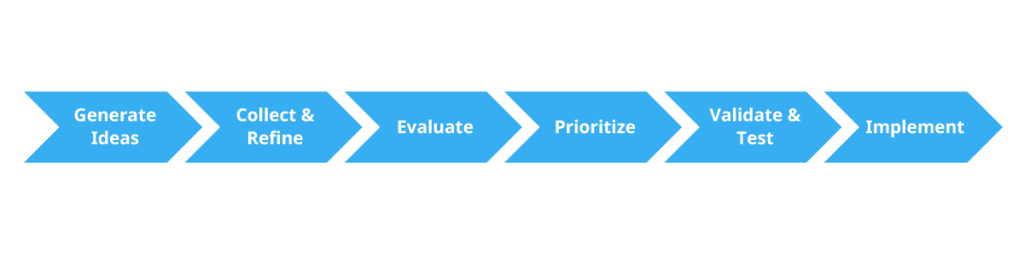
Idea management software fixes both problems at once. It moves ideas through a defined process, from idea capture to review to a decision. Evaluators score or vote on ideas against the same fixed criteria every time, not their own instincts.
This way, you can lower the turnaround time between the ideation stage and the patent stage. The best ideas are identified, implemented, reviewed, and evaluated, whereas the poor ones are discarded.
You can evaluate your best ideas using our idea evaluation matrix to decide whether to patent your ideas.
2. Room for Divergent Thinking
Good ideas rarely arrive fully formed. They start rough, half finished, sometimes a little strange. Employees need room to explore those early thoughts without fear of instant judgment.
People need a visible, low-pressure way to share unfinished ideas and build on each other’s contributions. Without that structure, people hide errors and withhold half-formed ideas rather than risk them. A 2026 global study across 47 countries reached a similar conclusion, calling psychological safety “the bedrock of high-performing teams.”
Idea management software provides exactly that structure. Ideas can be saved as private drafts first, refined quietly, and only published for review when ready. This gives employees a real way to think out loud, without a live audience judging a half-built idea.
3. Stronger Cross-Team Collaboration
How often a brainstorming discussion between team players turn into an ego-clash? Way too often.
Instead, an idea management system makes it easier for employees to engage in a collaborative effort without transforming the discussion into chaotic communication.
By inputting data into an idea management software, participants can keep track of the progress of the idea, any reservations to the idea, and potential avenues to improve the idea further. Every comment, objection, and suggestion stays attached to the idea itself, visible to everyone involved.
| What do Experts Say? The one feature that makes the biggest difference in idea management is real-time collaboration with accountability. Spreadsheets trap ideas in silos, but when teams can submit, discuss, and vote on ideas directly within a live platform, you don’t just capture suggestions; you create ownership. In our own system development, giving workshops a structured way to request features and upvote priorities turned customer “wishlist items” into actionable roadmaps. One popular idea, automated SMS reminders, went from concept to launch in under 90 days and reduced workshop no-shows by nearly 25%.The ROI of this approach is measurable: by closing the loop between idea capture and execution, workshops see faster adoption and stronger bottom-line impact. The insight we’ve gained is simple but often ignored ideas only create value when they’re connected to outcomes, and that requires visibility, collaboration, and the ability to act quickly. In the SaaS world, that’s the feature that separates innovation from noise. James Mitchell, CEO, Workshop Software |
4. Sharper Focus on Employee Effort
By guiding employees’ creative energies towards the fulfillment of business aims, a business can improve the quality and relevance of the suggestions. An idea management system allows a business to highlight specific business goals and even specific business processes to gather suggestions or feedback.
For example, the innovation program introduced by Altice Portugal (formerly known as Portugal Telecom) resulted in a 44% improvement in employee engagement over four years (58% in 2008 to 84% in 2012). The program also delivered $38 million in annual savings through business process improvements driven by employee ideas.
Also Read: 7 ways to Encourage Innovative Thinking at Your Workplace
5. A Stronger Culture of Innovation
Ideas are a vital ingredient in R&D. They form the backbone of the radical innovations that change how a business runs, or lead to entirely new products.
McKinsey’s research backs this up directly. In a 2025 survey of over 1,000 companies, the largest share of respondents named the ability to innovate as their single most important factor for growth. Across nearly every industry, innovation ranked among the top three growth levers.
Ironically, R&D departments can’t do this alone. They need feedback and suggestions from other departments to refine a rough prototype into something patentable.
A prime example of how an idea management system can foster innovation is Toyota Creative Idea and Suggestion System (TCISS). Since its inception in 1951, TCISS has received more than 40 million creative ideas—and the number keeps growing. This steady flow of innovation has helped Toyota build products that are world-renowned for their quality, reliability, and durability.
6. Clearer Thought Mapping
Ideas carry knowledge. When they’re scattered across emails and spreadsheets, that knowledge is easy to lose.
Research backs this up. Studies estimate Fortune 500 companies lose over $31.5 billion a year from failing to share knowledge internally. An idea management system prevents this by standardising how ideas are documented from the start.
This makes searching and storing ideas faster and more reliable. It protects a business from losing critical process knowledge or technical expertise when a project changes hands.
7. Full Transparency And Accountability
Visibility changes behaviour. A scientific study on creative collaboration found that people contribute more when their input stays visible to the group. Without that visibility, people hold back. They stop sharing unfinished thoughts because no one can see whether those thoughts matter.
Idea management software makes this visibility automatic. Every idea has a clear owner. Every status change is on the record. No one has to guess who is responsible or where an idea stands.
| “The one feature that makes the biggest difference in idea management is real-time collaboration with accountability. Without that visibility, even the best ideas tend to fade into silence.” – Cyrus Partow, CEO, ShipTheDeal |
8. Measurable ROI Over Time
Innovation is hard to justify without numbers. McKinsey’s research found that companies mastering core innovation practices deliver 2.4 times higher economic profit than those that don’t. That gap is real, but it only shows up if someone is actually tracking it.
Idea management software makes that tracking possible. Every idea carries a record: who submitted it, what it cost, what it delivered. One documented example shows how Whirlpool tracked its idea pipeline by brand, division, and region, which let leadership see exactly where ideas were working and where they weren’t.
Without this kind of tracking, a business only sees the ideas that happened to succeed. With it, a business can see the full picture: what was tried, what it cost, and what it returned.
9. Easier Patent Filing
When filing for a patent, it is necessary to provide steps that led to the evolution of a particular product or process. In this case, an idea management system can help the business capture the various inputs and outcomes that went into building a prototype, a marketable copy, and, eventually, the product itself.
Here’s our short video explaining how the TIP Tool can suit your team as an idea management software.
On a side note: Would you want to know how your patent application is progressing at the USPTO compared to other applications in the same domain?
The TIP tool offers statistics for the law firm/prosecutor and the examiner handling your patent application. Once the application is filed at the USPTO and an examiner is assigned to your case, the tool indicates the relative performance of the law firm handling your case. The statistics revolve around the number of arguments, grant rate, and grant time. The tool also indicates the case health; for instance, it can tell you if a case needs your attention. There is a whole bunch of insights that you can gather from the TIP tool for strategic patent prosecution.
Request insights for any of your cases at the patent office using the form below.
Parting Thoughts
A journal article in the Santa Clara High Technology Law Journal concluded that patent documentation could be a vital tool in planning development, producing statistical information, and even for the allocation of funding. An idea management system can work as a repository serving this function.
The application of an idea management system results in numerous benefits that translate into better functioning of business alongside enhanced employee engagement and morale.
In short, the benefits of idea management software go far beyond efficiency. Businesses are increasingly recognizing the value of capturing ideas to gain a competitive edge, and many are now investing in these platforms to support effective innovation mapping.
Ready to simplify your innovation pipeline? Try the TIP Tool™ by Triangle IP for free or get a tailored demo for your company’s needs.
Frequently Asked Questions on Idea Management Software
1. What is Idea Management Software?
Idea management software is a structured system for capturing, tracking and evaluating ideas from the moment someone submits them through to implementation. Instead of ideas disappearing into a shared inbox, the software gives every submission a visible record: who owns it, what stage it’s in, how it was scored, and what happened to it.
2. What is the Difference Between Idea Management, Ideation, And Innovation Management Software?
Ideation refers narrowly to generating ideas, the creative front end. Idea management covers the fuller cycle: capturing, evaluating, and tracking those ideas through to a decision. Innovation management is the broadest term, encompassing idea management plus strategic elements like portfolio planning, trend scouting, and resourcing across multiple initiatives at once. Most organisations searching for “idea management software” actually need the middle tier full lifecycle tracking, not just a brainstorming tool.
3. What Features Should I Prioritise in Idea Management Software?
Choosing the right idea management software starts with identifying your business goals. If you want to drive patentable innovation, look for tools that offer IP tracking, role-based dashboards, and integration with patent offices. For team collaboration, prioritise real-time editing, voting, and workflow automation. Ease of use is critical; complex systems discourage participation. Also, check for customizable invention disclosure forms, analytics dashboards, and integrations with tools like Slack, Microsoft Teams, or Jira. Finally, pilot-test the software with a small group of employees before rolling it out organisation-wide. This ensures both adoption and alignment with your innovation strategy
Read more: 5 Factors to Evaluate an Idea Management Software
4. How Does Idea Management Software Handle Ownership Disputes When Multiple Employees Contribute to the Same Idea?
Most idea management systems, including the TIP Tool™, maintain detailed version histories and contributor records, ensuring every participant’s input is time-stamped and traceable. This transparency helps organizations assign credit fairly and resolve disputes objectively. In cases of patentable ideas, these records become critical for defining inventor contributions under IP law. Clearly defined collaboration workflows and access controls further minimize ambiguity in shared innovation.
5. Why is it Helpful to Use Software Tools When Generating Ideas?
Manual systems break down for a structural reason, not a disciplinary one: even a well-run suggestion box has no way to enforce consistent evaluation criteria, track ownership as an idea changes hands, or notify a submitter when a decision gets made. Software fixes this by making the process itself the enforcement mechanism
6. What Are The Key Benefits of Structured Idea Management Tools?
Structured idea management tools help organisations capture, organise, and evaluate ideas in one centralised system, so valuable ideas don’t get lost. They improve collaboration and transparency by enabling employees, teams, and stakeholders to contribute, review, and refine ideas together. They also speed up innovation by prioritising the best ideas, tracking progress, and turning promising concepts into measurable business outcomes and ROI.
7. Does Relying on Software for Innovation Risk Making Creativity Too Procedural or Data-driven, Stifling Spontaneous Ideas?
Good idea management software should enhance human creativity. While it structures how ideas are captured and evaluated, it doesn’t dictate how employees think. Tools like the TIP Tool™ streamline documentation and collaboration so teams spend less time on admin and more on creative problem-solving. Features such as open commenting, tags, and real-time co-editing encourage spontaneous input from diverse voices while maintaining clarity and accountability.
Read more: 7 Ways to Encourage Innovative Thinking at Your Workplace