| TL;DR – Patent analytics helps IP teams understand examiner behavior, art unit dynamics, costs, timelines, and portfolio risk as patenting becomes more complex. This guide compares eleven best patent analytics software for 2026 based on how they deliver these insights. It also examines how well each tool supports real-world decision-making during filing and prosecution. The TIP Tool™ stands out for combining analytics with idea capture, prosecution workflows, and portfolio management in one system. |
Every enterprise leader faces the same challenge today: too many patent decisions and not enough clarity. Global filings keep rising, and with every new idea, uncertainty grows. Which filings deserve a budget? Which will stall? What risks are hidden in the portfolio?
The issue isn’t innovation. It’s visibility at the decision point. Examiner behavior varies. Art units perform differently. Costs and timelines shift based on factors most teams struggle to quantify. Without insight into these dynamics, even experienced IP teams are forced to rely on judgment instead of evidence.
That’s why enterprises are turning to the best patent analytics software like the TIP ToolTM. These tools analyze prosecution behavior, predict cost and timeline outcomes, and surface portfolio risks early, before decisions become expensive mistakes.
We’ve listed the strongest options below. But before you choose one, here are the essential questions to ask your vendors.
Questions to Ask Before Choosing the Best Patent Analytics Software
With the global patent analytics market on track to reach USD 4.1 billion by 2033, the number of software options is only going to skyrocket.
Exciting? Yes.
Overwhelming? Absolutely.
But it doesn’t have to be. So, to make a strategic selection, start with these key questions below to make sure you choose a platform that works the way your organization demands:
1. How Reliable and Up-to-Date Is the Patent Data?
Your analytics will only be as strong as the data behind them. Ask vendors:
- Does the tool pull live data from USPTO (Public & Private PAIR)?
- Does it fetch foreign data through Espacenet?
- How often are prosecution events updated?
- Can I view the full application timeline with linked documents?
2. What Examiner and Art Unit Insights Do You Provide?
Predicting examiner behavior is critical for prosecution strategy. Ask:
- Does the tool provide examiner-specific allowance rates?
- Can it estimate the expected number of argument rounds?
- Does it show the average time to allowance by the examiner or the art unit?
- Can it predict the likely art unit early, before filing?
3. Can the Software Help Identify Prosecution Risks?
Teams need visibility into what might delay or complicate a case. Ask:
- Does it show examiner difficulty signals?
- Can it reveal filings with unusually high argument rounds?
- Does it highlight where timelines are longer than expected?
4. What Portfolio-Level Visibility Does the Platform Provide?
Enterprise strategy requires more than document-level insights. Ask:
- Is there a dashboard for granted, pending, abandoned, and expired cases?
- Can we see prosecution efficiency across the portfolio?
- Can we filter by tags, technology areas, or business units?
- Are portfolio tables customizable?
5. Does It Support Our Full Idea-to-Patent Workflow?
Many teams want analytics that connect to the upstream innovation pipeline. Ask:
- Does the tool support idea capture?
- Can we vet, score, and prioritize ideas?
- Does it track drafting and filing progress?
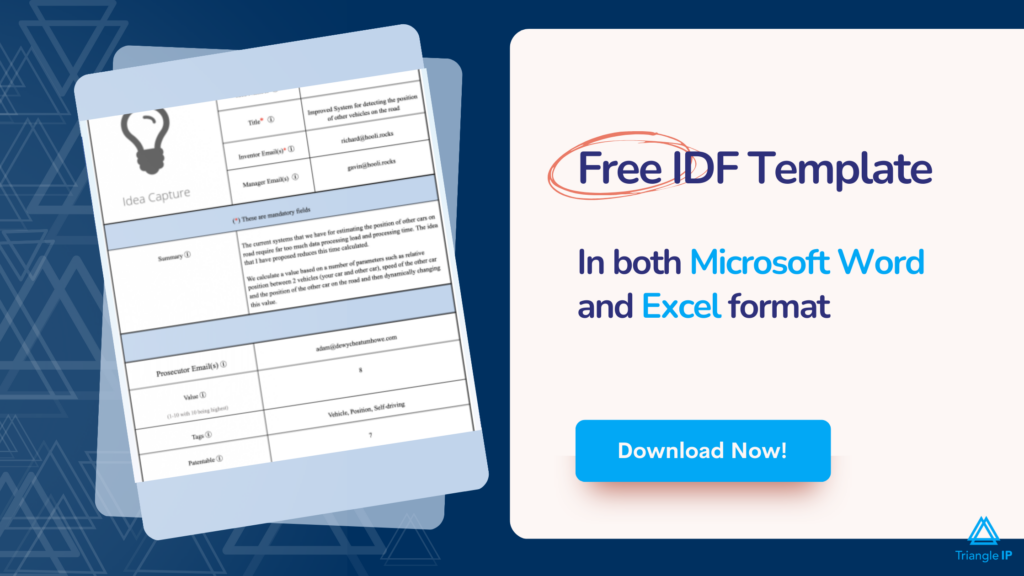
Check out the Invention Disclosure Form for a structured way to capture early ideas.
6. How Well Does the Tool Support Collaboration Across Roles?
Analytics fail if only experts can use them. Ask vendors:
- Can engineers, inventors, and R&D leaders use it easily?
- Are roles and permissions clear?
- Does it reduce back-and-forth with attorneys?
7. Does It Integrate With Our Docketing System?
Enterprises often rely on docketing data for decisions. Ask:
- Can the tool sync our docketing system automatically?
- Does it support field mapping and updates without manual cleanup?
- Does it show logs and sync history?
8. How Clear and Customizable Are Cost Predictions?
Budgeting is one of the biggest pains for enterprise IP teams. Ask:
- Does the tool predict costs across the lifecycle?
- Can we adjust entity size or attorney charges?
- Do those updates cascade across all ideas?
9. How Easy Is the Platform to Adopt and Maintain?
A tool fails if teams fail to adopt it. Ask:
- Is the interface intuitive for non-legal teams?
- Do you provide documentation and training?
- How often are new features released?
- Is there a dedicated helpdesk or support channel for troubleshooting?
With these questions in mind, it’s time to see which platforms truly deliver actionable patent analytics. Below are the best patent analytics software options that stand out in 2026.
Eleven Best Patent Analytics Software That Elevate Your IP Decision-Making
The market is crowded with patent analytics software, and many platforms are marketed as the best. In reality, the right choice is the one that enables teams to anticipate prosecution outcomes before costs escalate, identify risk before timelines slip, and allocate resources with confidence across the patent lifecycle.
Not all platforms approach this the same way. Some focus on deep analytical insight, others on AI-driven discovery or portfolio intelligence, and a few go further by connecting analytics directly to execution.
The tools below represent some of the best patent analytics software available to enterprise IP teams in 2026:
- The TIP Tool™
- PatSnap
- PatentSight+
- Innography
- Orbit Intelligence
- AcclaimIP
- IPRally
- Ambercite
- PatSeer
- Patlytics
- Octimine
We begin with a platform designed to make patent analytics actionable across the entire idea-to-patent journey: the TIP Tool™.
The TIP ToolTM
The TIP Tool™ by Triangle IP enables innovation and IP leaders to make confident patent decisions using patent analytics in an environment where uncertainty is costly and intuition falls short. It helps organizations build stronger patent portfolios while maintaining control over cost, timing, and strategic focus.
An effective patent strategy depends on visibility from early innovation through prosecution and portfolio management. The TIP Tool™ applies patent analytics to unify people, data, and decisions, allowing teams to align around evidence rather than assumptions.
Key Benefits and Supporting Features
Modern patent analytics must do more than summarize data. They need to help IP teams make better decisions at every stage of prosecution, from early filing choices to portfolio-level oversight. The benefits below show how analytics translate into practical guidance, clearer priorities, and more predictable outcomes across the patent lifecycle.
Make Filing and Prosecution Choices Less Speculative
With just an idea summary, the TIP Tool™ analyzes historical USPTO prosecution data at the earliest stage. It predicts patentability, likelihood of allowance, expected prosecution cost, estimated argument rounds, and time to grant. These metrics are generated before filing. They remain visible as the idea moves into drafting and prosecution.
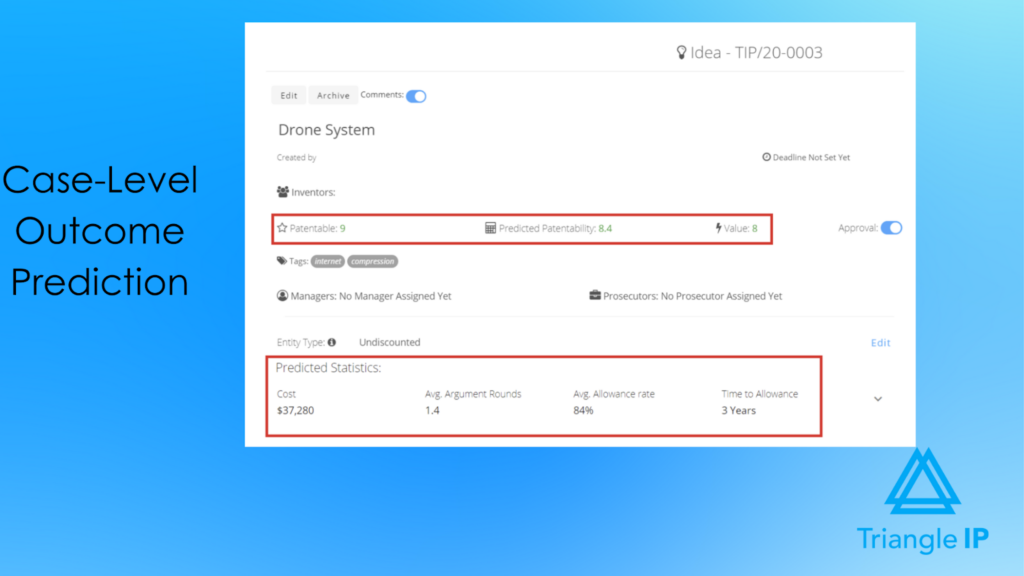
By surfacing these predictions directly within idea and filing views, the platform gives teams concrete, data-backed signals early. This helps teams decide what to file, how to draft, and what to expect during prosecution.
Not sure what level of detail makes an idea summary effective?
Use this Idea Summary Template to structure your invention description for early patentability, cost, and timeline predictions.
Understand Examiner Behavior Before It Shapes The Case
The Examiner Analytics feature provides examiner-specific statistics, including historical allowance rates, average office actions before grant, time-to-allowance, and comparison to Group art unit (GAU) and USPTO averages. These examiner profiles are accessible within the analytics views and linked to active applications to support prosecution planning and expectation-setting.
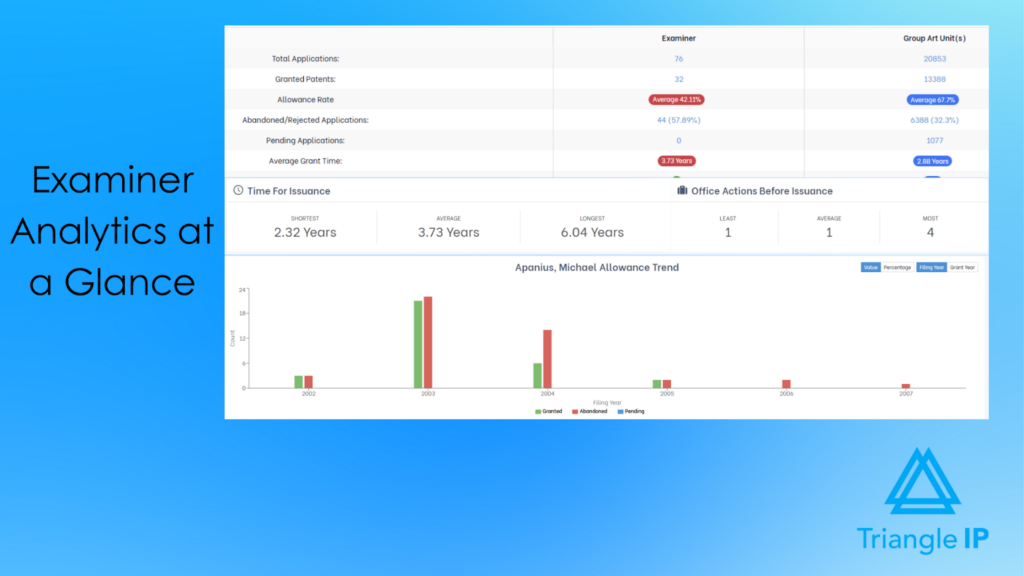
Now, Examiner Analysis also supports multi-examiner comparison. To learn more, read about the new update to the examiner analysis tool here.
Anticipate Art-Unit-Driven Challenges Earlier
The Art Unit Predictor analyzes invention text to identify likely USPTO art units, along with their historical allowance rates and prosecution characteristics. These predictions allow teams to assess examination risk before filing and adjust drafting focus, filing strategy, or portfolio priority accordingly.
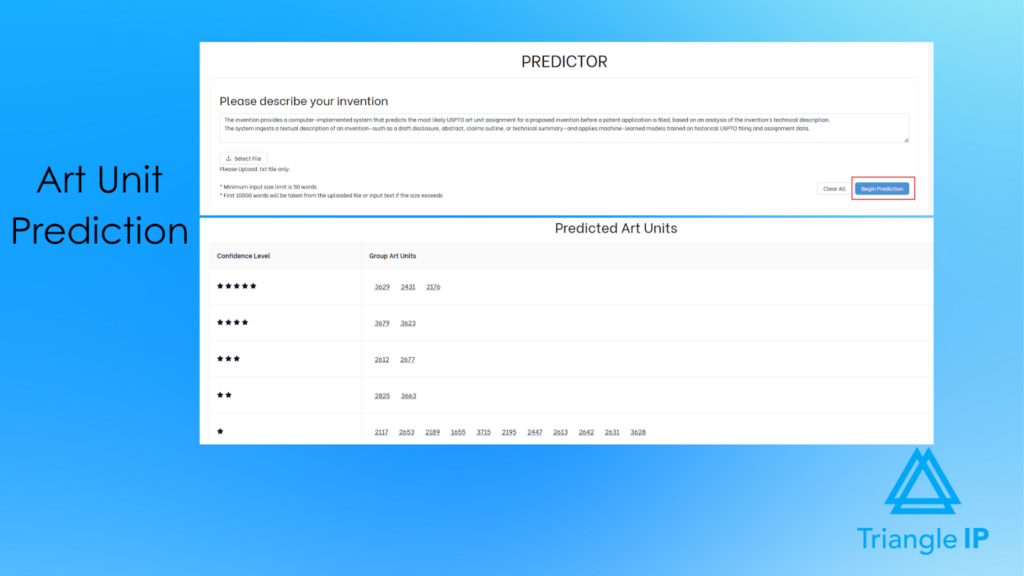
Check out the benefits of the patent art unit predictor here.
Maintain a Clear, Consolidated View of Portfolio Health
Dashboards and visual summaries bring portfolio status into a single view, showing granted, pending, abandoned, and expired cases at a glance. This centralized visibility allows enterprise IP leaders to assess portfolio health quickly and confidently, without relying on spreadsheets or fragmented reporting.
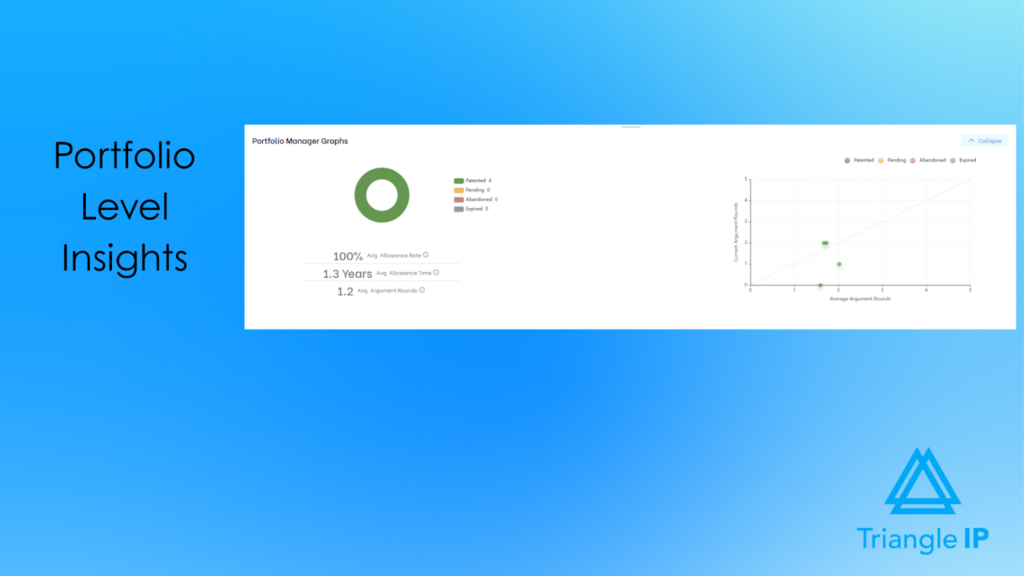
If you’d like to explore more tools that help you manage and strengthen your patent portfolio, you can check them out in our blog on the best patent portfolio management software.
Keep Prosecution Status Current Without Extra Effort
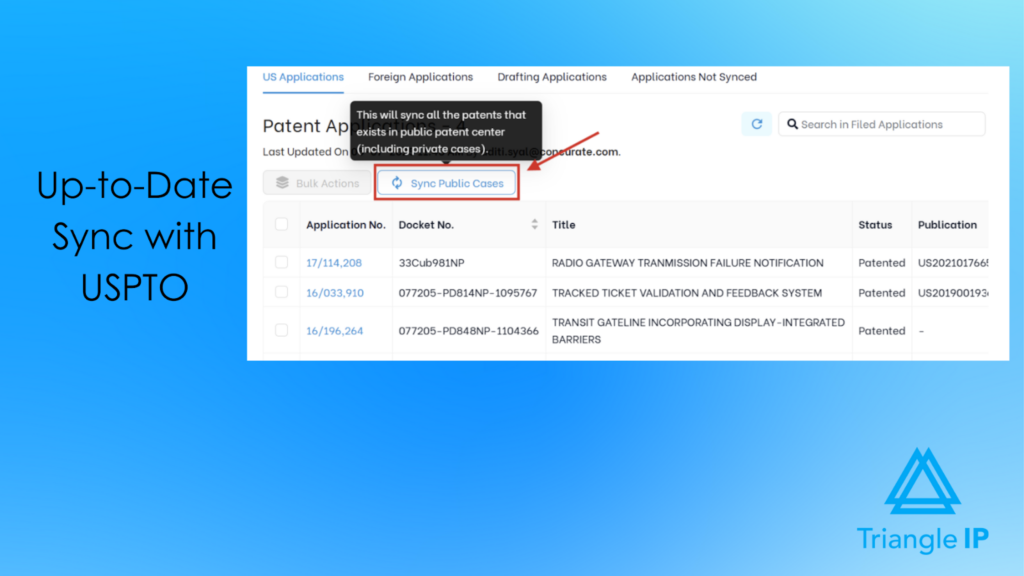
Prosecution data synced from the USPTO through Public and Private PAIR ensures application status and key events remain up to date.
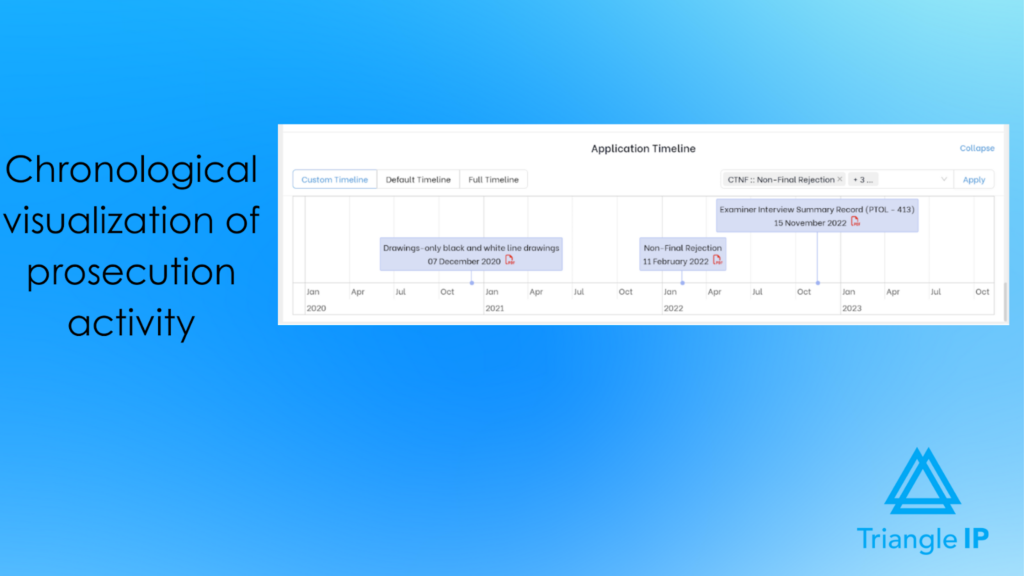
A chronological application timeline displays office actions, responses, interviews, and allowances, with direct links to associated documents.
Enable Shared Understanding Across Legal, Technical, and Business Teams
Analytics are displayed through role-aware dashboards and structured visual views accessible to inventors, managers, prosecutors, and administrators. This shared access ensures all stakeholders work from the same underlying data, reducing duplicate reporting and misaligned updates.
Best For
- The TIP Tool™ is built for teams that rely on patent analytics to guide prosecution decisions, from startups to global enterprises. It is especially useful for in-house IP teams, patent attorneys, and outside counsel who need a clear, structured, and data-driven workflow to manage applications efficiently from drafting to allowance.
Pricing
The TIP Tool™ offers flexible pricing designed for teams of all sizes:
- Free Plan: Ideal for getting started with up to 10 users.
- Premium Plan: Affordable monthly pricing for growing teams that need more users and storage.
- Custom Plan: Tailored options for large enterprises with advanced requirements. Contact the team to create your plan.
You can also purchase standalone add-on tools like Examiner Analysis, Art Unit Predictor, or the Patent Family Tree Generator.
For complete details, visit our full pricing page.
Real-World Success Story
A leading Silicon Valley technology company faced a familiar problem. Patent outcomes were hard to predict. Costs were uncertain. Examiner behavior felt opaque.
They needed clarity before decisions were locked in. So they adopted Triangle IP’s TIP Tool™. Patent analytics guided filing choices, prosecution strategy, and resource allocation. Results followed. Higher allowance rates. Lower prosecution costs. A more focused portfolio.
Read the full case study here.
Demo & Trial Availability
You can request an interactive demo of the TIP Tool™ and explore its features firsthand. A free trial is also available upon sign-up.
PatSnap
Patsnap is a patent analytics and innovation intelligence platform that combines a large proprietary global patent dataset with AI-driven analysis to support IP, R&D, and research teams. The platform is designed to turn complex patent and technical data into actionable insight across activities such as novelty search, technology scouting, competitive analysis, and patent landscaping.
Source: Patsnap Homepage
Beyond traditional analytics, PatSnap positions AI agents at the core of its workflow, helping users extract insights faster from patent, non-patent, and chemical data.
Key Benefits and Supporting Features
The following highlights explain how PatSnap’s features support common IP workflows in practice.
Faster Patent Discovery With AI-Assisted Search
PatSnap uses a domain-specific LLM trained on proprietary innovation data to accelerate prior art, novelty, and FTO searches, with support for semantic text, images, structures, and sequences.
Actionable Insights From Global Patent Data
Analytics tools turn data from 200M+ patents across 174 jurisdictions into filing trends, technology landscapes, and competitive insights, supported by daily data updates.
Improved Risk Monitoring And Prosecution Awareness
Legal status data, office action alerts, and monitoring tools help teams track competitors, identify white spaces, and surface potential IP risks earlier.
Centralized IP and R&D Collaboration
Workspace enables teams to review, annotate, vote on relevance, assign tasks, and share reports in one centralized environment.
Scalable Support For Varied IPWorkflows
Modular plans, AI agents, and secure enterprise infrastructure support use cases ranging from law firm searches to enterprise R&D and portfolio analysis.
Best For
Law firms, life sciences teams, and high-tech companies that need global patent analytics, AI-assisted search, and collaborative IP workflows.
Pricing
PatSnap offers custom, contact-sales pricing based on use case (IP, R&D, Materials, Life Sciences) and selected AI features. Pricing is not publicly disclosed.
Real-World Success Story
Gowling WLG, a global full-service law firm with one of Canada’s largest patent prosecution practices, uses Patsnap to bring advanced patent research, portfolio analysis, and competitive intelligence in-house. This enables its attorneys to deliver faster, more strategic IP advice across industries while reducing reliance on external search firms.
Read the full story here.
Demo & Trial Availability
Free Trial and Demo are available.
PatentSight+
LexisNexis® PatentSight+ is an IP analytics and intelligence platform focused on portfolio quality, competitive benchmarking, and strategic decision-making. It combines highly curated and enriched patent data with AI-driven analytics, proprietary metrics, and advanced visualizations. Together, these capabilities help organizations assess patent strength, track competitors, and optimize portfolio value.

Source: LexisNexis Homepage
The platform is best known for its Patent Asset Index, ownership-corrected data, and point-in-time analysis, which enable more accurate comparisons across companies, technologies, and jurisdictions.
Key Benefits and Supporting Features
Below is an overview of how PatentSight+’s core features support portfolio analysis and strategy in practice.
Clear Visibility Into Patent Portfolio Quality
PatentSight+ uses the Patent Asset Index and enriched classification data to objectively measure patent strength, technological impact, and portfolio quality across jurisdictions.
More Accurate Competitive Benchmarking
Pre-corrected ownership data, real-time legal status, and point-in-time analysis enable reliable comparisons across competitors, including the effects of M&A activity.
Faster Strategic Insights With AI-Driven Analytics
AI-powered analytics surface patterns, trends, and standout metrics, helping teams identify risks, opportunities, and next-step actions more efficiently.
Stronger Communication of IP Value
Advanced visualizations, interactive charts, and PowerPoint-ready exports help teams clearly communicate IP insights and strategy to business stakeholders.
Streamlined Workflows For Strategic IP Teams
Workflow tools support portfolio optimization, alerts, external data integration, and collaboration, enabling teams to move from analysis to decision with less friction.
Best For
Ideal for IP leaders and strategy teams seeking AI-powered patent intelligence to benchmark competitors, optimize portfolios, mitigate risk, and drive confident, data-driven decisions.
Pricing
Pricing is not disclosed on their website.
Real-World Success Story
Siemens, a global engineering and technology leader, used PatentSight to shift its IP strategy from patent volume to patent quality, aligning IP activities with business goals and innovation priorities. By adopting the Patent Asset Index, Siemens gained a clear, data-driven way to measure patent strength, improve portfolio value, and guide R&D and investment decisions. This approach elevated patents from a cost center to a strategic asset discussed at the managing board level.
Read the full story here.
Demo & Trial Availability
Demo is available upon request. Trial not available.
Innography
Innography is one of the best patent analytics software by Clarivate that combines patent, litigation, citation, and prosecution data to support portfolio analysis, competitive intelligence, and valuation. Its proprietary metrics and AI-powered classification help IP teams assess patent strength, benchmark competitors, and guide strategic decisions.
Source: Innography Landing page
Key Benefits and Supporting Features
The points that follow describe how the tool’s analytics and visualizations are applied in real-world IP decision-making.
Clearer Portfolio Strength and Value Assessment
PatentStrength scores and enriched patent data help evaluate patent quality, relevance, and potential value across portfolios.
More Reliable Competitive Intelligence
Normalized company and corporate hierarchy data connect patents, litigation, and citations for accurate competitor benchmarking.
Stronger Risk and Litigation Insight
Integrated global patent litigation data enables analysis of litigated patents, asserting entities, and outcomes across jurisdictions.
Faster, Noise-Free Analysis
Purpose-built analytics for citation mining, infringement detection, landscaping, and portfolio analysis surface relevant insights quickly.
Flexible, Insight-Driven Visualization
Customizable dashboards and 100+ visualizations support portfolio exploration, benchmarking, and stakeholder reporting.
Best For
Patent strategists and enterprise IP teams that need portfolio valuation, competitive intelligence, litigation insight, and analytics to support licensing, M&A, and long-term IP strategy.
Pricing
Pricing is not disclosed on their website.
Real-World Success Story
Pure Storage, a data storage company delivering modern, cloud-enabled storage-as-a-service solutions, partnered with Clarivate to modernize how it manages and defends its IP portfolio. By deploying IPfolio alongside Innography, their IP team gained flexible portfolio management, higher data accuracy, and deep competitive intelligence.
Read the full story here.
Demo & Trial Availability
Demo and Free Trial available upon request.
Orbit Intelligence
Orbit Intelligence by Questel is a global patent analytics and search platform that helps IP, legal, and R&D teams turn patent and scientific data into actionable insight. It combines large-scale patent, design, and non-patent literature coverage with AI-assisted search, analytics, and visualization to support strategic patent decisions.
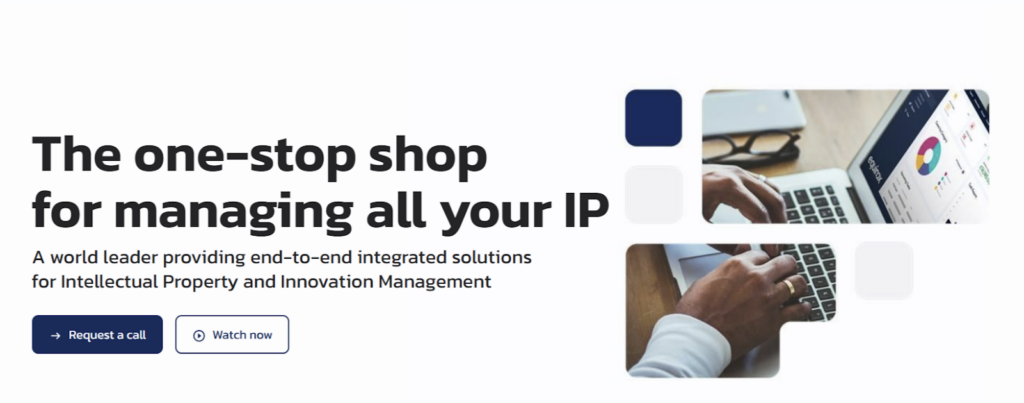
Source: Questel Homepage
Key Benefits and Supporting Features
Below is an overview of the platform’s main benefits and the capabilities that enable them.
AI-Assisted Patent Search With Higher Precision
Sophia, Questel’s AI assistant, helps users build complex patent queries in natural language, automatically adding synonyms, IPC classes, and filters to improve recall and accuracy.
Extensive Global Patent and Scientific Data Coverage
Access to 100M+ patents, 17M designs, and 150M+ non-patent literature records supports comprehensive prior art, landscape, and competitive analysis.
Reliable Analytics for Strategic Decision-Making
Verified ownership data, accurate legal status, translations, and links to litigation, licensing, and SEPs enable more confident portfolio, licensing, and risk decisions.
Advanced Analytics and Visualization Tools
Customizable graphs, clustering, similarity search, and interactive dashboards help uncover white spaces, benchmark competitors, and analyze portfolios at scale.
Workflow and Collaboration Support
Live and saved analyses, automated monitoring alerts, PowerPoint-ready exports, and guided use-case workflows streamline reporting and team collaboration.
Best For
IP professionals, legal teams, and R&D organizations that need global patent search, AI-assisted analytics, and visualization for prior art, competitive intelligence, portfolio management, and strategic IP decisions.
Pricing
Pricing is not disclosed on their website.
Real-World Success Story
Jarry IP, a boutique IP firm serving clients across Chile and Latin America, uses Questel’s Orbit Intelligence to strengthen prior art searches and patentability analysis. The platform offers broad global coverage, high-quality translations, advanced query syntax, and built-in AI assistance. These capabilities simplify workflows, improve accuracy, and support the firm’s daily operations.
Read the full story here.
Demo & Trial Availability
Custom demos available on request. Free trials are not publicly offered.
AcclaimIP
AcclaimIP, part of Anaqua, is a patent search and analytics platform focused on making patent analysis accessible and easy to use. The platform supports patent research and competitive landscape analysis. It also enables portfolio management through intuitive analytics, reporting, and integration with Anaqua’s IP management software.
Source: AcclaimIP Homepage
Key Benefits and Supporting Features
Below is an overview of the key benefits and supporting functionality offered by the platform.
Faster, More Intuitive Patent Research
A Windows-style interface with synchronized views links related patent data, allowing users to navigate prosecution history, citations, and legal status without context switching.
Efficient Patent Landscaping at Scale
Matrix-based queries let users build, update, and rerun hundreds of linked searches with one click, making large technology landscapes easier to analyze and maintain.
Deeper Prosecution and Rejection Insight
Weekly updated rejection data pulled directly from office actions provides clear visibility into how patents were examined and referenced.
More Precise Citation and Prior Art Analysis
Highly granular citation data includes family-level citations, claim and paragraph tagging, and ranked uncited prior art based on examiner behavior.
Clear Visibility Into European Enforceability
Detailed EP validation and legal status mapping show enforceable countries and annuity status at a glance.
Decision-Ready Reporting and Dashboards
Lifecycle-specific reports, interactive dashboards, and benchmarking tools surface actionable insights for prosecution, filings, annuities, and portfolio strategy.
Organized Workflows and Customization
Projects, private custom fields, and configurable forms help teams track research history, annotate patents, and build tailored review workflows.
Best For
Patent searchers, analysts, law firms, and portfolio managers who need deep patent search, citation analysis, prosecution insight, and large-scale patent landscaping through an intuitive, workflow-driven platform.
Pricing
Pricing is not publicly listed.
Real-World Success Story
Case study is not available on the website.
Demo & Trial Availability
AcclaimIP offers a free trial on request.
IPRally
IPRally is an AI-driven patent search and analytics platform designed to help analysts find, classify, and review patents more efficiently. It uses Graph AI and custom AI classifiers to surface relevant prior art, automate classification, and support faster, more accurate patent intelligence workflows.
Source: IPRally Solutions Page
Key Benefits and Supporting Features
The following highlights summarize the platform’s core benefits and the features that enable them.
More Relevant Prior Art Discovery
Graph AI, trained on millions of examiner citations, supports free-text, claim-focused, graph-based, image, and Boolean searches to surface highly relevant prior art.
Faster, Higher-Quality Patent Review
Multi-Patent Ask AI summarizes, analyzes, and compares patents across result sets, while AI highlighting and smart images accelerate technical understanding.
Efficient Custom Classification and Analysis
Custom AI classifiers trained on in-house data enable rapid, taxonomy-specific classification of patents and portfolios without relying on examiner classes.
Seamless Collaboration and Reporting
Projects, collections, commenting, tagging, and multi-format exports (Excel, PDF, Word) streamline sharing and stakeholder reporting.
Proactive Monitoring and Insights
AI-driven monitoring tracks new filings in real time, with automatic classification and portfolio statistics to support ongoing competitive and risk analysis.
Best For
Patent analysts, IP teams, and law firms that need AI-driven prior art search, review, and classification.
Pricing
IPRally offers two plans:
- Individual plan for solo users with core AI search and a 3-day free trial
- Team plan for teams with advanced AI, collaboration, and enterprise support, priced via sales.
Real-World Success Story
Unilever, one of the world’s largest consumer goods companies, uses IPRally to help its patent attorneys work more independently. The platform also enables analysts to deliver faster, higher-quality searches. By starting searches in IPRally, attorneys refine claims and understand prior art earlier. This reduces back-and-forth, improves search quality, and shortens turnaround times across the patent team.
Read the full story here.
Demo & Trial Availability
IPRally offers demos and a 3-day free trial.
Ambercite
Ambercite is an AI-assisted patent discovery platform that uses citation network analytics and deep learning to surface relevant patents often missed by keyword-based search tools. It helps IP professionals strengthen prior art, validation, and licensing searches by ranking and visualizing patents based on citation similarity.
Source: Ambercite Homepage
Key Benefits and Supporting Features
Below is an overview of the main benefits and supporting functionality of the tool.
Find Patents Missed by Traditional Search Methods
Ambercite uses citation network analytics and deep learning to surface relevant patents beyond keywords, semantics, and class codes.
Higher-Quality Prior Art and Validation Searches
AI-driven similarity scoring ranks patents based on citation relationships, improving search quality by up to 46% when used alongside conventional tools.
Faster, More Confident Patent Discovery
Clear ranking and visualization of similar patents enable rapid review and iterative refinement of results.
Reduced Search Risk and Uncertainty
Analysis of 175M+ patent citations helps uncover hidden prior art, supporting stronger validation, licensing, and litigation searches.
Seamless Integration with Existing Workflows
Ambercite AI and AmberScope complement standard patent databases or function as standalone tools, fitting easily into existing IP research processes.
Best For
IP firms, patent examiners, corporate IP teams, and analysts who need comprehensive prior art discovery beyond keyword search.
Pricing
Exact pricing details are not publicly listed and are provided upon contacting sales.
Real-World Success Story
A case study is not available on the website.
Demo & Trial Availability
Ambercite offers a free trial and demos on request through its website.
PatSeer
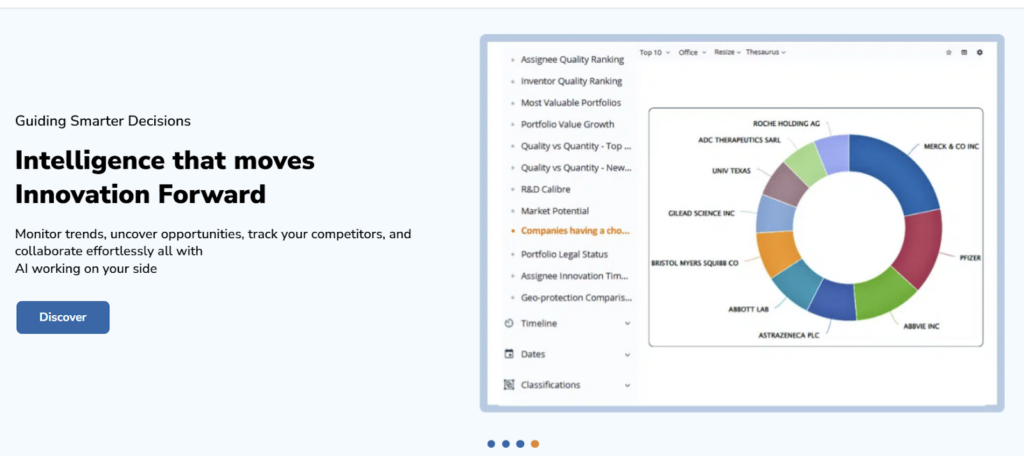
PatSeer is a patent search and analytics platform that combines AI-driven semantic search with traditional Boolean methods to support IP research across the innovation lifecycle. It offers global patent and design data, advanced analytics, and collaboration tools for patent search, portfolio analysis, and strategic decision-making.
Source: Patseer Homepage
Key Benefits and Supporting Features
The following highlights summarize the platform’s main benefits and the capabilities behind them.
Higher Recall and More Reliable Search Results
PatSeer reduces missed prior art by combining AI-driven semantic search with expert-grade Boolean logic. It is supported by a patent-trained LLM, semantic mapping, AI refinement, and recommender capabilities.
Faster and More Efficient IP Research
AI-assisted search, summaries, and an AI copilot streamline novelty, FTO, and prior-art analysis, while smart filters, charts, and trend analysis cut manual effort.
Truly Global Patent and Design Coverage
Users gain access to 172M+ patents and 23M+ design registrations across 113+ authorities, including full-text records, machine translations, and extended family data.
Clear, Actionable Insights for Strategic Decisions
Advanced analytics, dashboards, qualitative assessments, and competitive intelligence tools surface insights across ideation, portfolio management, licensing, and litigation.
Simplified Collaboration and Workflow Management
Built-in project organization, sharing, alerts, workflows, custom fields, and exports help teams track work and collaborate efficiently.
Stronger Design and Visual Analysis
AI-powered image recognition and design-specific analysis tools enable more accurate industrial design searches and comparisons.
Enterprise-Grade Data Security and Privacy
ISO 27001, SOC 2 Type 2, and GDPR compliance, combined with strong encryption and a strict no-AI-training policy, ensure user data remains secure and private.
Scales Easily from Individuals to Enterprises
Multiple editions support solo professionals, IP teams, and large organizations with varying research and analytics needs.
Best For
IP teams, law firms, and R&D professionals who need high-accuracy global patent search and AI-assisted analysis.
Pricing
Pricing not publicly listed.
Real-World Success Story
A PhD candidate at University College London used PatSeer to overcome complex patent entity-linking challenges during academic research. PatSeer enabled faster, more reliable patent searches, cutting research time from a full day to under an hour, while providing accurate data and strong analyst support that made the project feasible and successful.
Read the full story here.
Demo & Trial Availability
PatSeer offers a free trial on request through its website.
Patlytics
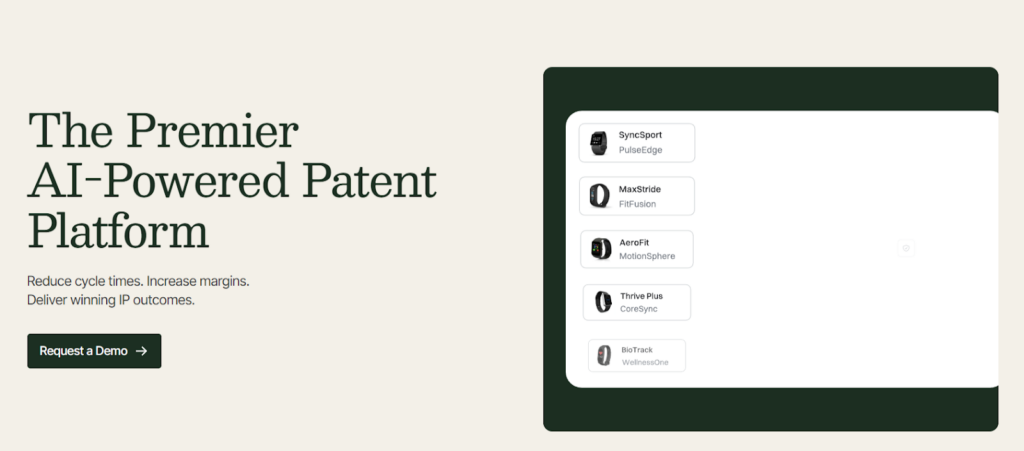
Patlytics is an AI-native, end-to-end patent intelligence platform designed to reduce cycle times and improve IP outcomes. It supports the full patent lifecycle, from invention disclosure and drafting to infringement detection, claim charting, and portfolio optimization. The platform uses high-accuracy, citation-backed AI and is trusted by leading enterprises and law firms.
Source: Patlytics Homepage
Key Benefits and Supporting Features
The following highlights summarize the platform’s primary benefits and how they are enabled.
Shorter Patent Cycle Times
A single AI platform supports invention disclosure, drafting, invalidity, infringement detection, claim charting, and pruning, eliminating tool switching and manual handoffs.
Stronger Litigation and Enforcement
Automated technical discovery, infringement monitoring, claim charts, and patent-to-product mapping help identify infringers and build cases faster.
Higher-Quality Drafting and Disclosures
Audit-ready IDFs and patent drafts are generated from internal and external materials, including technical documents, figures, and presentations, with flexible claim structuring.
Smarter Portfolio Decisions
AI-driven classification, tagging, and portfolio comparisons highlight high- and low-value patents to support licensing, monetization, enforcement, or abandonment.
Reliable, Defensible Insights
Citation-backed outputs, source auditing, and confidence indicators reduce risk and improve decision accuracy across IP workflows.
Enterprise-Grade Security
SOC 2 certification, encrypted and segregated data, no model training on customer data, and a 99.5% uptime SLA ensure trust and reliability.
Best For
Ideal for enterprise IP teams and law firms managing complex patent workflows at scale.
Pricing
Exact pricing details are not publicly listed.
Real-World Success Story
Young Basile, a leading IP law firm specializing in artificial intelligence law, adopted Patlytics to streamline patent drafting and prosecution while meeting strict client confidentiality requirements. After a hands-on trial, the firm saw a 15–20% reduction in drafting time, stronger claim strategies through AI-assisted claim trees, and fewer revisions, allowing attorneys to handle more cases and focus on higher-value strategic work without compromising security or quality.
Read the full story here.
Demo & Trial Availability
Patlytics offers demos on request, but free trial availability is not publicly disclosed.
Octimine
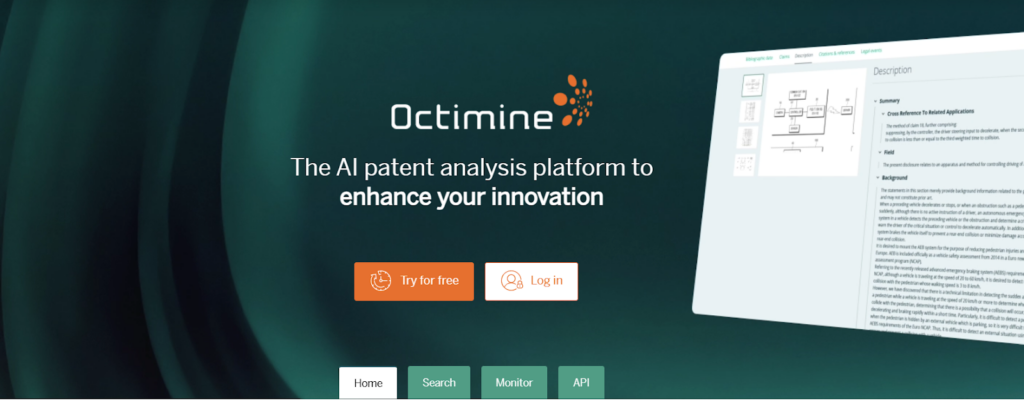
Octimine is an AI-powered patent search and analytics platform by Dennemeyer that combines semantic and deep-learning search with classical Boolean methods. It helps users quickly find, monitor, analyze, and collaborate on global patent and non-patent literature through an intuitive, secure, all-in-one interface.
Source: Octimine Landing Page
Key Benefits and Supporting Features
The points below highlight how the tool’s core features translate into practical benefits.
Faster, More Accurate Patent Discovery
AI-powered semantic and deep-learning search works alongside Boolean methods to surface relevant patents quickly. Results load in seconds and can be explored visually for faster understanding.
Clear Visibility Into Technology Trends And Competitors
Automated monitoring tracks new publications and legal status changes. Built-in analytics, interactive charts, and landscape views turn large datasets into actionable insights.
Seamless Collaboration Across Teams
Shared workspaces allow users to annotate, assign tasks, store documents, and collaborate in one searchable platform. This removes reliance on email chains and static PDFs.
Accessible for Users of All Experience Levels
An intuitive interface requires no specialized training. Students, inventors, and IP professionals can search, analyze, and collaborate with ease.
Enterprise-Grade Security and Data Control
SSL encryption, two-factor authentication, and secure servers in Germany protect sensitive IP data. Searches are processed securely and not retained beyond analysis.
Flexible Integration Into Existing Workflows
The Octimine API enables direct integration with internal systems, allowing teams to customize search, monitoring, and analytics within their own environments.
Best For
Octimine is best for IP teams, patent searchers, R&D professionals, and inventors who want fast, AI-assisted patent search, monitoring, and collaboration without a steep learning curve.
Pricing
Specific pricing details are not publicly listed.
Real-World Success Story
A case study is not available on the website.
Demo & Trial Availability
Octimine offers a free trial and also provides personal onboarding demos on request.
These platforms reflect the range of approaches used in patent analytics today. Most are effective at analyzing patent data to surface trends, risks, and comparisons. The harder challenge comes after those insights are available: enabling teams to act on them consistently across filings, prosecution, and portfolio decisions.
This is where the TIP Tool™ goes beyond standalone analytics, providing the structure and workflows modern IP teams need to execute informed decisions at scale. Let’s explore in detail.
Why the TIP ToolTM is the Best Patent Analytics Software Choice for Modern IP Teams
Patent analytics only matter when teams can use them directly in their daily workflows. Insights into prosecution outcomes, examiner behavior, and portfolio risk must guide filing decisions, prioritization, and budgeting. They should not live in separate dashboards that require manual interpretation or follow-up.
A leading global technology company achieved this shift after adopting the TIP Tool™. Now the team uses prosecution data to evaluate ideas early, select stronger filings, and manage applications more effectively. All resulted in faster filings, better-quality disclosures, and higher patent success rates across the portfolio.
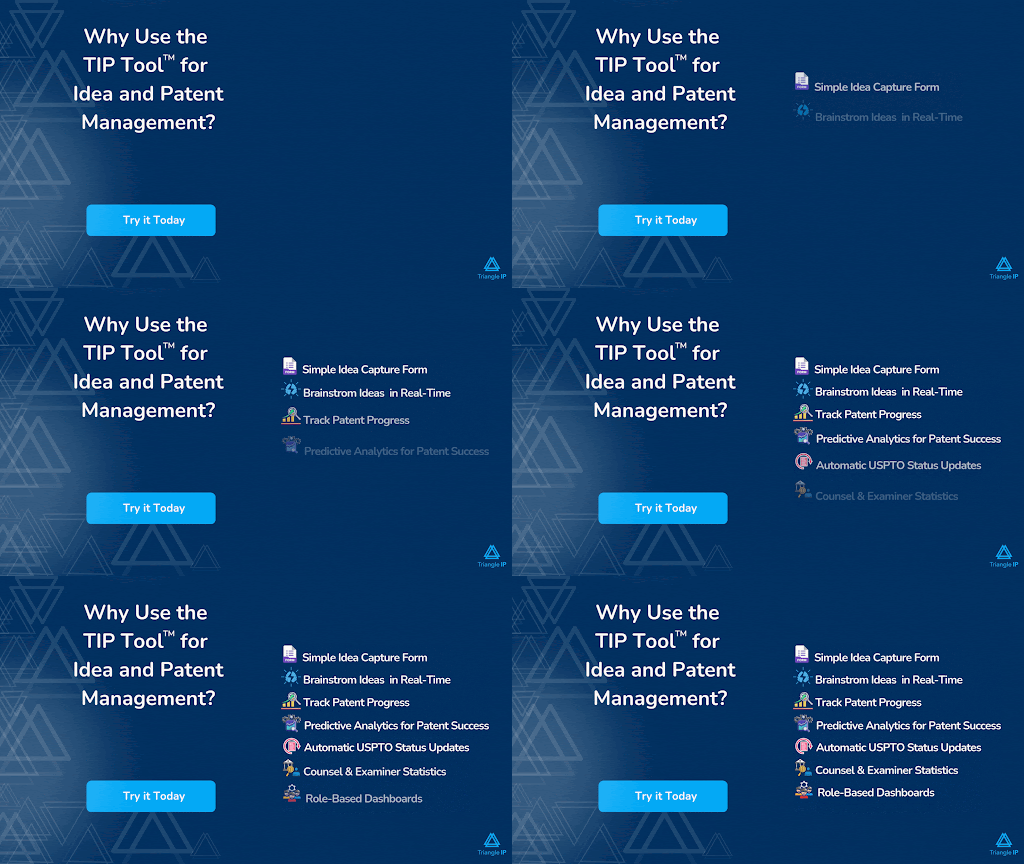
Not just that, beyond analytics, the TIP Tool™ enables execution through clearly defined capabilities:
- Customizable invention disclosure forms to capture analysis-ready technical and business details
- Configurable workflow stages to track ideas and applications from submission through prosecution
- Enterprise-wide collaboration enabling inventors, managers, and counsel to work from a single data source
- Tag-based portfolio organization and filtering to analyze trends by technology, product line, or business unit
- Patent family tree visualization to assess continuations, divisionals, and filing strategy
- Bulk import and export to keep portfolio data complete and ready for analysis at scale
- Admin controls for entity size and fee configuration to align cost projections with filing assumptions
Together, these capabilities ensure patent analytics are not just informative but actionable. IP teams can now make better decisions and manage patents with consistency and confidence across the entire lifecycle.
Get started now and experience it for yourself.
Disclaimer: The information in this article/review is sourced from the internet and may not be entirely accurate or up-to-date. We recommend visiting the respective software websites for the most current and reliable information. The Triangle IP team is not liable for any consequences that may arise from relying on the information provided in this article/review.
Best Patent Analytics Software: Most Frequently Asked Questions (FAQs)
1. How Should Patent Analytics Be Used Alongside Business and Product Strategy?
Patent analytics should inform decisions, not drive them in isolation. While analytics can surface risks, timelines, and cost patterns, IP decisions must also reflect product roadmaps, market timing, and competitive priorities. A patent with a lower allowance probability may still be critical for blocking competitors or supporting a key product launch. Strong IP teams use analytics to understand trade-offs and scenario impacts, then balance those insights against commercial value, enforcement goals, and long-term portfolio strategy.
Recommended Read: Empower Your Patenting Decisions With Patent Analytics for Better Returns.
2. How Reliable Are Examiner and Art Unit Predictions for Emerging or Interdisciplinary Technologies?
Examiner and art unit predictions are most reliable when an invention fits established technology categories with strong historical prosecution data. For emerging or interdisciplinary technologies, predictions still offer value but are less precise due to limited or fragmented prior cases. In these situations, predictions help surface early signals rather than exact outcomes. They can flag difficult art units, risky terminology, or differences in allowance behavior across domains. IP teams should view these insights as probabilistic guidance, not firm forecasts. Accuracy typically improves as claims mature and classification signals become clearer over time.
Recommended Read: How to Optimize Patent Prosecution Strategy with the Art Unit Predictor?
3. How Should IP Teams Validate or Challenge Analytics-Driven Recommendations Rather Than Accepting Them at Face Value?
IP teams should approach analytics as a second lens, not a substitute for expertise. Validation typically involves cross-checking tool-driven insights against internal knowledge, prior prosecution experience, and outside counsel judgment.
Practical ways to challenge recommendations include:
- Running multiple scenarios (e.g., alternate claim language) to see how predictions change.
- Comparing analytics outputs with known examiner or art unit reputations.
- Stress-testing recommendations against business strategy, not just allowance probability.
The most effective teams use analytics to structure better questions and discussions, rather than to automate decisions.
For a deeper look at how analytics fits into a balanced prosecution approach, read how to build a better strategy for patent prosecution.