
| TL;DR – High-stakes IP decisions like prosecutor selection for your patents require way more data than the basic credentials or firm details from existing online repositories. These decisions require hard prosecution data. Credentials and firm reputation only tell you so much. Of the three patent prosecutor analysis tools we evaluated, Triangle IP’s Patent Prosecutor Analysis is the only one that benchmarks a prosecutor’s performance against the specific examiners they faced. That context is what tells you whether an attorney is genuinely strong or simply benefiting from lenient examiners. IP Pilot and LexDana each bring real value, but from a different starting point entirely. |
Most in-house IP teams have worked with the same outside counsel for years, sometimes decades. The relationship runs deep. However, relationship history and prosecution performance are two very different things.
During a recent demo, a prospect put it plainly. They had followed the same patent attorney across three firms over 20 years. Strong relationship. Real trust. But when asked how they evaluated his performance, the answer was simple: they never had. No data. No benchmarks. Just continuity.
That is more common than most IP teams would admit. When leadership asks whether the prosecution budget is working, a long relationship is not an answer.
These three tools give you something better.
- Triangle IP benchmarks individual prosecutor performance directly against specific examiner difficulty
- IP Pilot excels in global law firm networking data
- LexDana offers leaderboard rankings based on overall volume and activity
To see how these platforms stack up against each other, here is a breakdown of their core capabilities at a glance.
Quick Comparison: Top Patent Prosecutor Analysis Tools
| Features | Triangle IP | IP Pilot | LexDana |
| Primary Differentiator | Benchmarks individual prosecutor performance against specific examiner difficulty | Global law firm intelligence and networking data | Broad leaderboard rankings based on overall volume and activity |
| Individual Attorney Analytics | ✅ Deep dive into specific attorney allowance rates and behaviors | ✅ Focuses on firm-level relationships | ✅ Ranks top attorneys based on historical activity and success rates |
| Examiner Context Benchmarking | ✅ Evaluates stats relative to the exact Art Units and examiners faced | ❌ | ❌ |
| Side-by-Side Comparison | ✅ Compare up to 3 individual attorneys or law firms | ✅ Firm-to-firm comparison | ❌ |
| Predictive Timelines & Effort | ✅ Forecasts expected office actions and prosecution length | ❌ | ✅ Looks at past efficiency but not predictive forecasting |
| Geographic Strengths | Highly detailed US prosecution data | Strong European and global law firm coverage | Focuses heavily on US patent data |
| Best Used For | Selecting the exact attorney for a difficult US patent filing | Finding international partner firms for global filings | Checking if a firm or attorney ranks on the top volume/activity leaderboards |
Before digging deeper into the solutions, let’s take a look at the factors that must be considered to make an informed prosecutor selection.
What Should You Look For In a Patent Prosecutor Analysis Tool
Not all prosecutor analysis tools are built for the same job. Some are designed to help law firms win new business. Others are built to help in-house teams make smarter decisions: whether you are evaluating your current outside counsel or selecting a new one.
Here are the nine questions to ask before choosing one:
- Can it Analyze Both Law Firms And Individual Attorneys?
- Does it Show Real Prosecution Insights or Just Profile Data?
- Can You Compare Attorneys And Firms Side by Side?
- Does it Evaluate Performance in Context?
- Does it Show How Cases Typically Progress?
- Can it Help You Anticipate Prosecution Time and Cost Implications?
- Can You Filter Prosecutor’s Insights for Most Relevant And Recent Data?
- Does it Show Who the Prosecutor Works With?
- Is the Data Easy to Interpret, to Explain to the Internal Team?
It’s hard to judge an attorney by credentials alone. Use this checklist to vet counsel and ask the right questions during your next consultation. – Download Now
1. Can it Analyze Both Law Firms And Individual Attorneys?
Firm-level data alone is incomplete. What matters is the ability to evaluate both the overall performance of a law firm and then drill down into the individual attorneys handling your cases.
This helps you first assess the firm’s broader capability, and then identify the specific prosecutor whose experience and success patterns make them the right fit for your case.
That way you move from selecting a firm based on reputation to selecting the right attorney within that firm based on actual performance. This approach is one of the most important things to know before hiring a patent attorney to ensure you’re hiring the right candidate.
2. Does it Show Real Prosecution Insights or Just Profile Data?
A basic bio and bar registration only confirm an attorney is legally allowed to practice but does not guarantee results.
What matters is accessing hard prosecution metrics like
- Historical allowance rates
- Office action frequencies,
- Request for Continued Examination (RCE)
So, you can verify if they actually secure patents efficiently and base your hiring decisions on proven capability.
| RCE: Request for Continued Examinations A Request for Continued Examination (RCE) is a filing made with the USPTO to continue prosecution of a patent application after a final rejection. Instead of appealing or abandoning the application, you pay a fee and reopen examination giving you another chance to amend claims or present arguments. |
3. Can You Compare Attorneys And Firms Side by Side?
Looking at an isolated attorney’s statistics won’t tell you if they are the absolute best option available.
What matters is the ability to place multiple attorneys or law firms side-by-side to immediately contrast their allowance rates, timelines, and technical experience.
This transforms your selection process from a messy exercise in cross-referencing spreadsheets and tab switching into an objective, head-to-head comparison.
4. Does it Evaluate Performance in Context?
A high allowance rate is misleading if the attorney only handles easy cases.
For accurate insights, you need to benchmark an attorney’s performance against the notoriously difficult examiners and Art Units they actually face.
This feature ensures you hire a prosecutor with a proven capability rather than someone whose stats are artificially inflated by lenient examiners.
5. Does it Show How Cases Typically Progress?
Knowing an attorney eventually got a patent granted doesn’t tell the whole story.
Data about the actual prosecution journey like how many office actions, interviews, and RCEs it takes them to secure an allowance is essential.
This reveals whether the attorney resolves rejections efficiently or drags cases through expensive, endless cycles, helping you optimize for total cost rather than just the final outcome.
6. Can it Help You Anticipate Prosecution Time and Cost Implications?
It is common to see wildly different price quotes for drafting the same patent, with every firm claiming “high quality.” But as one buyer asked: “How can they prove it? Do patent attorneys have some kind of statistics they can show?”
Relying solely on an attorney’s hourly rate or initial drafting fee leaves you blind to the true cost. A top patent prosecutor analysis tool gives you those exact statistics. It uses historical timeline and office action data to forecast the actual effort a case will require.
Moreover, it allows you to justify the upfront cost, evaluate their true efficiency, and accurately budget for the entire prosecution journey. Having this data on hand makes it much easier to get clear answers on the key questions regarding patent costs during your initial consultations.
7. Can You Filter Prosecutor’s Insights for Most Relevant And Recent Data?
An attorney might have a stellar career record built on hardware patents from a decade ago, but may struggle to navigate today’s complex AI or software art units. Knowing these kinds of details is crucial.
You need a tool that lets you filter performance data by recent years and specific technology centers.
This ensures you are evaluating their current capability and relevance to your specific invention. So, you hire someone actively winning in your deep-tech domain today, rather than resting on past successes.
8. Does it Show Who the Prosecutor Works With?
Evaluating a lawyer’s metrics without knowing their typical clientele only gives you half the picture. An attorney used to Fortune 500 budgets may not fit the lean, strategic needs of a deep-tech startup
A robust analysis tool will reveal the types of applicants an attorney frequently represents. This allows you to verify if their experience actually aligns with:
- Your company’s size
- Risk tolerance
- Specific business model
It ensures a much smoother and more effective partnership.
9. Is the Data Easy to Interpret, to Explain to the Internal Team?
When you need to justify your choice of counsel to the C-suite or R&D heads, you need clear visuals, not a wall of numbers. The right platform translates complex prosecution statistics into clean, easy-to-read dashboards.
This visual clarity makes it effortless to back up your hiring recommendations with hard evidence and secure quick stakeholder buy-in.
With the criteria checklist in hand now let’s take a look at each tool’s features and limitations with respect to patent prosecution analysis.
3 Top Patent Prosecutor Analysis Tools – Time for a Deep Dive
The comparison table tells you what each tool does. But a feature list alone rarely tells you enough.
In this section, we have done the deep dive to help you actually visualize these features. Besides that, we have also shared strengths, limitations, pricing, free trial, demo request form and other information that can make your decision easier.
1. Prosecutor Analysis by Triangle IP
Prosecutor Analysis by Triangle IP is a specialized analytics platform built to help deep-tech and IP teams transition from guessing about attorney quality to making data-driven hiring decisions.
The tool answers one question clearly like no other tool and is its biggest differentiator: How well are the prosecutors performing with respect to the assigned examiners (Decision makers)?
You can access the complete profile with timelines for grants, allowance rates and even compare different attorneys side by side. Moreover, you can view their success rates against the average.

What Are the Key Features of Prosecutor Analysis by Triangle IP
Prosecutor analysis provides the data you need to peek behind the curtain of law firm branding. Here are 8 insights from Triangle IP’s prosecutor analysis tool to make informed hiring decisions:
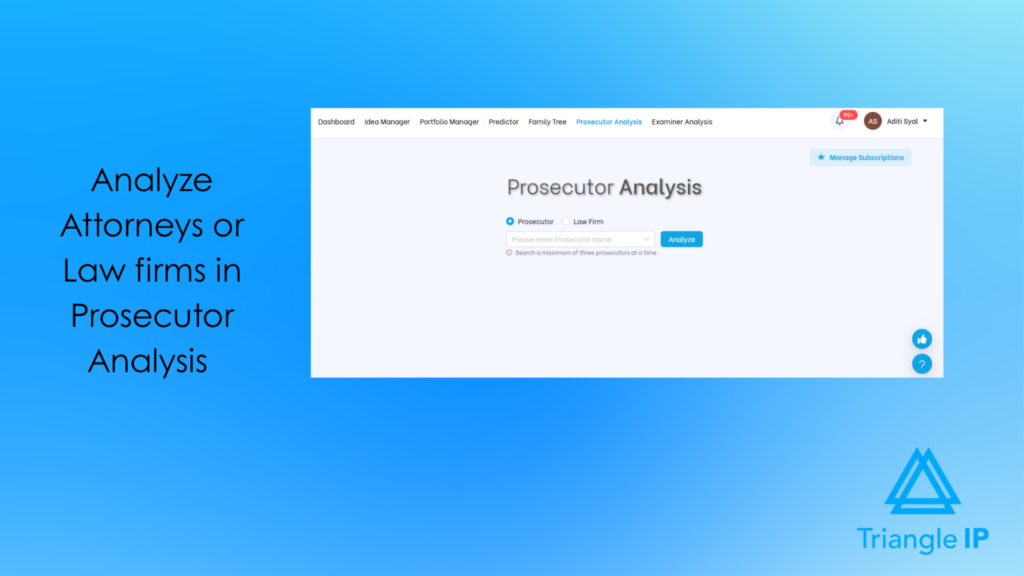
- Attorney and Law Firm Search:
Relying purely on a firm’s brand name hides the actual person doing the work, so you need the ability to instantly look up the specific attorney assigned to your case.
This reveals their individual prosecution record, allowing you to base your hiring decision on proven practitioner capability rather than corporate reputation.
- Side-by-Side Prosecutor Comparison:
Viewing an attorney’s metrics in isolation can mislead you regarding the available prosecutor and setting your benchmarks.
By placing up to three prosecutors or firms head-to-head, you immediately expose who is truly the most efficient. It turns a messy spreadsheet evaluation into a clear, confident selection. - Context-Based Performance Metrics:
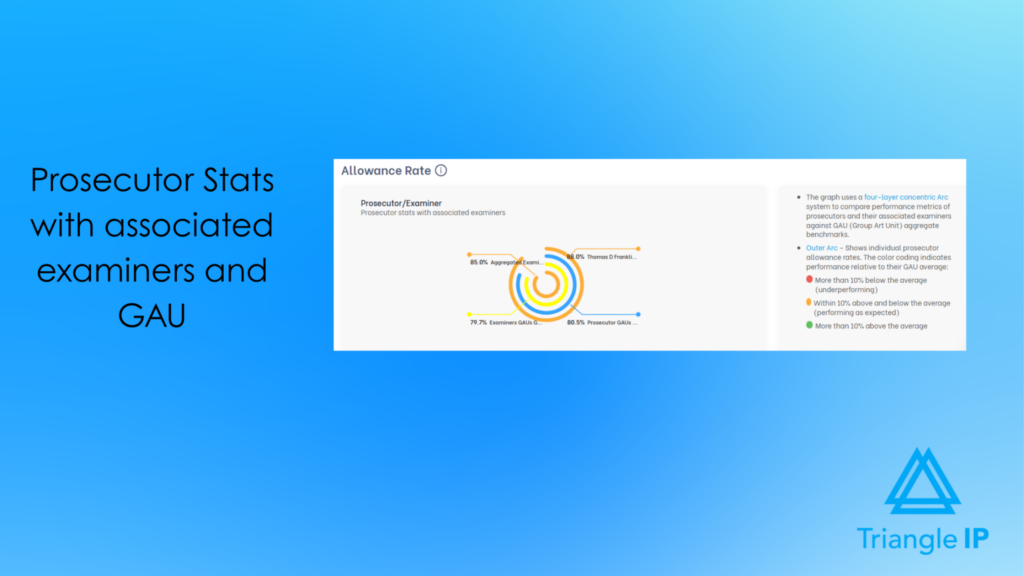
A high overall allowance rate can misdirect you if the attorney only handles easy filings.
Benchmarking their performance directly against notoriously difficult examiners and Group Art Units proves their true “ability to fight,” ensuring you hire someone capable of winning hard cases.
- Prosecution Outcomes and Timelines:
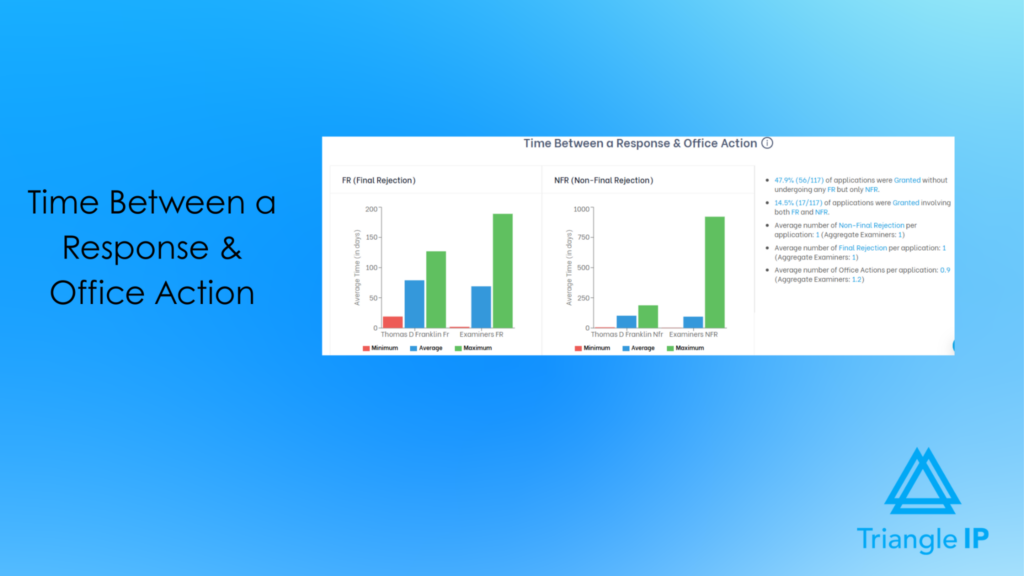
An attractive initial drafting fee often masks the true final cost of securing a patent.
Forecasting an attorney’s historical timelines, office actions, and RCEs reveals the actual effort required, enabling you to accurately budget for the entire prosecution journey.
- Prosecution Behavior and Trends:
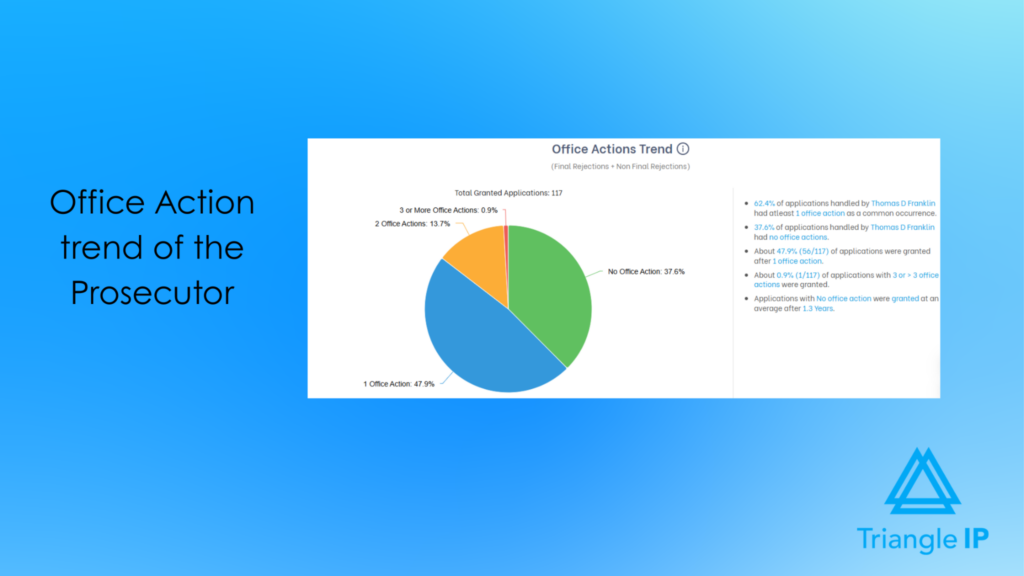
Knowing a patent was eventually granted doesn’t show how long it took or expensive the process was to get there.
Tracking an attorney’s historical behavior highlights whether they resolve rejections efficiently, empowering you to avoid practitioners who drag cases through endless, billable cycles.
- Advanced Filtering and Search:
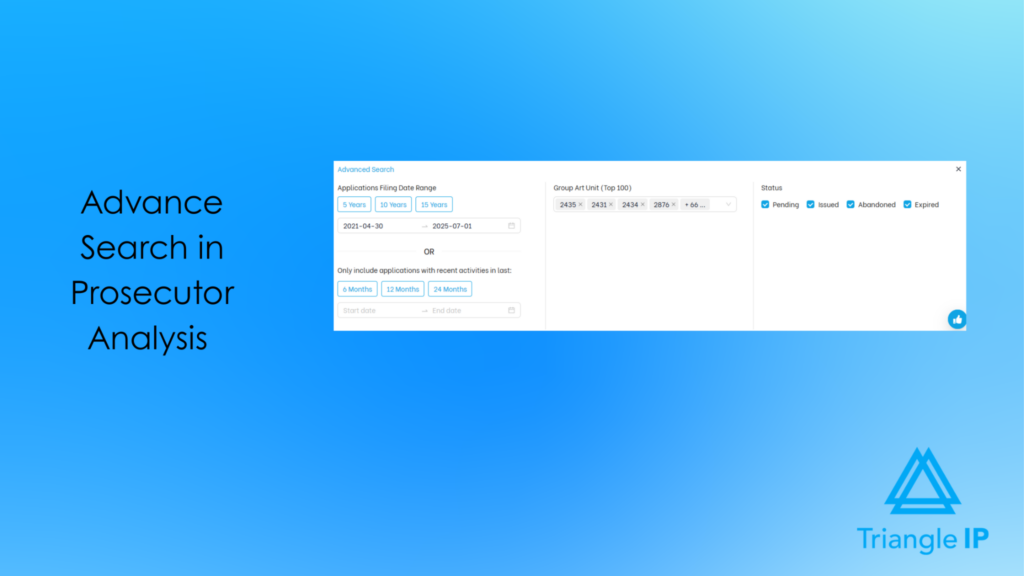
A lifetime success record is irrelevant if it stems from outdated technology or unrelated art units.
Isolating performance data by recent years and specific technology centers guarantees you are choosing an attorney actively winning in your exact deep-tech domain today.
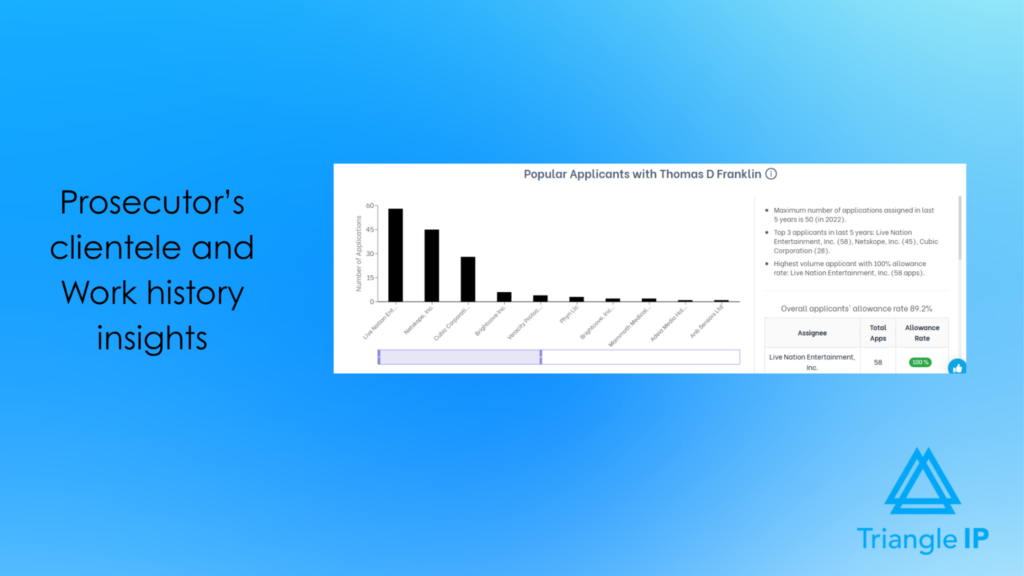
- Applicant and Work History Insights:
Evaluating performance metrics without considering an attorney’s typical clientele leaves a major blind spot in your assessment.
Reviewing their applicant history shows whether they are built for agile startups or volume-driven corporations, preventing strategic misalignment during your partnership.
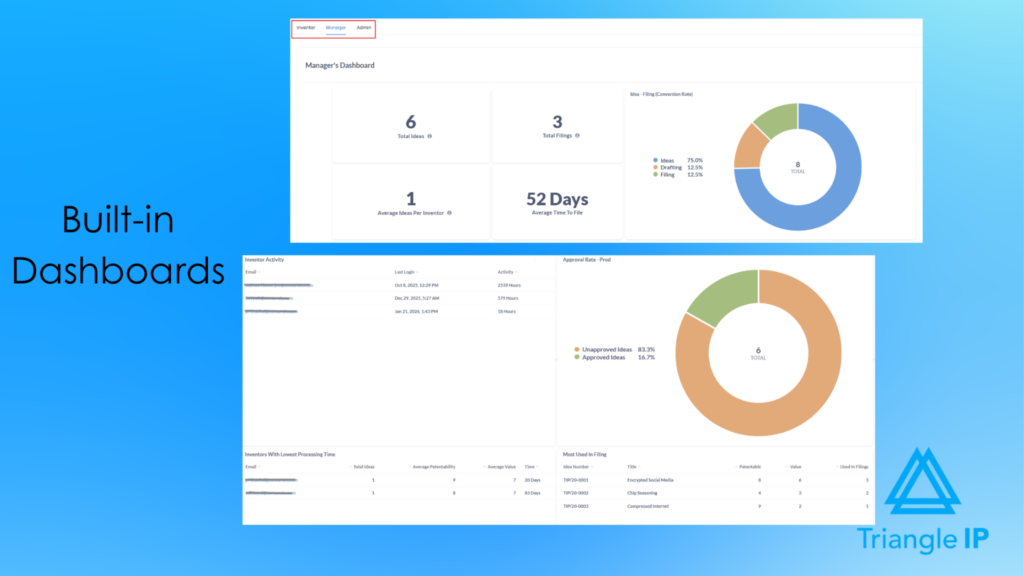
- Visual and Tabular Data Views:
Exporting raw USPTO data dumps only creates more analytical work for your team. Translating those complex statistics into clean, intuitive dashboards provides immediate visual evidence, making it effortless to justify your hiring recommendations to the C-suite.
Strengths of Prosecutor Analysis by Triangle IP
- Eliminates Brand-Name Bias: It prevents you from overpaying for a prestigious law firm by revealing whether the specific attorney assigned to your case actually has the proven track record to back up the firm’s reputation.
- Filters Out Inflated Metrics: By normalizing an attorney’s success rate against the actual difficulty of their assigned examiners, it ensures you aren’t fooled by practitioners who only look good because they coast on easy approvals.
- Total Prosecution Cost Control: Moving beyond just the initial drafting fee, it uses historical RCE and Office Action data to help you accurately forecast and manage the lifetime cost of securing the patent.
Limitations of Prosecutor Analysis by Triangle IP
- US-Centric Analytics: Its deep performance metrics and examiner benchmarking are powered exclusively by USPTO data. It is not designed for tracking examiner behaviors in European (EPO) or Asian jurisdictions.
- Initial Learning Curve: The depth of technical metrics can be overwhelming at first. To help, Triangle IP provides a comprehensive Knowledge Base and guided onboarding to turn that data into strategy.
What Is the Cost of Prosecutor Analysis by Triangle IP?
Prosecutor Analysis is priced at $500 per year per seat, billed annually. This specialized pricing is designed for motivated users who want to help shape the tool’s advanced search functionality as it evolves.
Does Prosecutor Analysis by Triangle IP Offer a Free Trial?
Yes, it uses a “freemium” model where you can view the first two graphs Attorney Details and Allowance Rates for free. A paid subscription is required to unlock deeper analytics like historical timelines and office action forecasting.
Book a personalized demo from the form below and see exactly where the TIP Tool™ fits your workflow.
2. IP Pilot
IP Pilot is a powerful market intelligence platform designed primarily for IP law firms and large corporate departments managing global portfolios.
Its core strength is analyzing international case flow, cross-border reciprocity, and global firm-to-firm networking based on over 110 million patent filings worldwide.
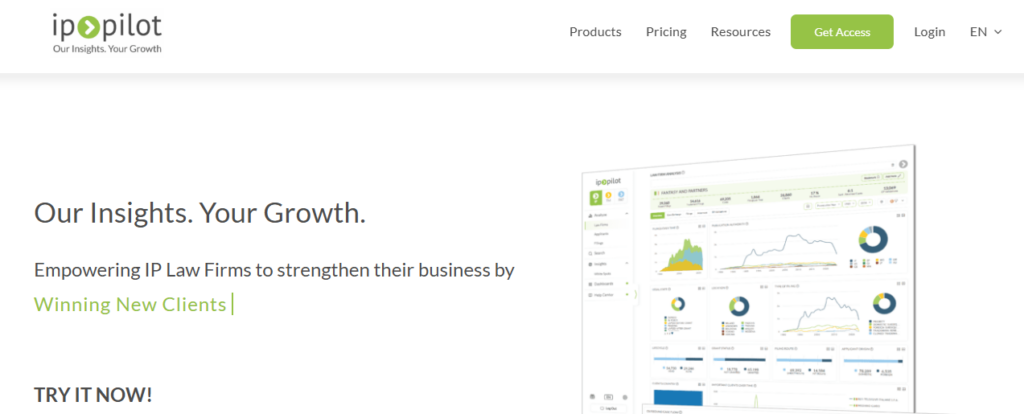
Source: IP Pilot
What Are the Key Features of IP Pilot?
For the teams managing international portfolios who need to vet law firms across different countries IP Pilot offers 3 key data points.
- Partner Autonomy Audit:
Most law firms claim to have a “vetted global network,” but often they just send work to firms that send them work back (reciprocity). So, IP Pilot’s algorithm identifies if a firm’s foreign partners were chosen independently or just mandated by a client. This allows you to audit whether your counsel is hiring the best technical expert for your case or just fulfilling a business favor. - Global Law Firm Profiling:
Evaluating a potential foreign associate based on a polished website bio is a massive gamble.
Accessing raw filing volumes and success rates across 35,000 global firms allows you to bypass the sales pitch. This allows you to verify their actual filing volumes and jurisdiction expertise before entrusting them with your valuable international IP. This data-driven approach is a key part of the strategies used to develop an international patent portfolio without over-relying on unverified marketing claims. - Technology Overlap Analysis:
Generic expertise in a broad field like “Electronics” isn’t enough for the complexities of deep-tech. Analyzing a firm’s specific technology sector overlap with your existing portfolio reveals whether they have successfully prosecuted inventions similar to yours. This enables you to hire firms that already understand the nuances of your innovation, reducing the learning curve and improving grant outcomes.
Strengths of IP Pilot
- Consolidated IP Visibility: For teams managing more than just patents, IP Pilot Ultimate provides a 360-degree view by combining both patent and trademark representation data. This allows you to evaluate the full-service strength of a global firm, ensuring consistency across your entire intellectual property portfolio.
- Objective Jurisdiction Verification: IP Pilot uses real-world data from over 120 jurisdictions to verify their actual footprint. It lets you confirm if a potential firm is truly a “top player” in a specific target market..
Limitations of IP Pilot
- No Examiner Insights: Lacks granular USPTO examiner data, such as “allowance arcs” or interview success rates, making it impossible to troubleshoot specific stalled applications.
- Macro vs. Micro Focus: Analyzes broad firm filing volumes rather than the individual “ability to fight” of a single prosecutor.
- Data Latency: Relies on international databases (like EPO’s DOCDB) which can lag behind tools that plug directly into the real-time USPTO Private PAIR system.
- Missing Prosecution Metrics: Does not track tactical stats like an attorney’s average Office Action count or their specific success rate in overcoming Section 101 rejections.
What Is the Cost of IP Pilot?
IP Pilot does not explicitly mention a set price for their tools. The pricing depends on total size of your firm and the specific tool you choose (IP Pilot Patents, IP Pilot Trademarks and IP Pilot Ultimate
Does IP Pilot Offer a Free Trial?
Yes, IP Pilot offers a “Forever Free” Access: They offer a basic free account that requires no credit card. While this is “highly limited,” it allows you to explore the interface.
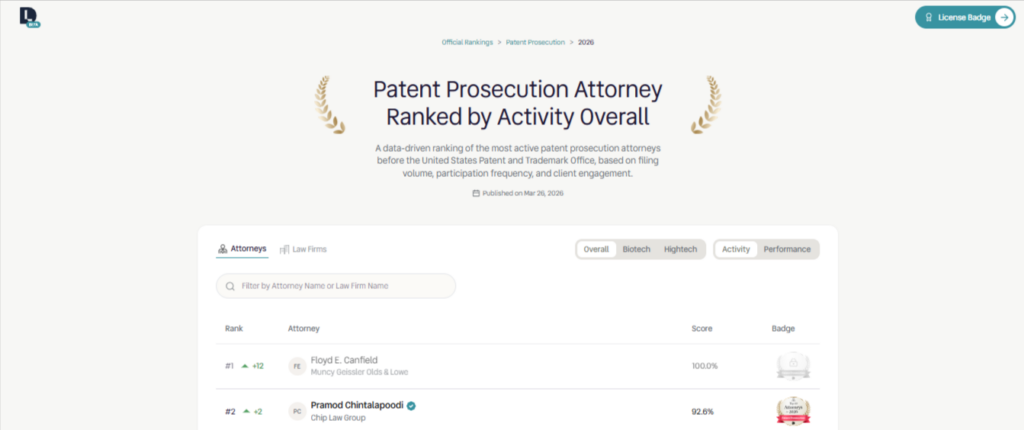
3. LexDana
LexDana is a high-level performance and activity ranking platform powered by Patexia’s entity-resolved database.
It is designed for IP teams who need to move beyond firm-wide reputations to identify the “Top 250” elite prosecutors and firms in the US
Source: LexDana
What Are the Key Features of LexDana?
LexDana, powered by Patexia, focuses on high-level rankings and “entity-resolved” data to help you identify the elite tier of US patent prosecutors.
- Dynamic Performance Leaderboards:
Unlike static annual reports, LexDana provides real-time rankings of the Top 250 patent attorneys and firms. This ensures your vendor selection is based on current activity and success rates from the most recent period. - Sector-Specific Efficiency Scoring:
Prosecutors often have varying success rates across different technology centers. LexDana categorizes rankings into specific domains like Biotech and High-Tech, allowing you to verify that an attorney’s performance matches your specific deep-tech niche. - Claim Quality Benchmarking:
Beyond just measuring grant rates, LexDana evaluates the quality and breadth of the claims secured. For an in-house team, this is critical for ensuring your outside counsel is building enforceable, high-value patents rather than just pursuing “easy” allowances.
Strengths of LexDana
- Data-Backed Due Diligence: Powered by Patexia’s “entity-resolved” engine, LexDana eliminates the confusion caused by messy USPTO records. This gives you a clean, unified view of a firm’s true track record.
- Talent Retention Security: Because it tracks individual attorney lateral moves, you gain a “talent-first” view of your IP strategy. You can instantly see if the firm has lost the specific experts responsible for your high success rates, allowing you to move your portfolio with the talent.
Limitations of LexDana
- No Predictive Budgeting: It is a performance and ranking tool, not a forecasting tool. It does not offer predictive modeling to estimate the exact number of Office Actions or the total “cost to grant” for an upcoming individual application.
- High-End Positioning: The tool’s algorithm is heavily geared toward the “Top 250” elite tier of the US patent prosecutors. If you are working with smaller, boutique regional firms or solo practitioners, they may not have enough data volume to appear in these high-level comparative rankings
What Is the Cost of LexDana?
LexDana has transitioned to a subscription model starting at $895–$995/year for basic rankings. For enterprise tiers scaling up to $4,000+ for full “Top 250” benchmarking and lateral move tracking.
Does LexDana Offer a Free Trial?
LexDana provides a forever-free version of its Top 250 Rankings directly on the Patexia website. While the “Subscription-only” plan hides deep metrics like specific efficiency scores and individual case links.
Each tool in the list gives insights regarding patent prosecutors. Some tools show the data in the form of rankings and others show it as credentials or firm reputation. However, benchmarking alone is not enough for IP workflows.
Innovating teams need an end to end solution from idea management to post patent filing and tracking. This is where Triangle IP’s TIP Tool™ is built as a complete solution.
Beyond Prosecutor Analysis: How Triangle IP Supports End-to-End Patent Management with the TIP ToolTM
Choosing the right patent prosecutor analysis tool is important but solving only for counsel selection isn’t enough.
Deep-tech teams also need to manage everything that happens before and after that decision. From capturing ideas to prosecuting and tracking them at scale.
Triangle IP’s TIP Tool™ brings this together by supporting the full patent lifecycle with:
- Enterprise-Wide Idea Capture – Use a simple invention disclosure form that allows anyone across teams (engineering, product, or R&D) to submit ideas with key details the moment they arise, so nothing gets lost in the process.
- Real-Time Collaboration – Enable inventors, attorneys, and internal stakeholders to review, refine, and prioritize ideas collaboratively without back-and-forth emails or disconnected documents.
- USPTO Updates Without Docketing Overhead – Automatically track application status and updates without relying on separate docketing tools or manually checking USPTO systems.
- Prosecution Insights – Leverage tools like Examiner Analysis and Art Unit Predictor to understand examiner behavior, anticipate challenges, and make more informed prosecution decisions.
- Portfolio Management – Get a centralized view of all filings, pending applications, and outcomes so you can prioritize efforts and align IP strategy with business goals.
- Patent Family Tree Visualization – Instantly map parent, continuation, and divisional relationships to identify gaps, expansion opportunities, and portfolio coverage.
Together, this connects counsel selection with every other decision that impacts prosecution success.
If that makes you curious enough to explore the tool and see how it fits your patent workflows, you can book a demo with the founder NOW!
Get a guided walkthrough tailored to your use case.
Disclaimer: The information in this article is sourced from the internet and may not be entirely accurate or up-to-date. We recommend visiting the respective software websites for the most current and reliable information. The opinions expressed here are those of the author and may not reflect the views of Triangle IP. We are not liable for any consequences that may arise from relying on the information provided in this article.
Frequently Asked Questions about Prosecutor Analysis
1. What Should I Look for When Evaluating a Patent Attorney Before Hiring?
Look for a high allowance rate within your specific Art Unit, a technical background that matches your invention, and a track record of the prosecutor with respect to the examiners.
2. Can I Switch my Patent Attorney in the Middle of Prosecution?
Yes, switching attorneys during prosecution is a common business move, but it requires specific steps and strategic caution.
To make the change official, you must file a Power of Attorney form (usually USPTO form AIA/82) with the Patent Office. This document does two things:
- Revokes the authority of your current firm.
- Appoints your new attorney so they can legally access your files and sign responses.
3. What Should I Watch Out for When Switching My Patent Attorney?
When switching patent counsel mid-stream watch out for these 5 factors:
- Review Costs: If you’re hiring a new attorney expect to pay for the new attorney’s time to read your entire “file wrapper” (history). They must catch up on every past argument and examiner rejection to take over the case effectively.
- Deadline “Squeeze”: Avoid switching within 60 days of a USPTO deadline. If the new firm has to rush, you will likely face high extension fees or “emergency” billing rates.
- Strategic Inconsistency: If the new attorney changes the technical “theory” of the invention, it can create a record of inconsistency. This can be used by competitors later to narrow your patent’s scope.
- Work Product Handoff: Ensure your old firm transfers all working drafts and search results you’ve already paid for. You don’t want to pay the new firm to redo work that was already 90% finished.
- Access Blackout: The new attorney cannot see your private USPTO files until the Power of Attorney (Form AIA/82) is officially processed. File this immediately to avoid a period where no one is monitoring your case.