| TL;DR – Not all idea management software is created equal, and the market is growing fast. Valued at $5.9 billion in 2024, idea management market is projected to reach $17.25 billion by 2034. That growth means more vendors, more noise, and more room to pick the wrong tool. If you want ideas that actually turn into revenue and patent assets, you need an idea management tool that’s simple, secure, and built for real collaboration, not just idea capture. In this article, we break down 7 key factors to evaluate idea management software: ease of use, engagement, real-time updates, full lifecycle management, security and compliance, measurable ROI, and continuous evolution. Get these right, and you’ll avoid wasted spend and build innovations that actually fuel growth. |
A study by Accenture suggests that a year-over-year increase of at least 6% in innovation spending is necessary to be “reinvention ready” and effectively launch new products and services. That spending isn’t slowing down.
As more vendors enter the idea management space every year, that makes evaluation harder, not easier. Before comparing features, identify your use case first.
Some innovation tools focus narrowly on collecting employee ideas. Others are built for full enterprise innovation programs, spanning collaboration, evaluation, and ROI tracking. Getting this distinction right saves you from evaluating idea management software that was never built to solve your team’s problem.
For example, IP-focused teams specifically, this decision carries extra weight. Any investment in idea and innovation management only pays off if the resulting intellectual property has the potential to be monetised either by licensing or selling. After all, filing a single patent costs a minimum of USD 10,000.
On the other hand, for product teams, the requirement for idea management software needs to align with their workflow from idea capture to product or feature shipment.
Once you’ve identified your specific usecase evaluate your idea management based on these seven key factors to find your perfect fit.
7 Key Factors to Evaluate Idea Management Software To Pick The Best Tool For Your Requirement
Recently, Canny changed its pricing model, and multiple customers reported unexpected cost increases as their teams grew. It’s a familiar story.
A team picks a tool to track ideas that looks right on day one, then gets blindsided months later by a pricing shift, a missing feature, or a workflow that never fit how they actually work.
Most of this is avoidable. Evaluating an idea management software properly before you commit means checking it against the right criteria, not just the demo. Here are the seven factors that matter most.
- Evaluate Your Idea Management Software Based on Ease of Use
- See How Well Your Employees Actually Engage With the Software
- Does Your Idea Management Tool Keep You Updated in Real Time?
- Look for a Tool That Manages the Full Idea Lifecycle, Not Just Capture
- Check Whether the Software Actually Protects Your Ideas and Data
- Can You Prove the ROI of Your Idea Management Software?
- Make Sure the Software’s Pricing Model and Features Are Built to Grow With You
1. Evaluate Your Idea Management Software Based on Ease of Use
There is a good possibility that you might have used one of the following ways to manage ideas at your company:
- Spreadsheets
- CRM Software
- Home grown tools comprising forms and tabular data
- Collaboration tools
- Expensive Docketing Software
Ensuring engagement in idea management is akin to understanding the benefits of specialized idea management software, which can significantly increase participation and idea quality.
The biggest shortcoming of these solutions is the complexity of use. If your team needs training just to submit an idea, adoption drops fast. Nobody fills out long forms voluntarily.
As the number of ideas and collaborators increases, tracking updates on innovations and organising ideas becomes tricky and painful.
Test this yourself before committing to idea management tool. Ask a non-technical employee to submit an idea during your demo. If they struggle, your whole team will too. The best idea management software feels obvious within minutes, not after a training session.
2. See How Well Your Employees Actually Engage With the Software
No employee innovation program is going to be successful unless you make it engaging. If the tool is not engaging, your team won’t be excited or motivated enough to share his/her ideas.
Encouragement to share the ideas is the very basis of such a program. For example, an intuitive idea capture form for inventors can go a long way to minimise friction for inventors to submit invention disclosures.

You can check our free idea incentive guide to structure your incentive programs and improve your employees’ participation in idea sharing.

3. Does Your Idea Management Tool Keep You Updated in Real Time?
Context switching is already a problem for most teams. The average employee switches between 35 work apps over 1,100 times a day, according to Pegasystems. A static, outdated Idea/IP status report just adds to that noise.
A spreadsheet report goes stale the moment it’s generated. Real-time visibility means you see updates as they happen: a new comment, a status change, a collaborator’s input. You shouldn’t need to request an update to know where an idea stands.
Here is how real-time updates are really beneficial:
1) People get busy developing the product, they forget about what’s happening with their innovation.
2) A system that monitors what’s going on shall help in making sure things are adhering to the process.
3) Timely updates help is avoiding last moment rush:
- Realizing that you haven’t filed a patent yet and you are closer to the product release.
- And then you are scrambling through to find out what’s happening and reaching out to IP counsel to get an update.
4) A one-shot way to update all the stakeholders allows for the transparency of the IP management.
| What do Experts Say? I’ve found that the single most important factor in driving real innovation through idea sharing is quick, transparent feedback. At ShipTheDeal, automated workflow triggers are now baked into how we tackle internal idea submissions. When someone submits an idea, they instantly receive acknowledgement and can track its progress, which keeps engagement high. Without that visibility, even the best ideas tend to fade into silence. Cyrus Partow, CEO, ShipTheDeal |
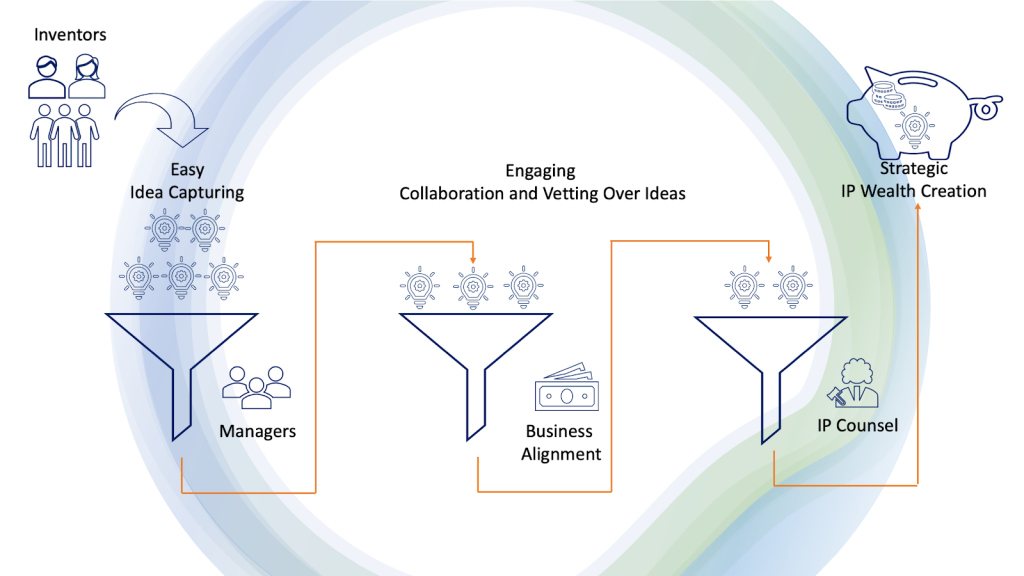
4. Look for a Tool That Manages the Full Idea Lifecycle, Not Just Capture (Idea to Patent)
A good idea needs more than a place to land. It needs to move through idea evaluation, development, and a real decision on what happens next, whether that means a shipped feature, a process change, or a patent filing.
A tool that only captures ideas leaves the hardest question unanswered: what happens after submission? For IP-focused teams specifically, that question gets sharper. Filing a single patent costs a minimum of $10,000, so deciding early whether an idea is even patent-worthy saves real money.
The right software carries an idea from submission through vetting to a final outcome on one platform. It should flag redundant ideas early and let subject matter experts weigh in before any drafting starts.
Full lifecycle management means no idea gets stuck between stages, regardless of where it ends up.
Below are the 10 factors to look for to leverage your idea management software in creating patents that are strategic business assets:
1. Minimizing the friction to share ideas/feedback/updates or anything related to the software.
2. A notification of idea submission to the collaborators for review.
3. A notification of feedback reception to innovator/inventor.
4. Patent Analytics driven Artificial Intelligence (AI) based review/rating on an idea from the software.
5. Redundancy indication from IP Counsel.
6. Inputs on making the claims stronger for a Patent from IP Counsel.
7. Update on an innovation from a business angle to all the collaborators.
8. Budget sanction notification for a successful innovation to be patented.
9. Patent draft available for review notification for all the stakeholders.
10. Inviting ideas to solve certain business challenges through innovation.
5. Check Whether the Software Actually Protects Your Ideas and Data
Your ideas are valuable long before they’re patented. IBM’s 2025 data breach report found intellectual property costs $178 per compromised record, more than standard customer data.
A breach doesn’t just cost money. It can compromise novelty before you ever file. Look for encryption, role-based permissions, and domain whitelisting as baseline requirements.
Ask who can see an idea at each stage, and who approved that access. If a vendor can’t answer clearly, that’s your answer.
6. Can You Prove the ROI of Your Idea Management Software?
Innovation spend is easy to justify in theory, harder in practice. McKinsey’s 2025 survey of over 1,000 companies found innovation ranked among the top three growth levers across nearly every industry. But that only helps if you can measure it internally too.
ROI looks different depending on where an idea lands. Sometimes it becomes a process change that cuts costs. Sometimes it ships as a product feature that drives new revenue. For IP-focused teams, sometimes it becomes a patent that protects market position. Good software tracks all three outcomes, not just one.
It should show how many ideas actually reached implementation, not just how many were submitted. It should connect ideas directly to the value they created, whatever form that took. If your tool can only show idea volume, you’re investing blind.
7. Make Sure the Software’s Pricing Model and Features Are Built to Grow With You
Remember the Canny example from earlier? That’s exactly what happens when pricing doesn’t scale with usage. A tool that looks affordable at 50 users can become unpredictable at 500. Ask how pricing changes as your idea volume grows, not just what it costs today.
Features need the same scrutiny. Software that stands still falls behind fast. Gartner projects that over 70% of independent software vendors will embed generative AI into their products by 2026, up from under 1% in 2023. A tool that hasn’t added meaningful features in two years is already behind.
Ask vendors two things before you commit. First, what happens to your bill as your team or idea volume grows. Second, how often they ship real feature updates, not just bug fixes. A platform that gets both right protects your investment as your needs change.
Here’s our short video walkthrough of how TIP Tool can be a suitable idea management software.
Pitfalls to Look Out For When Evaluating Idea Management Software
Even careful buyers make predictable mistakes. Most of these show up months after signing, not during the demo. Here’s what to watch for.
- Assuming every tool serves your specific use case. A voting-and-feedback tool and a full enterprise innovation platform solve different problems. Buying the wrong category wastes budget even if the software works exactly as advertised.
- Choosing based on the demo, not real usage. A polished sales demo hides friction that shows up on day one. 71% of projects fail because requirements were never clearly defined in the first place, not because the software itself was broken. Test with a real employee submitting a real idea before you commit, not just your evaluation team.
- Ignoring how pricing scales. A tool that looks affordable at 50 users can become unpredictable at 500, the same trap Canny customers hit when its pricing model changed in 2025. Ask what your bill looks like at double your current size, not just today’s price.
- Picking a tool that only captures ideas. Capture is the easy part. If a tool can’t carry an idea through evaluation and into a real outcome, you’ve bought a digital suggestion box, not a management system.
- Skipping security until after something goes wrong. Ideas are valuable before they’re ever finished. Waiting until a breach happens is the most expensive way to learn this.
- Not checking how often the vendor actually ships updates. A platform that hasn’t meaningfully changed in two years is already falling behind competitors that have.
Parting Thoughts
We hope that this article could give you pointers to make the right choice for idea management software.
If you’re ready to put these seven factors into practice, Triangle IP built the TIP Tool™ around exactly this checklist. Every idea starts with an invention disclosure form, and you can customize its fields to match how your team actually works, not a generic template. Once an idea is in, real-time collaboration keeps everyone on the same page. Comments, status changes, and feedback are visible the moment they happen, not after someone remembers to send an update.
Status itself lives on a simple drag-and-drop board, so anyone on the team can see where an idea stands without opening it individually. Role-based access means the right people see the right ideas at the right stage, nothing more, nothing less.
TIP ToolTM is one such software that Triangle IP is actively developing along the lines mentioned above. It promises smooth idea capturing, vetting, and lot more.
Try the TIP ToolTM for free or get a tailored demo for your company’s requirements.
Frequently Asked Questions
1. What Metrics Show that Idea Management Software is Actually Improving Innovation?
Think beyond counting ideas. The real indicators are how many ideas turn into patents or products, how fast they’re evaluated, and how many people across teams are actively contributing. If you see your idea-to-patent conversion rate rising, fewer redundant submissions, and quicker approvals, that’s real progress. A growing patent portfolio value also signals true innovation ROI.
2. How Do Real-Time Updates in Idea Management Software Integrate with Enterprise Tools?
The best systems don’t live in silos. Triangle IP’s TIP Tool, for instance, connects smoothly with CRM, PLM, and patent docketing platforms. So, when product teams update launch timelines or patent counsel logs a filing, everyone sees it instantly. No need to dig through emails or spreadsheets. The information just flows. This integration helps teams make faster, better-informed IP decisions.
Read more: Triangle IP – Docketing System Sync Update
3. What Security Measures Protect Sensitive Ideas in Cloud-Based Platforms?
When you’re dealing with early-stage innovations, security has to be airtight. Look for idea management tools that use data encryption, SSL/TLS protection, and role-based permissions so only approved users can access information. Domain whitelisting ensures collaborators are from trusted organisations. Essentially, it combines enterprise-grade protection with easy access for authorised users. So, your best ideas stay yours.
4. Is There a Framework to Evaluate Ideas Before Choosing Software?
Yes. Most reliable frameworks score ideas against consistent, defined criteria rather than gut feeling. Look for tools that let you weigh factors like feasibility, market demand, and potential ROI on the same scale for every submission. The seven factors covered in this article double as a framework for evaluating the software itself, not just the ideas inside it.
5. What Are the Core Pillars of Innovation Management?
Most innovation management programs rest on four pillars: idea capture, evaluation, implementation, and measurement. Idea management software typically covers the first two deeply and the third partially. The fourth, measurement, is where many tools fall short, which is why proving ROI is one of the seven factors worth evaluating closely.
6. Is There Free Idea Management Software Available?
Yes, several vendors offer free tiers, usually capped by user count or idea volume. Free plans work for small pilots but rarely include full lifecycle management, security controls, or ROI tracking. Treat a free tier as a way to test usability, not as a long-term solution for a growing idea program.
7. What Does an Idea Management Software Evaluation Actually Look Like in Practice?
In practice, it means testing a tool against real use, not just a sales demo. Have a non-technical employee submit a real idea. Check how status updates surface. Confirm pricing at double your current team size. The seven factors above are the checklist; running them against your own team is the actual evaluation.