| TL;DR – Patent costs don’t explode at filing. They build over time through a mix of predictable fees and unexpected prosecution expenses. Patent cost estimator tools exist to bring visibility to both before budgets spiral. In this article, we analyze six patent cost estimator tools including the TIP Tool™. Let’s see which ones truly support IP budgeting and decision-making. |
Filing a patent is only the opening move. What follows is a long tail of costs. Over its lifetime, a single U.S. patent can exceed $50,000, with costs spreading out over years.
Some costs are easy to plan for. Teams expect filing, examination, issuance, and maintenance fees. The real strain comes from unexpected costs. Prosecution delays, examiner pushback, and extra argument rounds surface mid-process. When this happens, IP teams are forced to rework budgets and justify spend after key decisions are already locked in.
Patent cost estimator software helps to bring clarity earlier. It surfaces both expected and hidden costs before budgets drift and options narrow.
In this article, we compare leading patent cost estimator tools, including the TIP Tool™ by Triangle IP. We examine what actually enables confident IP budgeting, starting with the questions teams should ask before choosing a tool.
Key Questions to Ask Before Choosing a Patent Cost Estimator Tool
Patent cost estimator tools often promise clarity. However, many deliver only surface-level numbers. When those numbers drive filing decisions, budget approvals, or portfolio cuts, shallow estimates can quietly turn into expensive mistakes.
This is why the real difference between cost estimators is not how they look. Instead, it lies in the questions they can answer. Taken together, the questions below separate tools that merely calculate from those that support real IP strategy, accurate budgeting, and risk-aware decision-making.
1. Does the Tool Estimate the True Cost of a Patent Across Its Lifecycle?
A patent cost estimator should reflect real-world spend from filing through prosecution, not just an initial filing fee. In other words, it should account for costs that surface well after filing.
To evaluate this, you can ask:
- Does it include USPTO government fees based on entity size?
- Can it account for attorney or prosecutor charges?
- Are downstream prosecution costs (office actions, RCEs, amendments) included?
2. Are the Cost Estimates Transparent and Explainable?
Even when an estimate looks comprehensive, it only becomes useful if you can explain and defend it. This is especially important when presenting numbers to management or inventors.
At this stage, you can ask:
- Can I see a clear breakdown of how the estimate is calculated?
- What inputs or assumptions drive higher or lower costs?
- Are the assumptions editable or fixed?
3. Can the Estimator Be Customized to Match My Organization?
Generic averages are rarely accurate. As a result, your estimator should reflect your legal, operational, and portfolio realities.
You can ask:
- Can I configure my entity size (micro, small, large)?
- Can I update attorney or law firm rates based on my agreements?
- Does customization apply at the portfolio or organization level?
4. Is Cost Estimation Connected to Patent Risk and Likelihood of Success?
On its own, cost tells only part of the story. To be truly meaningful, it must be evaluated alongside patentability, prosecution difficulty, and time to allowance.
Accordingly, you can ask:
- Does the tool link cost with patentability scores?
- Are art unit or examiner trends factored into cost predictions?
- Can I compare the cost against the predicted allowance probability?
5. Do Cost Estimates Update as the Application Progresses?
Patent costs evolve over time. For that reason, estimates should adjust as real prosecution data becomes available.
You can ask:
- Are estimates recalculated after filing or examiner assignment?
- Can I see both cost-to-date and predicted remaining cost?
- Do office actions or prosecution events impact the estimate?
6. Who Can View and Control Cost Information in the Tool?
As more stakeholders engage with cost data, access control becomes critical to avoid confusion or misalignment.
You can ask:
- Are cost settings restricted to admins?
- Can business users view high-level cost insights without editing rights?
- Is access controlled by role or portfolio?
7. Can the Tool Scale From Individual Ideas to Portfolio-Wide Budgeting?
What works for a single filing often breaks at scale. As portfolios grow, cost estimation must support forecasting and strategic planning at scale.
You can ask:
- Can I aggregate costs across multiple ideas or applications?
- Can costs be filtered by portfolio, tag, or business unit?
- Is cost data exportable for reporting and budget reviews?
8. Does the Estimator Support Decisions?
Ultimately, cost estimation only matters if it informs action. The best tools help you decide whether to file, continue, or abandon.
You can ask:
- Does the tool highlight cost-heavy, low-value cases?
- Is cost insight integrated into portfolio review workflows?
Use the Idea Evaluation Matrix below to compare ideas before committing a patent budget.
With these questions as a lens, let’s take a closer look at the patent cost estimator tools and how each one approaches cost prediction and IP budgeting.
6 Best Patent Cost Estimator Tools For IP Budgeting in 2026
Patent costs are shaped as much by time as by filings. First office actions often take close to 20 months. Longer prosecution leads to more examination rounds, higher outside-counsel fees, and recurring USPTO charges. Because of this, IP budgeting shifts from a one-time estimate to ongoing spend management.
Accordingly, the value of a patent cost estimator depends on how well it supports forecasting and spend governance. Some tools act as basic calculators. Others, however, account for prosecution dynamics and portfolio-level planning.
Below, we review six patent cost estimator tools commonly evaluated by IP teams when planning patent spend and managing outside counsel.
- The TIP Tool™ Cost Estimation
- Clarivate IP Cost Forecasting
- Anaqua Global IP Estimator
- Prokurio IP Forecaster
- Computer Packages (CPI) Patent Cost Estimator
- IP-Coster
Let’s start with the TIP Tool™, which approaches patent cost estimation as a budgeting and decision-support problem, not just a calculation exercise.
The TIP Tool™ Cost Estimation
The TIP Tool™ Cost Estimation capability helps organizations make informed IP investment decisions by predicting the true, long-term cost of pursuing a patent. Rather than relying on gut instinct or partial filing quotes, it provides data-driven visibility into expected government fees and attorney costs. Beyond upfront expenses, it also accounts for prosecution effort and long-term maintenance expenses over the life of a patent.
To achieve this, the TIP Tool™ combines historical USPTO data with examiner and art unit behavior. As a result, enterprises can build more accurate budgets before significant legal spend occurs.
This allows teams to prioritize inventions with the strongest balance of value, patentability, and cost efficiency. Ultimately, enterprises can allocate IP budgets strategically and avoid over-investing in low-probability or high-risk filings.

Here’s what Triangle IP’s founder, Thomas Franklin has to say on how companies can forecast their patent portfolio cost:
Key Features
The following features highlight how the TIP Tool™ approaches cost estimation across the entire patent lifecycle:
1. Customizable Cost Inputs (Admin-Controlled Cost Model)
The TIP Tool™ allows administrators to configure the core cost parameters used across the platform. Specifically, this includes USPTO government fees based on entity size and customizable prosecutor charges that reflect the organization’s actual law firm fee structure.
All cost inputs are managed centrally through the admin panel and are automatically applied across all ideas and applications.
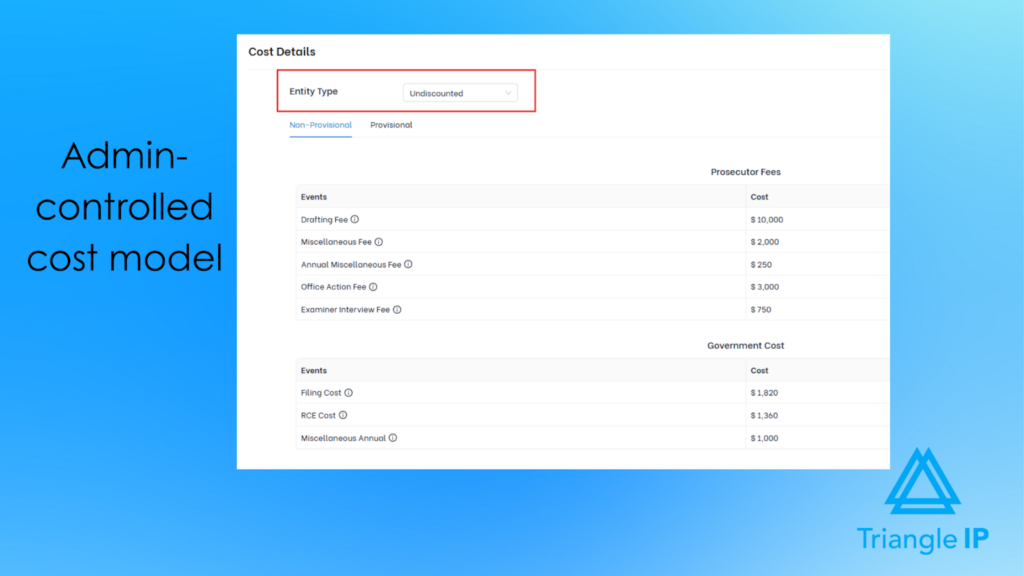
Why it matters: This ensures all cost estimates are grounded in real organizational economics rather than generic market averages. As a result, downstream predictions are more reliable and defensible for budgeting.
2. Indicative Cost Visibility at the Idea Stage
Once an idea summary is entered, TIP Tool™ shows indicative cost-related statistics alongside other predictive insights such as argument rounds, allowance rate, and time to allowance.
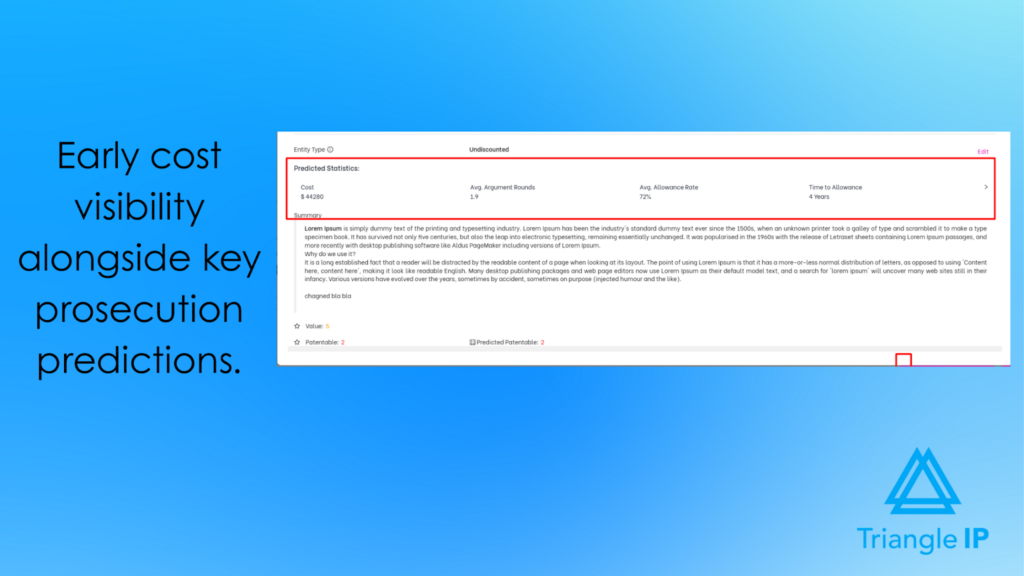
Use the Idea Summary Template to structure invention descriptions for clearer cost, risk, and prosecution predictions at the idea stage.
Why it matters: Teams gain early financial awareness before drafting or filing begins, enabling smarter screening of ideas when changes are still low-cost.
3. Application-Level Cost Breakdown
For each filed application, the Portfolio Manager displays:
- Detailed cost breakdown
- Visibility into the financial progress of the case
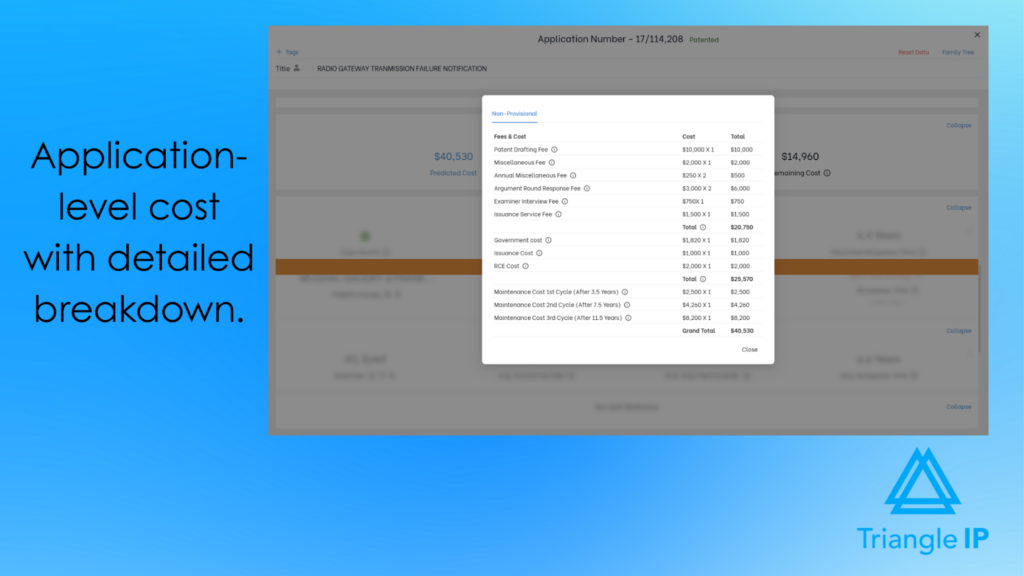
Why it matters: This provides per-application financial transparency, helping teams understand where budget is being consumed across the portfolio.
4. Next and Future Cost Prediction for Each Application
Beyond historical spend, TIP Tool™ shows predicted upcoming and future costs for each application based on prosecution progress and expected next steps.
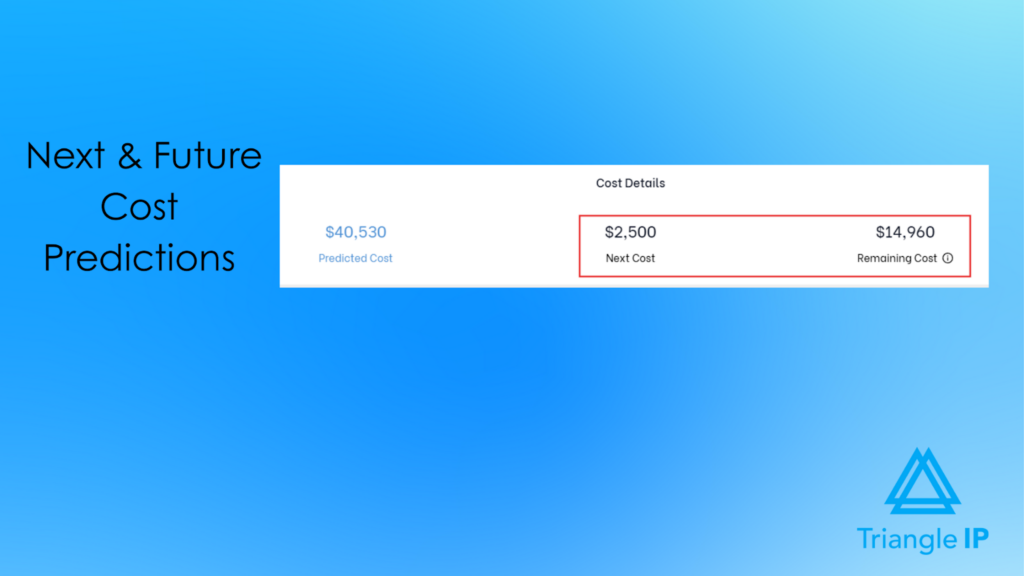
Why it matters: Organizations can anticipate future budget requirements and avoid surprise legal expenses, especially during prolonged prosecution.
5. Examiner Analytics–Driven Cost Insight
Examiner profiles reveal historical patterns such as allowance rates, average office actions, and time to grant, all of which influence prosecution effort and cost.
Check out the examiner statistics here.
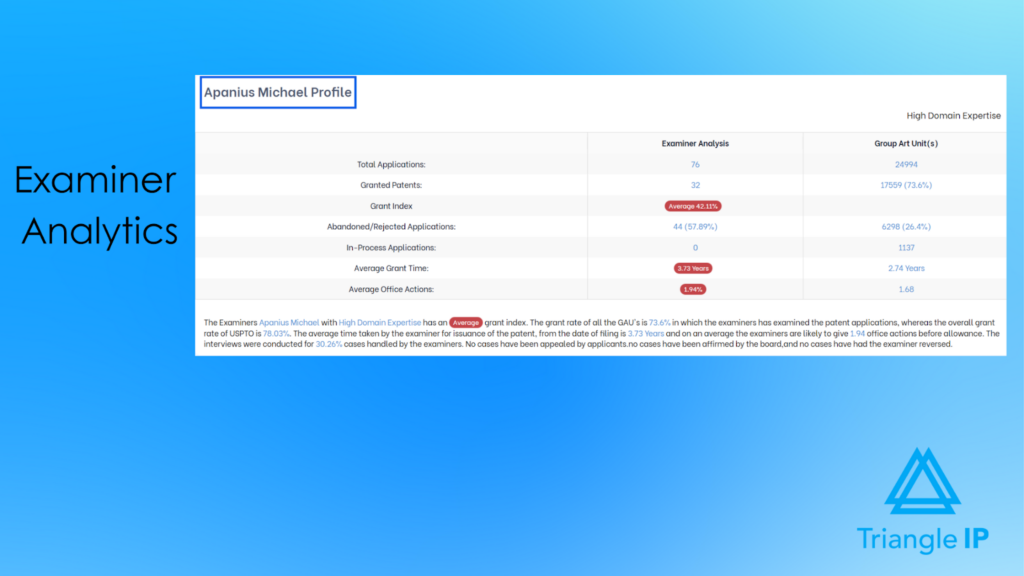
Why it matters: Understanding examiner behavior helps teams forecast cost escalation, decide when to continue prosecution, and plan legal strategy more efficiently.
6. Art Unit–Based Cost Risk Assessment
The Art Unit Predictor estimates where an application is likely to be assigned and provides historical allowance and delay data for those art units.
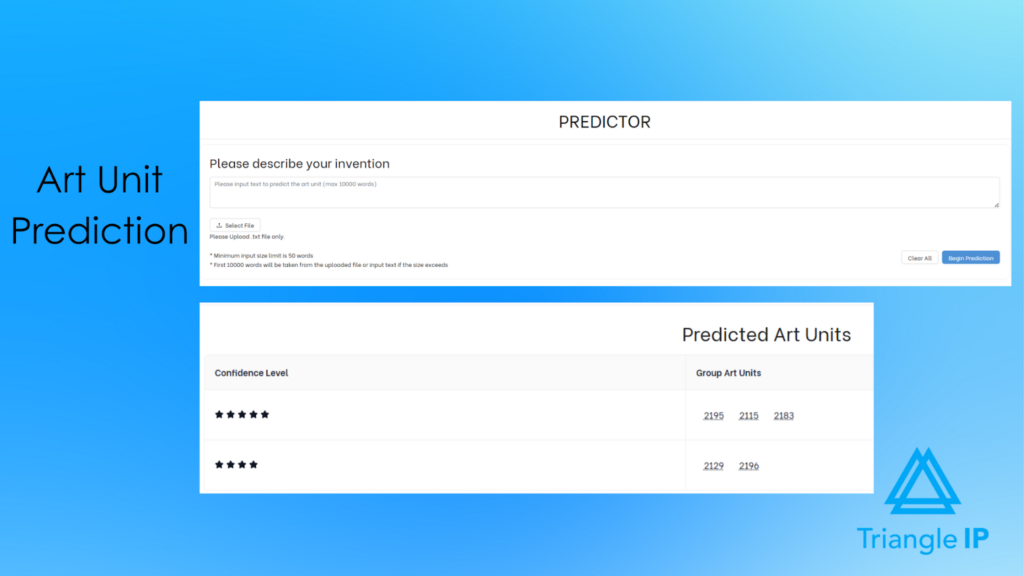
Why it matters: Since tougher art units often mean more rejections and higher legal spend, this insight helps reduce cost risk through informed drafting and filing strategy.
Explore the predictor here.
7. Cost Estimation Integrated with Docketing Data (Indirect Cost Control)
By syncing application status data from docketing systems into TIP Tool™, cost predictions and portfolio cost views remain aligned with real prosecution status.

Why it matters: Accurate, up-to-date status data improves cost forecasting and helps identify filings that may require additional investment or reevaluation.
To put these cost insights into context, the table below outlines typical patent cost components and estimated ranges across the patent lifecycle.

Also Read: How to Predict Software Patent Costs in 2026
Best For
- The TIP Tool™ patent cost estimation is well-suited for enterprises of all sizes that manage patent prosecution budgets and need ongoing cost visibility. It supports in-house IP teams, patent attorneys, and outside counsel by combining cost forecasting with prosecution-stage analytics.
Pricing
The TIP Tool™ provides patent cost visibility in both its free and paid versions.
For complete details, visit our full pricing page.
Clarivate IP Cost Forecasting
Clarivate IP Cost Forecasting (branded as Forecast) is part of Clarivate’s broader IP management software ecosystem. It focuses on helping organizations forecast, track, and manage IP spend at scale, with a strong emphasis on budget planning, approvals, and reporting.

Source: Clarivate-Forecast
Key Features
1. AI-Powered Budget Forecasting
Predictive models analyze historical IP spend to generate forward-looking budget forecasts that automatically update as new cost data arrives.
2. Actuals vs. Forecast Tracking
Dashboards compare real costs against projected budgets in real time, helping teams identify overruns early and adjust plans before budgets drift.
3. Scenario-Based Budget Planning
“What-if” scenarios allow teams to model the financial impact of decisions such as increasing filings, reallocating budgets, or shifting spend across business units.
4.Portfolio-Level Cost Transparency
Teams can view and filter costs by patent family, IP right, vendor, business unit, or jurisdiction, with drill-down access to individual records.
5.Integrated Budget Approval Workflows
Built-in workflows support review and approval of IP budgets and new expenditures, streamlining collaboration between IP, legal operations, and finance teams.
Best For
Clarivate IP Cost Forecasting is best suited for mid-to-large enterprises with established IP portfolios that need structured budget planning, spend tracking, and internal approvals.
Pricing
Clarivate IP Cost Forecasting is offered as part of Clarivate’s enterprise IP management solutions. Pricing is not disclosed on the website.
Anaqua Global IP Estimator
Anaqua Global IP Estimator is Anaqua’s standalone cost estimation solution that helps IP teams generate forward-looking IP cost estimates across jurisdictions. In practice, the tool is primarily used to forecast official fees and timeline-based costs across jurisdictions. As a result, teams gains clear visibility into how filing strategy and geographic scope shape long-term IP spend.

Source: Anaqua Homepage
Key Features
1. Worldwide Fee Coverage
Includes timelines and official IP fees for virtually every country, along with PCT and EPO routes, enabling accurate cross-border cost comparisons.
2. Multi-IP-Type Estimation
Supports patents, trademarks, designs, and utility models within the same estimation workflow.
3. Customizable Reports and Formats
Estimates can be exported in multiple formats and currencies, making them suitable for internal reviews and budget discussions.
4. Timeline-Based Cost Projections
Incorporates filing and prosecution timelines to help teams understand when costs are likely to occur, not just how much they may total.
5. Continuously Updated Fee Database
Official and associate fee data is updated regularly by Anaqua’s expert teams, reducing manual tracking effort for IP staff.
Best For
Anaqua Global IP Estimator is best suited for IP teams managing international filing strategies.
Pricing
Pricing is not disclosed on the website.
Prokurio IP Forecaster
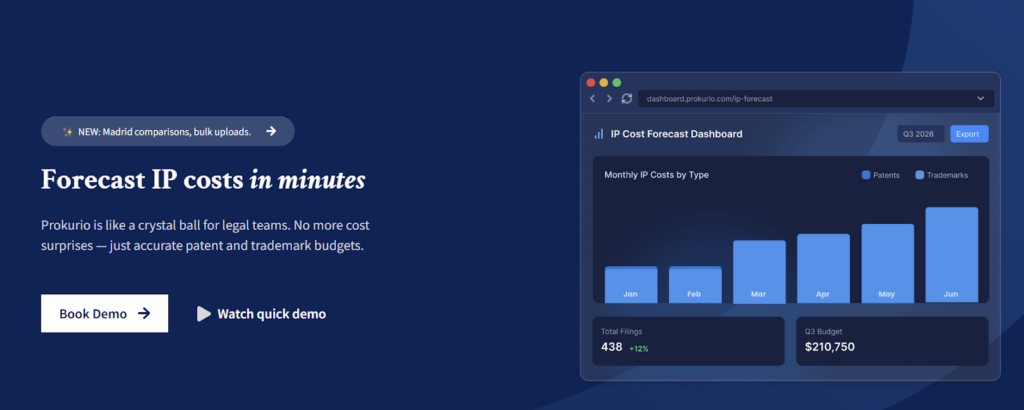
Prokurio IP Forecaster is Prokurio’s dedicated cost forecasting platform designed to generate detailed, jurisdiction-level IP cost forecasts across the full patent lifecycle. It supports patent, trademark, design, and recordal forecasting, with a strong focus on transparency, configurability, and exportable cost breakdowns.
Source: Prokurio Homepage
Key Features
1. Lifecycle-Based Cost Breakdown
Forecasts include detailed cost estimates for each phase of the patent lifecycle, with drill-down visibility by jurisdiction and stage.
2. Route Finder for Filing Strategy Comparison
When multiple filing routes are available, the Route Finder presents options ranked from least to most expensive, helping teams compare cost implications of different strategies.
3. Custom and Optional Fees
Users can toggle optional PTO fees, add ad-hoc dynamic fees, or apply custom law firm charges on a per-forecast basis.
4. Translation Cost Optimization
Built-in translation forecasting allows teams to preview translation costs by country, with support for custom translation provider rates where configured.
5. Reusable and Shareable Forecasts
Forecasts can be saved, duplicated, emailed, or exported (e.g., to Excel), enabling reuse across planning cycles and easy sharing with stakeholders.
Best For
Prokurio IP Forecaster is best suited for organizations that need structured, jurisdiction-aware patent cost forecasts.
Pricing
Prokurio offers tiered annual pricing with unlimited users and forecasts across all plans.
- Essentials – $10,000/year
- Advanced – $15,000/year
- Ultimate – $25,000/year
All plans include a free trial.
Computer Packages (CPI) Patent Cost Estimator
Computer Packages Inc. (CPI) offers a Patent Cost Estimator as an add-on to its Real-Time Patent Management System. The tool supports global patent budget planning by providing jurisdiction-specific cost estimates tied directly to CPI’s IP management workflows.

Source: Computer Packages Homepage
Key Features
1. Global jurisdiction-specific fee coverage
Provides country-by-country patent office fee data so cost estimates reflect local filing, prosecution, and maintenance requirements.
2. Inclusion of official fees, agent costs, and translation expenses
Combines government fees with typical agent and translation charges to present a more complete view of expected patent spend.
3. Unlimited estimates under a fixed-price license
Allows teams to generate as many cost forecasts as needed without per-estimate or usage-based fees.
4. Native integration with CPI’s IP management modules
Keeps cost estimates aligned with live portfolio and matter data inside CPI’s patent management system.
5. Role-based access controls and data security features
Restricts visibility and editing of cost data based on user roles while protecting sensitive budget information.
Best For
It is best suited for enterprises already using CPI’s IP management system that need reliable, centralized cost forecasting across global patent portfolios.
Pricing
Pricing is not disclosed on the website.
IP-Coster
IP-Coster is a global IP cost estimation and filing platform. It enables users to generate jurisdiction-specific patent cost estimates, obtain quotes, and directly initiate filings and maintenance services worldwide.
Unlike predictive cost forecasting tools, IP-Coster is built around fee quotation, budgeting, and execution, combining cost visibility with operational IP services.

Source: IP-Coster Homepage
Key Features
1. Jurisdiction-specific patent cost estimates
Generates country-level cost estimates based on selected filing routes and application details.
2. Inclusion of official fees, agent charges, and translation expenses
Combines government fees with local agent and translation costs to present a more complete upfront estimate.
3. Budget forecasts before and after filing
Allows teams to plan expected patent spend at both the pre-filing and post-filing stages.
4. Direct quote-to-filing and payment workflows
Enables users to move from cost estimation to filing and payment within the same platform.
5. Support for patent annuities, renewals, and maintenance budgeting
Provides cost visibility for long-term patent maintenance and renewal obligations across jurisdictions.
Best For
IP-Coster is best suited for organizations seeking upfront cost visibility and streamlined international filing execution. In particular, it is useful for startups, SMEs, and teams managing global filings without a dedicated IP management system.
Pricing
Pricing is not disclosed on the website.
Across these tools, one pattern becomes clear. Cost estimation is only useful when it informs real IP decisions. Tools that present costs in isolation may help with forecasting, but they fall short when teams want to decide on what to file, or where to stop spending.
Viewed through that lens, the TIP Tool™ approaches cost estimation as part of the IP workflow, not a separate calculation.
Why is the TIP Tool™ a Go-To Patent Cost Estimator for IP Budgeting?
Let’s be honest, if you don’t know what a patent is going to cost, every filing decision feels like a gamble. Teams either over-file and overspend, or hesitate and miss valuable protection.
The TIP Tool™ removes that uncertainty by putting cost estimation at the center of IP decision-making, not as an afterthought. Using real prosecution data, configurable fee assumptions, and live case progress, it shows what you are likely to spend. These insights apply before filing, during prosecution, and after grant—when cost visibility matters most.
That said, cost estimation is only one part of effective patent decision-making. Beyond forecasting spend, the TIP Tool™ supports earlier and more informed choices by helping teams:
- Capture ideas in the Idea Manager.
- Score ideas by value and patentability.
- Manage ideas, filings, and patents in one portfolio.
- Visualize relationships using patent family trees.
- Collaborate across inventors, managers, and IP teams.
If you need to estimate patent costs early, decide which ideas are worth filing, and manage spend across your portfolio, the TIP Tool™ gives you one place to do it, clearly and reliably.

Get started with the TIP Tool™ and take control of your patent budgeting.
Disclaimer: The information in this article/review is sourced from the internet and may not be entirely accurate or up-to-date. We recommend visiting the respective software websites for the most current and reliable information. The opinions expressed here are those of the author and may not reflect the views of Triangle IP. We are not liable for any consequences that may arise from relying on the information provided in this article/review.
FAQs
1. How Accurate Are Patent Cost Estimators When Prosecution Takes an Unexpected Turn, Such as Appeals, Interviews, or Claim Strategy Changes?
Patent prosecution is inherently unpredictable. Appeals, examiner interviews, additional office actions, and claim amendments can all alter cost trajectories. For this reason, tools like the TIP Tool™ do not claim to predict every event in advance. Instead, they improve accuracy by modeling likely prosecution effort using historical examiner behavior, art unit patterns, and typical argument rounds.
As prosecution progresses, the TIP Tool™ shifts from pure prediction to live financial visibility. Teams can see costs incurred to date, understand what stage the case is in, and view projected next and future costs based on where the application currently stands. As a result, teams can recalibrate budgets as unexpected events arise, rather than being surprised after costs have already been incurred.
Related Reading: How the TIP ToolTMEnables Enterprises to Maximize Patent Prosecution Efficiency?
2. Can Focusing Too Much on Cost Lead Teams to Reject Valuable Inventions??
Yes—when cost is viewed in isolation. High-value inventions often involve complex technology or crowded art units, which can drive higher prosecution effort and expense. If teams look only at predicted cost, these strategically important ideas can appear unattractive too early.
The TIP Tool™ reduces this risk by pairing cost estimates with Value and Patentability Scores. This ensures cost is evaluated in context, not as a standalone decision factor. Instead of asking, “Is this expensive?” teams can ask, “Is this cost justified by the strategic value of the invention?”
In practice, this approach helps prevent underinvestment in complex, high-impact inventions while still flagging cases where high cost is not supported by business value.
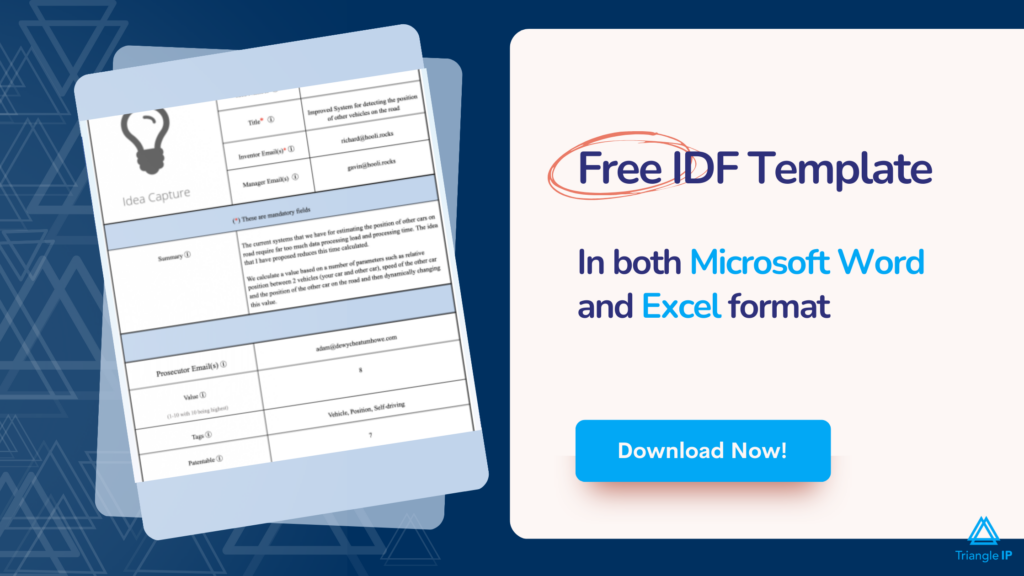
Use the Invention Disclosure Form below to document strategic value and technical complexity early, so high-impact ideas are not screened out by cost alone.
Related Reading: Patentability Assessment of Ideas: 6 Must-Ask Questions to Filter the Best Ideas for Patents
3. What Happens When Internal Cost Assumptions Change Mid-Prosecution, Such as Switching Law Firms or Renegotiating Fee Arrangements?
Cost assumptions are not static. Recognizing this reality, the TIP Tool™ is designed to adapt. At any time, admins can update prosecutor charges and other cost inputs in the Admin Panel. Once updated, these changes automatically flow into future cost predictions across the portfolio.
At the same time, historical costs remain intact, while forward-looking estimates reflect the new assumptions. As a result, teams can model the financial impact of operational changes with confidence, without losing visibility into what has already been spent.
Related Reading: How Much Does a Patent Cost? A Strategic Guide for SMEs