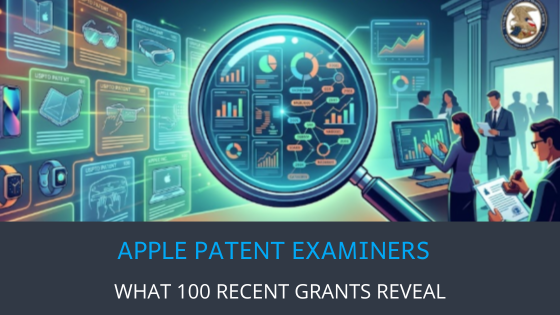
| TL;DR: We analyzed every USPTO examiner behind Apple’s 100 most recent patent grants (Q2 2026). Across 116 examiner assignments, allowance rates ranged from 4.9% to 93.8%. Examiner experience drove a 44-point gap. Apple’s cohort average (75.3%) matched the USPTO baseline (~77%), meaning even Apple gets the average draw. The technology domain mattered less than the individual examiner. Examiner interviews lifted allowance by 8 to 30 points; Post-RCE allowance rates ranged from 31.6% to 72.8% across three examiners. |
Patent approval at the USPTO is often described as a merit-based process. The data tells a different story.
We pulled the 100 most recent utility patents granted to Apple Inc. using the Google Patents Public Dataset on BigQuery. These 100 patents were granted in the second quarter of 2026. We looked up every examiner who decided on them. Sixteen of those patents were examined by two-person teams, giving us 116 examiner assignments across 100 patents.
We then ran each examiner through Triangle IP’s TIP database to surface their career allowance rate, current art unit, total applications examined, average grant time, and average office actions before allowance.
The picture that emerged is one corporate IP teams rarely see laid out this clearly. Even with Apple’s experienced prosecution counsel, examiner assignments varied immensely. The toughest examiner Apple drew, Chin Vivian C, has a career allowance rate of just 4.9%, while the most lenient, Soward Ida M, allows at 93.8%.
But these findings are just the tip of the iceberg. There is a lot more to this story, especially what it means for your IP strategy. Let’s dig in.
Is Patent Examiner Seniority Bad News?
For a moment, think back to school and college. The pattern was familiar: the more senior the examiner, the harder it was to crack their paper, whether it was a written test or a viva. Seniority meant tougher questions, sharper follow-ups, less patience for hand-waving.
Patent examiner data tells a different story.
We grouped the 116 examiner assignments behind Apple’s 100 patents into five experience buckets based on the total number of applications each examiner has handled throughout their career. The pattern was unambiguous.
| Examiner experience | Examiners in cohort | Average allowance rate |
| Under 250 applications | 9 | 44.7% |
| 250 to 500 applications | 15 | 66.6% |
| 500 to 1,000 applications | 53 | 75.9% |
| 1,000 to 2,000 applications | 31 | 83.8% |
| 2,000+ applications | 8 | 89.2% |
A junior examiner with fewer than 250 applications behind them allows at 44.7%. A veteran with more than 2,000 allows at 89.2%. That is a 44-point gap, driven purely by experience. The correlation between an examiner’s career application count and their allowance rate is +0.55, which is strong by any social science standard.
| “If your application lands with a junior examiner, the same patent has roughly half the chance of being allowed compared to landing with a veteran.” |
Veteran examiners may recognize genuine novelty faster, having seen more prior art across their careers. Newer examiners, still under productivity review themselves, may default to caution.
Either way, the moment an examiner’s name appears on the case is the moment prosecution strategy should be calibrated.
Apple Gets the Average Draw
Back to the school analogy. We expect top scorers to outperform the class average consistently.
So when we look at Apple, which has been granted more than 30,000 patents over the past five years, we expect the same. But that’s not the case.
The average allowance rate across the 116 examiner assignments behind Apple’s 100 patents is 75.3%. The USPTO baseline allowance rate, calculated on the same per-examiner basis, sits at around 77% (based on weighted analysis of USPTO examiner 3-year grant rates). Apple is filing into the same examiner distribution as everyone else. There is no easier draw waiting for them because of who they are.
This finding cuts against an assumption corporate IP teams quietly carry: that the biggest filers must be benefiting from some structural advantage at the USPTO. The data says no.
| “If your IP team is hitting a 75% allowance rate, you are matching Apple.” |
It’s Less About Technology. It’s More About the Examiner.
A common assumption among corporate IP teams is that certain technology areas are inherently harder to patent than others. Software is contested. Wearables face scrutiny. Hardware is easier. The technology heat map across Apple’s 100 patents tests that assumption.
| Domain | Examiner assignments | Avg allowance | Avg grant time | Avg OAs |
| Semiconductors / Circuits (2800s) | 23 | 82.9% | 2.4 yrs | 1.5 |
| Software / AI (2100s) | 12 | 75.1% | 2.9 yrs | 2.1 |
| Networking / Wireless (2400s) | 28 | 75.0% | 3.0 yrs | 1.9 |
| Display / Touch / Sensors (2600s) | 46 | 74.8% | 2.8 yrs | 1.8 |
| UI / Interaction (3600s) | 4 | 69.9% | 3.0 yrs | 2.1 |
| Mechanical / Wearables (3700s) | 3 | 35.7% | 3.4 yrs | 1.9 |
Four of the six domains cluster within a narrow 7-point band. Apple’s semiconductor patents sit at the top with an 82.9% allowance rate across 23 examiners. The big middle of the table, where 86 of Apple’s 116 examiner assignments live, runs between 74.8% and 75.1%. The technology doesn’t move the needle much across that middle.
The bottom row is the outlier worth examining. With just three examiners and an average allowance rate of 35.7%, mechanical and wearables look like the harshest examination environment in Apple’s cohort. The sample is admittedly thin, but the gap is wide enough to dig into. What we found reframes the entire story.
What looks like a technology problem is actually an examiner problem.
Both of Apple’s patents in this domain are health-tech wearables. US-12588825-B2 is an inflatable blood pressure cuff. US-12588830-B1 is a breath-sensing system. Both landed in USPTO art units 3791 and 3792, which examine surgical instruments, drug delivery systems, and biometric monitors. These are medical device art units, not consumer wearable art units. Apple’s health features pushed these filings into a different examination culture entirely.
We pulled the full Triangle IP profiles for the three examiners on these patents.
| Examiner | AU | Allowance rate | AU avg | Gap | % apps with final rej | % apps with RCE | % apps with interview |
| Cruickshank Destiny J | 3791 | 13.6% | 62% | -48 pts | 70.8% | 44.4% | 29.2% |
| Marmor, II Charles A | 3791 | 35.1% | 62% | -27 pts | 36.2% | 18.4% | 18.6% |
| Downey John R | 3792 | 61.2% | ~62% | 0 pts | 56.1% | 43.5% | 21.6% |
Note: RCE is Request for Continued Examination. Think of it like a student requesting a re-evaluation after failing an exam. Rather than abandoning the application, the applicant submits new arguments, amendments, or evidence to convince the examiner to reconsider.
Two of the three examiners are not just below the USPTO baseline. They are significantly below their own art unit’s average. AU 3791 itself allows at 62%. Cruickshank, working inside that same art unit, allows at 13.6%. Marmor allows at 35.1%. The variance isn’t structural to the art unit. It lives at the examiner level.
| “The variance that matters in patent prosecution doesn’t live between technology domains. It lives between individual examiners within those domains.” |
Interviews: What the Data Says Works
For each examiner, Triangle IP tracks how allowance rates change when the applicant requests an interview.
| Examiner | Interview lift | Strategy signal |
| Marmor | +29.7 pts (29.7% → 59.3%) | Interviewing is essential. Nearly doubles odds. |
| Downey | +19.9 pts (56.8% → 76.7%) | Interview gives strong lift. |
| Cruickshank | +8.2 pts (11.8% → 20.0%) | Interview helps modestly. Sample tiny. |
The pattern is consistent across all three examiners. Interviews work in medical device art units. For Marmor in particular, the effect is so large that not requesting an interview is leaving allowance odds on the table.
RCEs: Where Strategy Diverges
The RCE data tells a less uniform story. With one examiner, RCEs work. With another, they barely move the needle.
| Examiner | Post-RCE allow rate | Signal |
| Downey | 72.8% | RCE works well. |
| Cruickshank | 40.0% | RCE has limited effect. Small sample. |
| Marmor | 31.6% | RCE barely moves the needle. |
Filing an RCE with Marmor, based on his historical outcomes, rarely changes the result. His post-RCE allowance rate of 31.6% sits just below his baseline of 35.1%. With Downey, RCEs lift allowance above his baseline.
| “Same prosecution tool, opposite outcomes, driven entirely by which examiner is on the file.” |
Parting Thoughts
This analysis covered 100 patents from a two-week window in early 2026. The same exercise repeated across other major filers like Microsoft, Google, or Samsung would surface different examiner cohorts, different art unit clustering, and different prosecution strategies that work. The methodology is reproducible. The data is public. The corporate IP teams running this kind of analysis on their own portfolios are seeing patterns the rest of the industry is missing.
Frequently Asked Questions (FAQs)
When is Examiner Seniority Not Good News?
When a senior examiner shows a track record of rejecting nearly everything. Janice Mooneyham, for instance, holds a 1.64% allowance rate despite decades of experience. With such examiners, continuing to push the application often costs more than it returns. Abandonment or strategic refiling may be the wiser call.
When Two Examiners are Assigned to My Patent Application, What Should be My Prosecution Strategy?
Look up both examiners’ allowance rates and interview lift separately. The examiner with the lower allowance rate typically sets the prosecution risk. If their allowance rate sits 20% or more below the art unit average, interview early and lead with the strongest claim narrowing rather than broad arguments.
How Can I Steer Away from Tough Examiners Even Before My Patent Application Gets Assigned One?
Use Triangle IP’s Art Unit Predictor before filing. It forecasts which USPTO art unit your application will likely land in based on the technical language. By adjusting terminology and emphasizing technical depth, you can steer the application toward art units with higher allowance rates and avoid known restrictive examiners.
How Can Corporate IP Teams Create a Winning Patent Examiner Interview Strategy?
Match the situation to the examiner’s data profile. Compare their allowance rate to the art unit average, check their interview lift, and review which firms have succeeded with them. Read the full Patent Examiner Interview Playbook for Corporations for the four metrics that turn data into strategy.
What’s Triangle IP?
Triangle IP builds ideas, innovation, and patent management software for corporate IP teams. Standalone tools include the Patent Family Tree Generator, Art Unit Predictor, Examiner Analysis, and Prosecutor Analysis. The complete TIP Tool™ integrates idea capture, prosecution analytics, and portfolio tracking in one platform.