| TL;DR: Innovation managers struggle to collect ideas across the company and have a hard time figuring out which ideas actually matter. Moreover, filing gets messy when multiple teams need to jump in. In addition to that, not every innovation management software will perfectly fit your specific innovation workflow and organization. That’s why in this article we break down the criteria to evaluate the innovation tools and a curated list of 15 innovation management software for different use cases. So you can pick the right innovation tool that fits your workflow and not the other way around. |
If you manage innovation, you’ve likely faced it first-hand: too many innovative ideas, not enough clarity. Submissions pile up across tools and emails, reviews drag on, and valuable concepts lose momentum before they become patents or products.
Two problems are probably sitting underneath most of that friction for you. Your R&D, legal, and business teams likely work in separate systems. If you’re coordinating across regions and time zones, cross-functional collaboration keeps breaking down. Once your ideas do move forward, you probably can’t reliably track the return on that investment, which makes it hard to prove which initiatives are actually worth your budget.
Both are cited as leading barriers to effective innovation management by MarketsandMarkets. This research also estimates the innovation management software market at USD 2.98 billion in 2025, growing to USD 5.38 billion by 2030.
If you’re facing either of these issues, that’s exactly why you should invest in the right innovation management software.
The right innovation tool gives your ideas a real path to becoming patents, products, or shipped features. Moreover, it gives you a way to track the ROI behind that entire journey, not just guess at it.
Seven Key Questions You Should Ask Before Choosing an Innovation Management Software
An innovation management platform may look impressive during a vendor demonstration. Yet problems often appear after employees and decision-makers begin using it.
59% of global businesses regret at least one software purchase made in the past 18 months, per Capterra’s 2025 Tech Trends Survey. Poor choices can create adoption, integration, cost, and performance problems.
Before committing, evaluate these 7 criteria for the innovation tool:
1. Does the Innovation Management Software Fit Your Workflow?
Every organisation manages innovation differently. Your software should support your process, team size, and innovation goals.
An enterprise may need complex approvals, multiple business units, and advanced reporting. A smaller company may need simpler workflows, faster setup, and fewer administrative controls.
Your required innovation lifecycle may also differ. Some teams need support from idea capture through patent portfolio management. Product teams may need ideas to move into development, testing, and feature deployment.
Other teams may need only idea evaluation, collaboration, or pipeline visibility.
Choose software that fits your workflow, rather than reshaping your workflow around it.
- Which lifecycle stages must the software support?
- Do you need idea capture, evaluation, product delivery, patent filing, or complete lifecycle management?
- Does the platform suit your team size and organisational complexity?
- Check its support for multiple teams, regions, approval levels, and user roles.
- Can you configure it around your existing workflow?
- Review whether the stages, forms, permissions, and alerts align with your established process.
Once workflow fit is clear, consider whether employees will actually use the platform.
2. Is Idea Submission Easy Enough for Employees to Actually Participate?
Employees will not submit ideas if the process feels like additional administrative work. The form should capture enough detail without demanding a complete business case.
For IP teams and patent practitioners, an idea submission may later become a formal invention disclosure. However, employees should still be able to capture early or incomplete concepts easily.
Evaluate the submission experience of the innovation tool using these questions:
- Can employees save unfinished ideas privately and complete them when ready?
- Does the form request only the information needed at that particular stage?
- Can employees add relevant product, technology, team, or business-unit tags immediately?
- Can the platform suggest categories or automatically tag submissions using their content?
The platform should also support files, links, images, and collaborator details. A frictionless process captures ideas before employees forget or abandon them. Moreover, it increases the participation of employees in the innovation program.
Once ideas enter the system, teams must avoid repeatedly exploring the same opportunities.
3. Can It Prevent Duplicate Work and Preserve Organisational Knowledge?
Large organisations often receive similar ideas from different teams, regions, or business units.
The platform should detect related submissions and make previous work easy to find. It should preserve research, evaluations, decisions, attachments, and lessons around each idea.
For IP teams, this history can support early prior-art and patentability assessment discussions. However, it should not replace a professional prior-art search.
For product teams, it can reveal previous experiments, proposals, and rejected features. Operational teams can discover existing solutions before repeating the same investigation.
So verify the following before committing to the innovation management software:
- Can the platform flag duplicate or closely related ideas during submission?
- Does it record why ideas were approved, rejected, paused, or reconsidered?
- Can employees search previous ideas, attachments, comments, and evaluation decisions?
- Can reviewers merge related ideas while preserving contributors and original records?
4. Does the Innovation Management Software Support Real-time Collaboration, Ownership, and Accountability?
Innovation usually requires real-time collaboration from employees, reviewers, business leaders, technical experts, and legal teams. The innovation tool should allow them to collaborate without losing control over responsibilities or confidential information.
- Can internal teams comment, edit, review, and share supporting files in real time?
- Can you assign clear owners, reviewers, deadlines, and approval responsibilities?
- Does the platform record decisions, changes, and pending actions?
- Can external collaborators receive limited access to selected ideas or projects?
5. Is Your Innovation and Intellectual Property Data Actually Secure?
Innovation platforms may store unpublished inventions, technical documents, product plans, financial estimates, and confidential discussions. Basic password protection is not enough for such sensitive information.
Review encryption, role-based permissions, audit logs, data residency, backups, and recognised security certifications. You should also understand how the platform uses artificial intelligence.
Some tools use AI to summarise, categorise, score, or compare ideas. Confirm whether your information is shared with external AI providers or used to train models.
Ask the vendor:
- Is data encrypted during transfer and while stored?
- Can access be restricted by role, project, team, or business unit?
- Is customer information used to train shared AI models?
- Can you export and permanently delete your data when required?
6. Can You Operate and Maintain the Platform Without Constant Vendor Support?
A highly configurable platform can become expensive and difficult to manage. Your team should not need vendor assistance for every form, workflow, report, or permission change.
Check how long setup takes and who must manage the platform internally. Review whether administrators can update workflows, users, fields, dashboards, and evaluation criteria without coding.
Integrations also matter. The software should connect with collaboration, project management, identity, reporting, and IP systems without requiring repeated manual work.
Evaluate these practical questions:
- Can internal administrators configure workflows without coding or vendor assistance?
- How much training is required for administrators and everyday users?
- Does it integrate with the systems your teams already use?
- What additional costs apply to setup, migration, integrations, training, and support?
Before committing, ask the vendor to demonstrate your actual innovation workflow. A scripted use case will reveal more than a standard product presentation.
7. Can You Measure Innovation Performance and ROI Through the Innovation Tool?
Tracking idea volumes alone does not show whether your innovation program creates value. The platform should connect activities with outcomes and show where ideas generate measurable impact.
Look for visibility across submission, evaluation, approval, implementation, and completion. Dashboards should reveal bottlenecks, participation levels, cycle times, and conversion rates.
However, the required outcomes will depend on your innovation program.
Before committing, ask the vendor to demonstrate your actual innovation workflow. A scripted use case will reveal more than a standard product presentation.
A Quick Comparison of Top 15 Innovation Management Software
| Software | Best For | User or G2 Rating | Free Plan / Tier | Starting Price |
| TIP Tool™ | Corporate IP teams managing invention disclosures, patent evaluation, filing, and prosecution | 4.9/5 | Yes. Free forever for up to 10 users | $50/month or $495/year for Premium |
| Qmarkets | Mid-sized and large enterprises running complex innovation funnels, crowdsourcing, technology scouting, and portfolio programs | 4.5/5 | No free tier publicly listed | Pricing uses an annual licence and setup fee |
| IdeaScale | Enterprises, governments, universities, and communities collecting and evaluating ideas at scale | 4.5/5 | A free subscription is referenced, but current limits are not published | Custom subscriptions based on features and scope |
| HYPE Innovation | Large enterprises connecting innovation strategy, foresight, ideation, external partnerships, and execution | 4.8/5 | No free tier publicly listed | Pricing is customised after consultation. Based on third-party sources, the pricing is $16,000/year. |
| Brightidea | Enterprise innovation programs, employee ideation, hackathons, challenges, and innovation labs | 4.3/5 | No confirmed permanent free tier. Free trials are available for products such as Idea Box | Not publicly available |
| ITONICS | R&D, corporate foresight, strategy, technology scouting, roadmapping, and innovation portfolio teams | 4.4/5 | No permanent free tier. 30-day free trial available | Not publicly available. Team, Professional, and Enterprise plans require a quote |
| InnovationCast | Organisations running structured innovation communities, challenges, idea evaluation, and implementation programs | No G2 rating yet. | No free tier publicly listed | $2,999/month for Standard |
| Ideanote | Small teams and enterprises seeking accessible, AI-supported idea collection, evaluation, automation, and reporting | 4.7/5 | Yes. Free forever for up to 10 users | $6 per user/month, billed yearly |
| Traction Technology | Enterprise innovation teams managing technology scouting, vendors, startup relationships, pilots, and innovation portfolios | 4.5/5 | No full-platform free tier publicly listed | $4,000/year per Standard seat |
| Planview IdeaPlace | Large enterprises crowdsourcing ideas and connecting selected opportunities with project and portfolio execution. | 4.0/5 | No free tier publicly listed | Not available on their website |
| KaiNexus | Lean, Kaizen, operational excellence, quality improvement, and continuous improvement programs | 4.9/5 | No free tier publicly listed | Pricing is customised by users, workflows, add-ons, and services |
| Braineet | Enterprises managing ideas, product development, innovation projects, and project portfolios | 5.0/5 | No permanent free tier. 14-day free trial available after an onboarding call | €2,000/user/year |
| Sideways 6 | Employee-led innovation programs using Microsoft Teams, intranets, and frontline idea capture | 4.4/5 | Yes. Free for up to 10 users | $3 per user/month for 11–500 users |
| Ideawake | Mid-sized and large organisations running innovation challenges, continuous improvement, hackathons, and ROI-focused programs. | 4.6/5 | No permanent free tier publicly listed | $500/month for Flex licensing. Support packages start at $250/month |
| Wazoku | Large enterprises running challenge-driven, open, employee, and ecosystem innovation programs | 4.4/5 | No free tier publicly listed | Custom quote |
A quick comparison is a starting point for shortlisting innovation management software that fits your workflow.
However, a deep dive into each innovation tool will give you a full picture of the strengths, limitations, and real-world results behind each one.
Fifteen Best Innovation Management Software For Different Innovation Workflows
Not every platform on this list solves the same problem. Some are built for enterprise-wide innovation management, and other carries ideas all the way through patent prosecution.
Here are the 15 innovation tools worth evaluating:
- TIP Tool™
- Qmarkets
- IdeaScale
- HYPE Innovation
- Brightidea
- ITONICS
- InnovationCast
- Ideanote
- Traction Technology
- Planview IdeaPlace
- KaiNexus
- Braineet
- Sideways 6
- Ideawake
- Wazoku
Let’s start with the TIP Tool™.
1. TIP Tool™
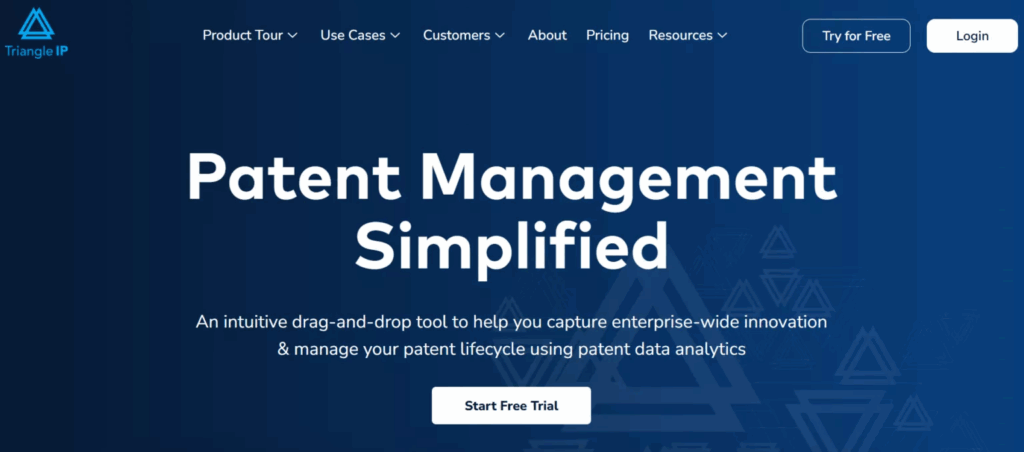
The TIP Tool™ by Triangle IP gives innovation managers complete visibility across the entire ideas-to-patents pipeline. It brings every team member and data-backed insight together to guide strategic decisions in patent prosecution.
Thomas Franklin, a patent attorney with over 25 years of experience, founded the TIP Tool™. It reflects real challenges innovation managers face driving enterprise IP success.
Key Features of the TIP Tool™ for Innovation Management
- A Simple, Customizable Invention Disclosure Form
The idea capture form is short and intuitive by default, just title, summary, and inventors, so it doesn’t intimidate non-IP employees. Admins can customize it with additional fields to match how your organization actually works. This makes it easy for teams across the company to participate in ideation.
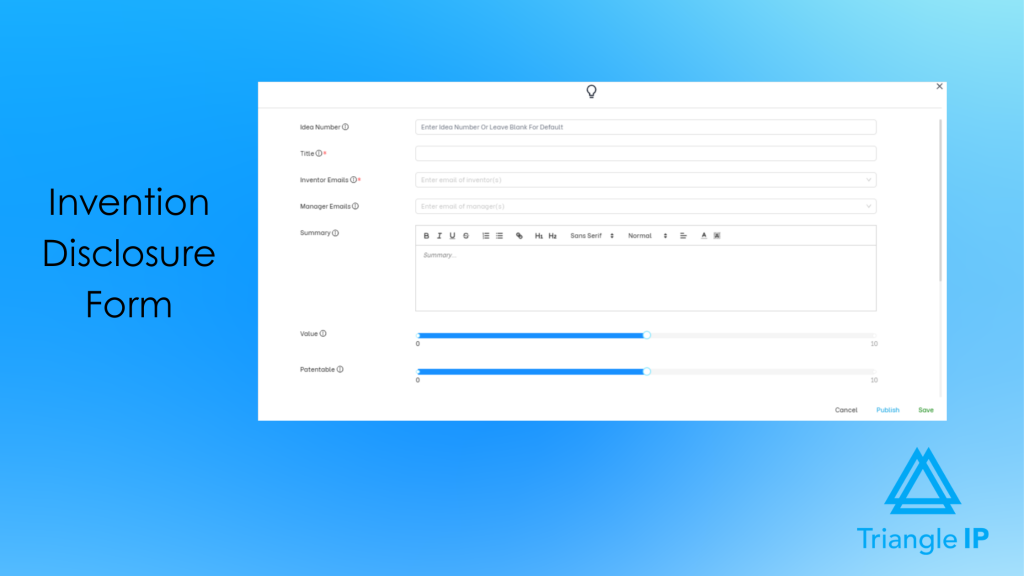
- Save Privately, Publish When Ready
Ideas don’t have to be fully formed to get started. Contributors can save an idea as a private draft, refine it over time, and publish it only when it’s ready for wider review, keeping half-finished thoughts from cluttering the shared pipeline. - Real-Time Collaboration and Summary
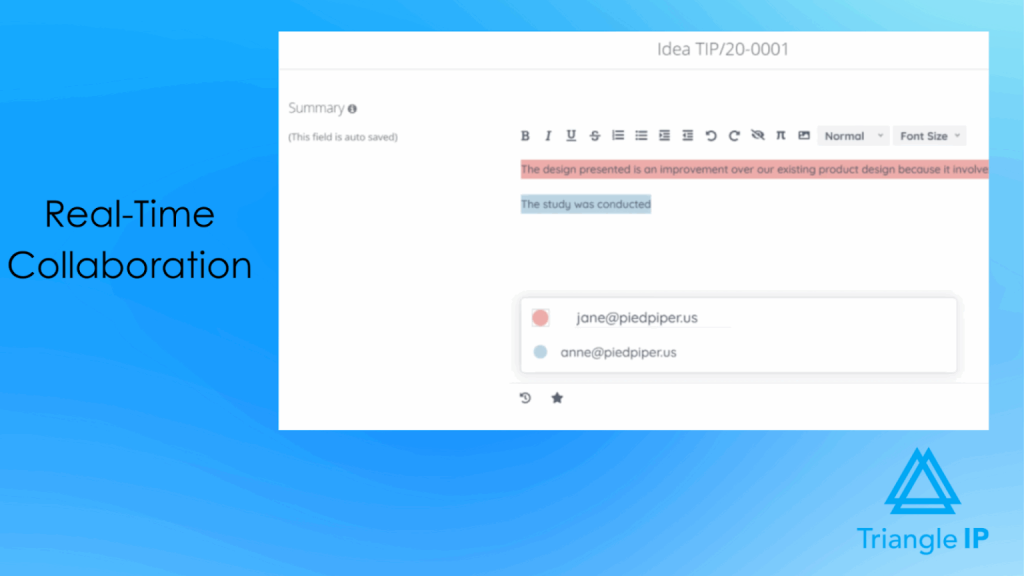
Once published, inventors, managers, and reviewers can comment, edit, and refine an idea together in real time, similar to co-editing a shared document. A structured summary keeps the core of the idea clear as multiple people contribute to it.
- Objective Evaluation Through Value and Patentability Scoring
Stakeholders score each idea using a structured evaluation matrix, covering business value and patentability, so decisions about which ideas to pursue are based on consistent criteria, not individual opinion.
- Portfolio-Level Pipeline Visibility
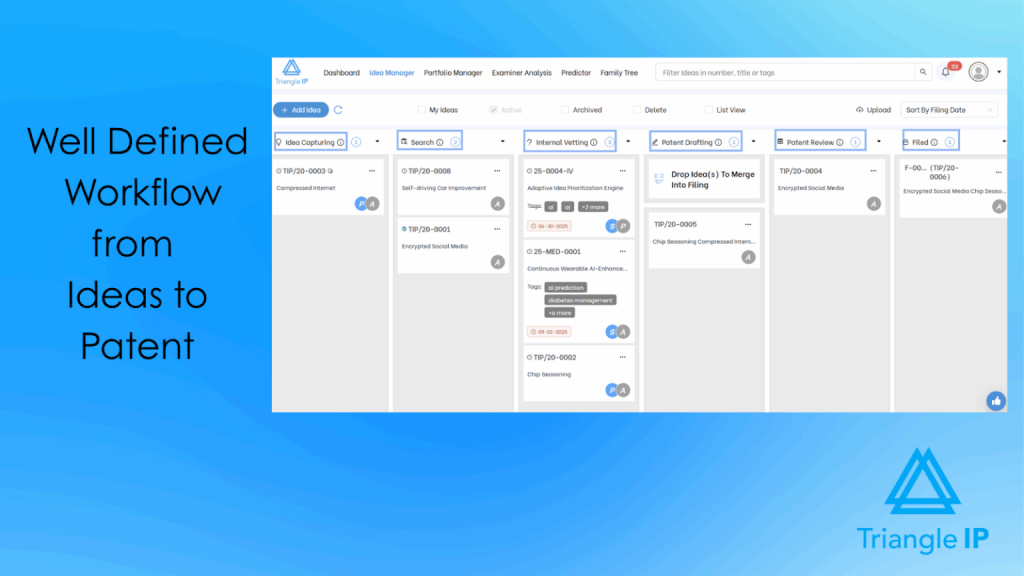
Every idea moves through visible stages: Capture, Search, Internal Vetting, Drafting, Review, so leadership can see where the whole innovation program stands at a glance, not just the status of one idea.
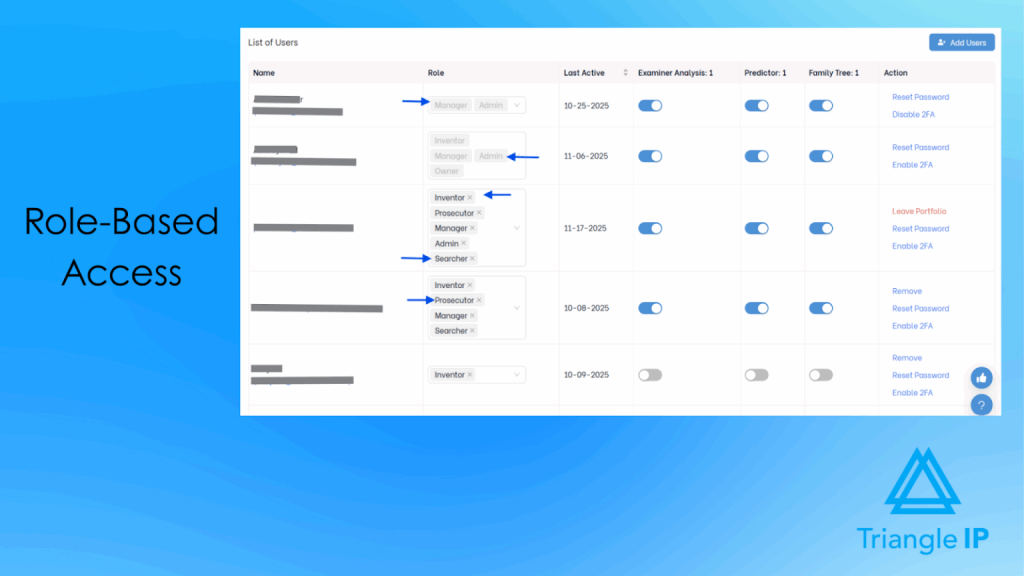
- Role-based Access: It ensures that each user sees only what they need. Inventors can submit ideas, reviewers can evaluate disclosures, patent counsels can check IP potential, and innovation managers can oversee portfolios. This keeps collaboration secure and focused.
Integrations
- Supports manual data control and bulk migration using Excel and CSV when needed, independent of a docketing system connection.
- For IP teams, it is worth noting that the TIP Tool™ automatically fetches status updates directly from the USPTO, no manual checking required.
Best For:
The TIP Tool™ is ideal for enterprises, particularly mid-to-large organizations that actively file patents and manage extensive Intellectual Property portfolios.
Pricing:
TIP Tool™ offers tiered pricing plans and a custom plan for large organisations.
- Free Plan: free forever, up to 10 users, 5GB storage, one portfolio.
- Premium Plan: $50/month or $495/year, up to 100 users, 20GB storage, three portfolios.
- Custom Plan: flexible limits for large enterprises with advanced requirements.
In addition to that, you can access the standalone add-ons:
- Examiner Analysis and Art Unit Predictor at $5/user/month each
- Patent Family Tree Generator free with a personal tool purchase or $1/user/month organisation-wide (10-user minimum)
- Prosecutor Analysis at $500/user/year.
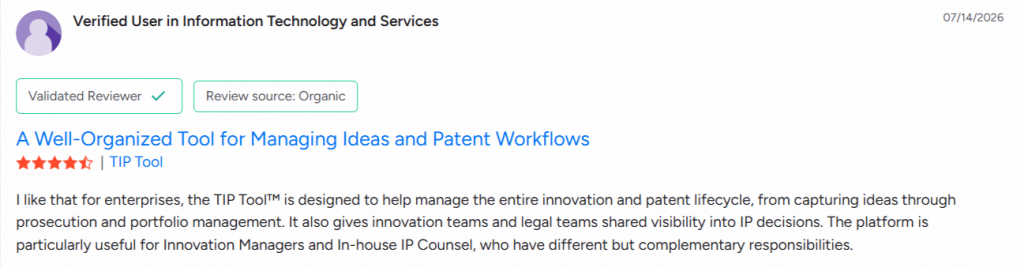
User Reviews
Source: G2
Strengths
- Very easy to adopt; reviewers say teams were up and running quickly.
- Centralized and secure innovation storage, with password-free access using Microsoft SSO login.
- You can use the tool to cover the entire innovation process from invention disclosure, idea organization, to patent filing and patent portfolio management.
- Reviewers call out the availability of a robust free plan as a plus for smaller teams.
- Importing or configuring tags to match your internal product lines, technologies, or business units for consistent categorization.
Limitations
Occasional learning curve for structured IP workflows: Users unfamiliar with formal IP processes may need time and documentation to get fully comfortable. However, a dedicated knowledge base and detailed videos explain every process and feature in the tool.
What Customers Gained from the TIP Tool™
A leading Silicon Valley tech company was losing valuable ideas to disorganized tools and manual tracking. Innovation slowed, and promising concepts were slipping away.
After adopting the TIP Tool™, the company streamlined idea capture, improved collaboration, and gained real-time visibility into its patent pipeline.
The results:
- 30% more idea submissions across departments
- 95% of top ideas advanced for patenting
- 25% faster filings through automation
- 20% higher success rate with data-driven decisions
Demo and Free Trial
Sign up for an interactive demo of the TIP Tool™ and explore its features first-hand. The demo playground comes with pre-filled data, allowing you to easily navigate and experience how the tool works in action.
You can also sign up for a free trial.
2. Qmarkets
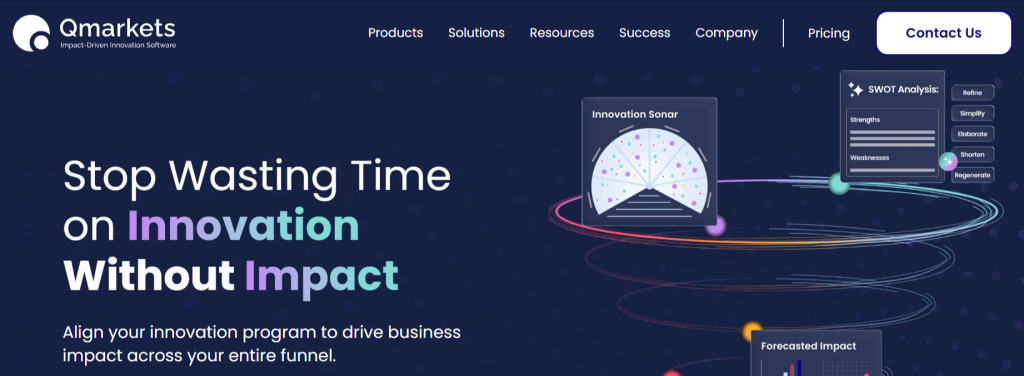
If your innovation program spans multiple regions, business units, or thousands of employees, and leadership keeps asking what it’s actually returning, Qmarkets is built to answer that question directly, tracking ROI across an entire portfolio, not just individual ideas.
Source: Qmarkets Homepage
Key Features of Qmarkets for Innovation Management
- Technology and trend scouting (Q-trend): Surfaces emerging technologies and market shifts to inform which ideas get prioritized.
- External innovation hub (Q-scout): Connects internal programs to a global network of external innovators for open innovation or hackathon-style initiatives.
- Portfolio-level ROI tracking (Q-impact): Manages the full project lifecycle after approval, tracking bottom-line impact across an entire portfolio, not a single initiative.
- Multi-region, multi-language deployment: Supports localization across 20+ languages with enterprise-grade permissions for organizations coordinating innovation across countries and business units.
Integrations
Microsoft 365, Salesforce, and SharePoint. SSO via SAML, Kerberos, or Google Workspace. A secured web services API for custom data sync. It directly integrates with Wellspring for external research and trend content.
Best For
Qmarkets’ capabilities are suited for Large and mid-sized organizations running structured, enterprise-scale innovation programs.
Pricing
Qmarkets pricing uses an annual license plus a setup fee, scaled to organization size and modules selected.
User Reviews

Source: G2
Strengths
- Highly customizable and scalable for complex innovation workflows.
- Strong automation and reporting features.
- Excellent customer support and onboarding.
- Robust backend and integration capabilities.
Limitations
- Steep learning curve and time-consuming setup.
- Some admin functions rely on support.
- Occasional bugs or translation issues post-updates.
What Customers Gained from Qmarkets
ICL, a global specialty minerals company, used Qmarkets to power its “BIG” Internal Innovation Accelerator, reporting a forecasted ROI of over $1 billion from ideas surfaced and tracked through the platform.
Demo and Free Trial
A demo is available directly through Qmarkets’ website; no self-serve free trial is offered.
3. IdeaScale
If you need to crowdsource innovative ideas from a large, distributed community of thousands of employees, customers, or even the public. IdeaScale is built specifically for that scale.

Source: IdeaScale Homepage
Key Features of IdeaScale for Innovation Management
- Portfolio-level outcomes dashboard: Tracks incoming ideas and opportunities across an entire innovation portfolio, with PowerBI-powered reporting for benchmarking performance over time.
- Value and cost estimation tools: A built-in proposal builder estimates value and cost for ideas moving toward implementation, supporting portfolio-level prioritization decisions.
- Global, multilingual community management: Cloud-based translation lets multinational teams participate in the same innovation program in their own language.
- Configurable stage-gating: Ideas move through admin-defined approval stages. It also supports complex, multi-step innovation governance rather than a simple submit-and-vote flow.
Integrations
IdeaScale integrates with Slack, Trello, and Yammer for team collaboration. Facebook, LinkedIn, and Google Analytics for public-facing campaigns. API access and Power BI for custom reporting and data export.
Best For
As per GetApp’s data, IdeaScale is best for Large enterprises, government agencies, and academic institutions running innovation programs at scale. IdeaScale’s client roster includes NASA, McKinsey & Co., Ford, and Pfizer.
Pricing
IdeaScale does not list per-user pricing; plans scale by feature access and program size. However, third-party sources like TrustRadius show four pricing plans for IdeaScale.
- Engage $12,999/year
- Evolve $21,999/year
- Advance $34,999/year
- Transform $64,999/year
User Reviews
Source: G2
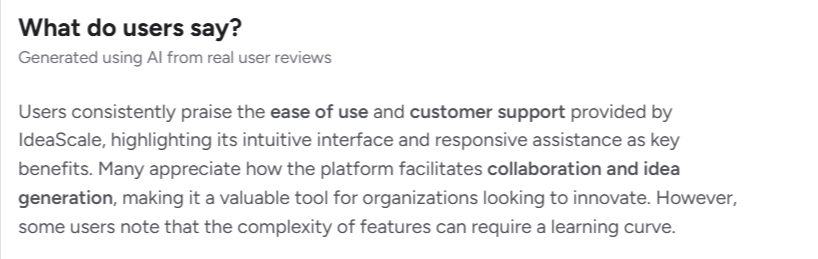
Strengths
- Customizable workflows that adapt to different innovation needs.
- Responsive and knowledgeable customer support team.
- Strong engagement features like voting and commenting.
- Multilingual support suited to global programs.
Limitations
- Feature richness and flexible configuration can overwhelm new users without proper onboarding support.
- Slight learning curve for new administrators given the depth of configuration options.
What Customers Gained from IdeaScale
Amway used IdeaScale to launch The Voice, a global crowdsourcing platform connecting over 3 million Amway Business Owners across 100 countries. With support for 12 languages, they achieved 88% market participation.
Demo and Free Trial
A demo is available on request, and sources indicate a free trial is offered, though exact trial limits aren’t publicly detailed.
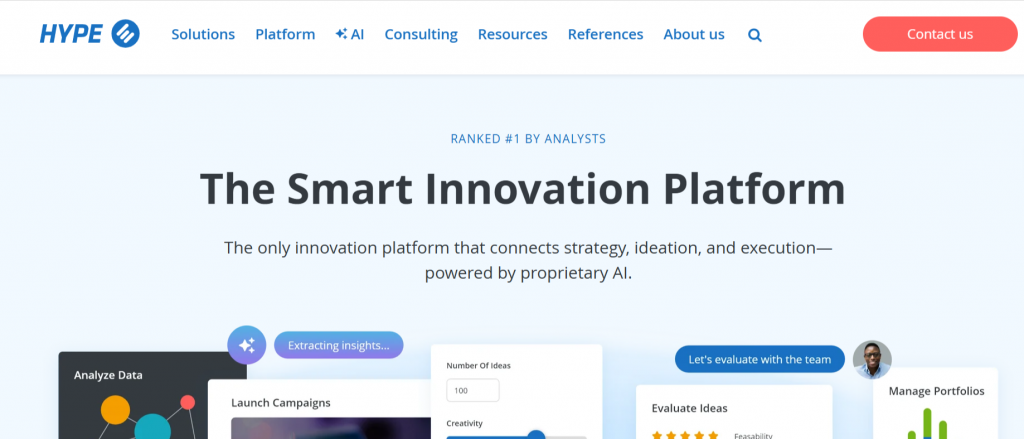
4. HYPE Innovation
HYPE Innovation is built for large organizations. It works well if you manage innovation across multiple business units, internal teams, and external partners. It brings strategy, trend scouting, and execution together in one system. It is designed to handle complex innovation programs at scale.
Source: HYPE Innovation Homepage
Key Features of HYPE Innovation for Innovation Management
- Trends module: You can monitor and analyze market developments to inform strategic direction, not just individual idea scoring.
- Partnering module: Identifies and manages collaboration with universities, startups, and corporate partners, extending innovation beyond internal walls.
- Projects module: Tracks and validates ideas as they move into full innovation portfolios, with real-time analytics on outcomes across the whole program.
Integrations
Microsoft Teams and SharePoint for daily collaboration. An open, universal API with REST support and plugin options for custom enterprise connections.
Best For
HYPE Innovation is built for large enterprises running multiple innovation types with dedicated teams.
Pricing
The pricing details are not available on their website. However, third-party estimates put enterprise deals around $16,000 per year.
User Reviews
Source: G2
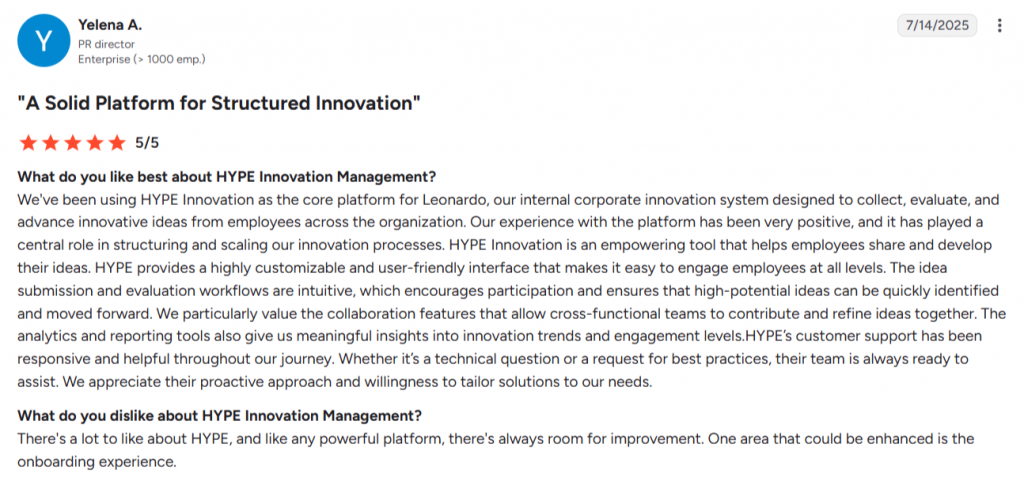
Strengths
- Highly user-friendly and easy to navigate for both admins and end users.
- Strong customization and scalability for enterprise needs.
- Outstanding customer support and proactive consulting services.
- Robust AI-powered analytics and reporting tools.
Limitations
- Pricing tied to user count may limit flexibility for larger organizations.
- Complex setup for self-administered configurations.
- Some users mention limited ROI tracking and a need for more advanced project analytics.
What Customers Gained from HYPE Innovation
Fujitsu’s European division launched Activ8, a co-innovation program connecting clients with Fujitsu experts through structured ideation and prototyping. The initiative generated £25 million in direct revenue, a 10x ROI, and surfaced over £500 million in new business opportunities.
Demo and Free Trial
A demo is available on request; HYPE does not offer a self-serve free trial.
5. Brightidea
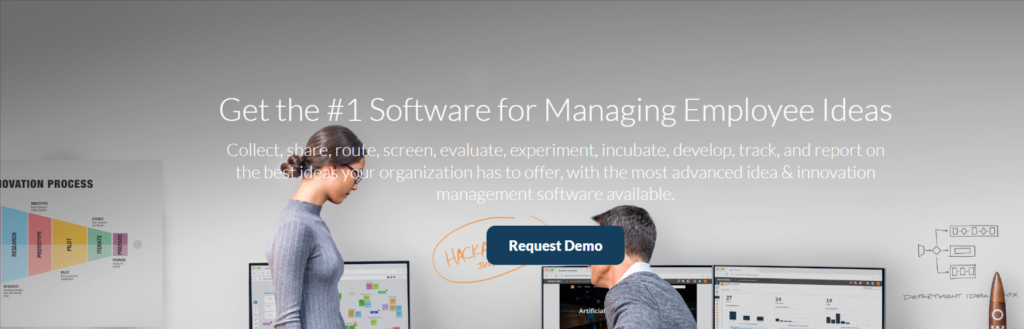
Brightidea is a good fit for organizations that run different types of innovation programs. This can include hackathons, employee idea campaigns, and continuous innovation initiatives. It helps you manage all of them in one place. You can also compare the projected financial impact with the actual results across your entire innovation portfolio.
Source: Brightidea Homepage
Key Features of Brightidea for Innovation Management
- Business proposal and funding portal: Employees submit funded proposals individually or as teams. Managers can score them and approve budgets, connecting ideation directly to financial decision-making.
- Projected vs. actual impact tracking: Compares cost estimations against what actually happened after implementation. It closes the loop on whether an innovation investment paid off.
- Idea linking across webstorms: Related or duplicate ideas from different campaigns can be linked in parent/child relationships. You can keep the portfolio view clean as multiple initiatives run in parallel.
Integrations
Microsoft Teams, Slack, Jira, Asana, and ServiceNow for daily workflows. ChatGPT, Power BI, and Zapier for automation and reporting. One G2 reviewer specifically noted they’d like to see stronger native Teams integration going forward.
Best For
BrightIdea is suited for organizations of any size running internal or external innovation programs.
Pricing
Pricing is not available on their website. However, based on Capterra, the pricing starts from $59/month.
User Reviews
Source: G2
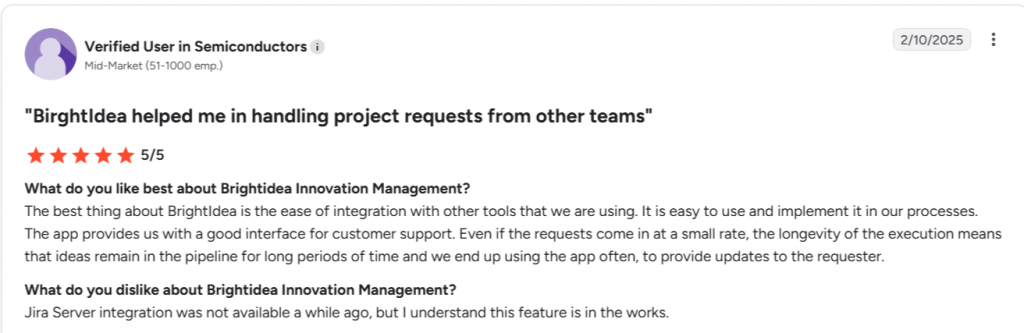
Strengths
- Easy for employees to submit and track ideas.
- Highly customizable and scales well for large enterprises.
- Strong customer support and frequent product updates.
- Linking related ideas together reduces duplicate or scattered submissions.
Limitations
- Setup workload is intensive, though customer support during implementation is well-regarded.
- Real-time dashboards could be more robust, per reviewer feedback.
- Managing user roles and permissions during import isn’t always straightforward.
What Customers Gained from Brightidea
Haskell used Brightidea to replace a scattered SharePoint-based idea management software with a structured innovation hub. Through its “Big Pitch” challenge, the company cut administrative effort, increased engagement across 2,000+ employees, and turned employee submissions into patented, real-world deployments.
Demo and Free Trial
A live demo is available through Brightidea’s website. Free trials are offered for individual products like Whiteboard and Idea Box, though not for the full platform.
6. ITONICS
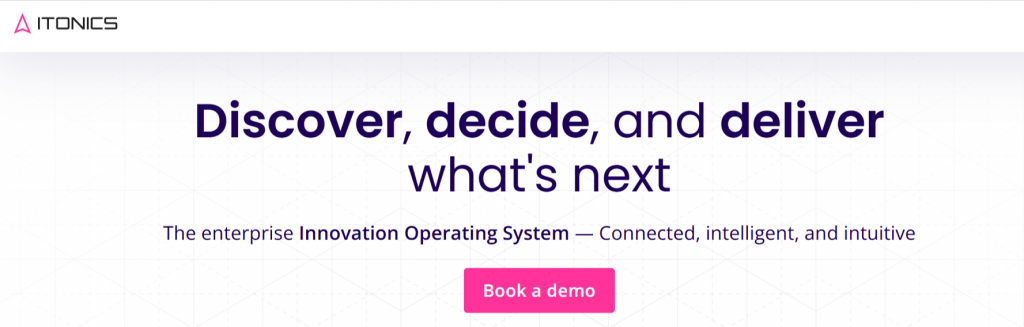
ITONICS unifies trend scouting, ideation, and portfolio management into a single operating system.
Source: ITONICS Homepage
Key Features of ITONICS for Innovation Management
- Trend and technology radars: Visual scouting tools track emerging technologies and market shifts before they reach mainstream awareness.
- Roadmapping: Visual timelines connect strategic priorities directly to which ideas actually get funded.
- Innovation portfolio management: Tracks budgets, performance, and risk across all active projects, not just individual submissions.
- AI-powered scanning: Automated trend scanning pulls from sources like Crunchbase and PitchBook to accelerate R&D scouting.
Integrations
ITONICS integrates with Jira for project sync. Salesforce and HubSpot for partner and customer data. Microsoft Teams, Slack, and SharePoint for daily collaboration. Power BI and Tableau for advanced analytics. It also has SSO for enterprise identity management.
Best For
Enterprises and R&D teams managing global innovation programs and technology portfolios. ITONICS also offers a 6-month free Educator plan for professors and researchers.
Pricing
The pricing is on a Quote basis. ITONICS has three main tiers:
- Team (small teams, standard templates)
- Professional (custom workflows, dashboards, AI, SSO)
- Enterprise (API access, BI/PLM/EA integrations, MFA, 24/7 support)
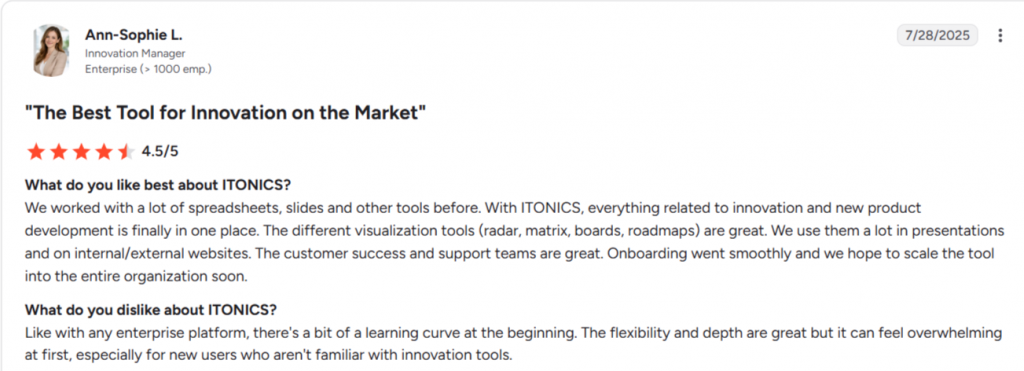
User Reviews
Source: G2
Strengths
- Centralizes all innovation and R&D activities in one platform.
- Powerful visual tools like radars, matrices, and roadmaps.
- Highly configurable templates, workflows, and dashboards.
- Strong foresight and trend-tracking capabilities powered by AI.
Limitations
- Steep learning curve for new users.
- Setup and customization can take real time.
- Occasional bugs and minor technical glitches reported.
What Customers Gained from ITONICS
Sartorius used ITONICS to centralize global R&D and technology scouting. The platform connected 60 team members, assessed 400 technologies, and revealed 450 collaboration opportunities, giving Sartorius a 360-degree view of its innovation pipeline.
Demo and Free Trial
A demo is available, and new users can access a 30-day free trial.
7. InnovationCast
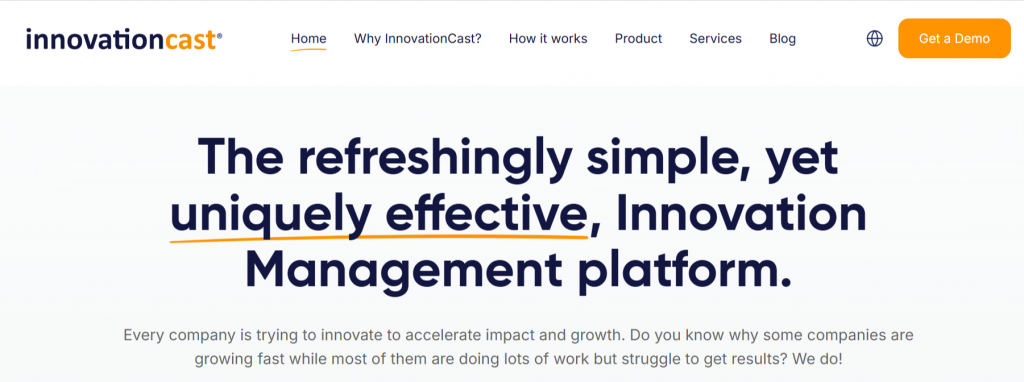
InnovationCast turns raw ideas into funded, tracked projects. It is a collaborative innovation management software that helps companies engage people to co-create ideas and bring them to life.
Source: InnovationCast Homepage
Key Features of InnovationCast for Innovation Management
- Innovation Radar: Scans the business environment for trends, technologies, and companies that could trigger new opportunities.
- Stage-gate project workflow: Approved ideas move through configurable stages: concept, feasibility, business case, build, launch, each with a go/no-go decision.
- Opportunities module: Tracks emerging possibilities separately from active projects, keeping early-stage scouting distinct from execution.
- Recognition and engagement analytics: Measures who’s contributing across the whole innovation cycle, not just who submitted the most ideas.
Integrations
Custom SSO and enterprise data sync are available on request.
Best For
Organizations with defined, stage-gate innovation processes. Innovation Cast is best for teams that want structure enforced by the system itself, not just idea collection.
Pricing
Starter from $2,999/month, scaling to Enterprise plans around $7,199/month. The Standard plan includes only 2 admin seats before extra costs apply.
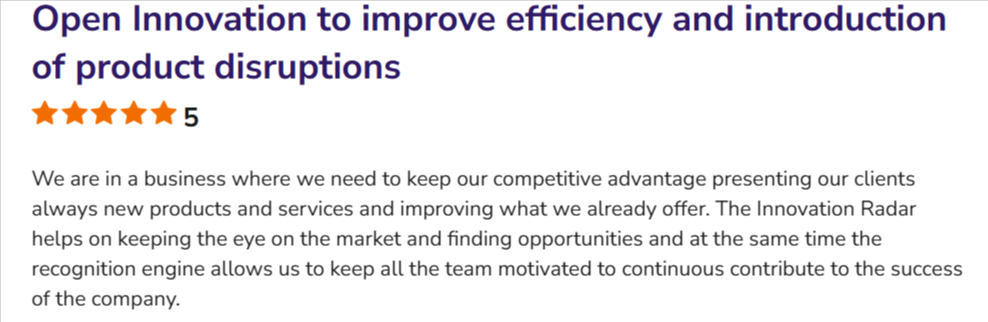
User Reviews
Source: SoftwareAdvice
Strengths
- Covers the entire innovation lifecycle from idea to implementation.
- Intuitive interface with quick onboarding.
- Modules exist for every stage: scouting, ideation, projects, engagement.
- Responsive, proactive customer support, per multiple reviewers.
Limitations
- No permanent free tier or free trial available.
- Admin seats are capped low on lower-tier plans.
- Requires genuine process discipline to get full value.
What Customers Gained from InnovationCast
VU Amsterdam used InnovationCast to launch Impact Lab, uniting students, lecturers, and staff to solve real-world challenges. The initiative gathered over 150 ideas, with some concepts becoming real projects.
Demo and Free Trial
A demo is available on request; no free trial is offered.
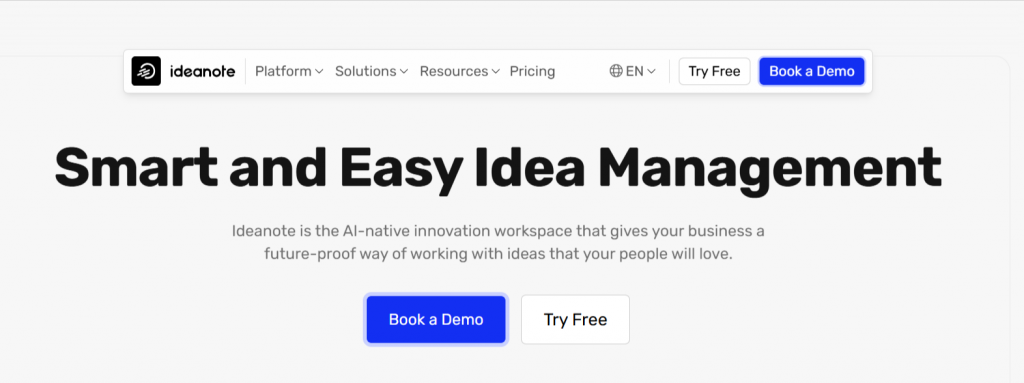
8. Ideanote
Ideanote makes launching an idea program fast. It is an AI-native innovation workspace that gives your business a future-proof way of working with ideas that your people will love.
Source: Ideanote Homepage
Key Features of Ideanote for Innovation Management
- Duplication detection: Automatically flags similar submissions across large idea volumes, keeping the innovation pipeline clean at scale.
- Audience segmentation: Targets specific campaigns to specific groups, useful for running parallel innovation programs across departments or regions.
- 10-language support: Runs innovation programs across global teams without a separate localization effort.
- Automation workflows: Reduces repetitive admin work as an innovation program scales from a pilot to company-wide.
Integrations
Ideanote has over 20 integrations, including HubSpot CRM, Jira, GitHub, Asana, Google Drive, Gmail, Microsoft 365, and Mailchimp.
Best For
Ideanote is suitable for a wide range of company sizes from individual freelancers up to a reported 140,000-employee enterprise deployment. Named customers include IKEA, Roche, and Novo Nordisk.
Pricing
Free plan and free trial available. Scale plan runs approximately $6/user/month. Ultimate plan is $899/month, adding unlimited ideas, automation, AI, SSO, SCIM, and audit logs.
User Reviews
Source: G2
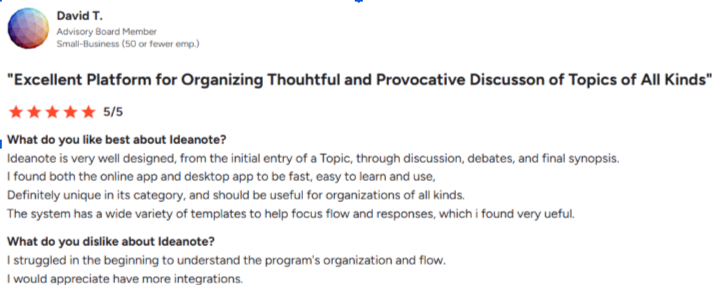
Strengths
- Clean, intuitive interface with a fast setup.
- Strong at collecting and structuring ideas at volume.
- Helpful AI for idea generation and de-duplication.
- Responsive customer support, per multiple reviewers.
Limitations
- Reporting and analytics could be stronger, per reviewer feedback.
- Some users want more native integrations beyond the current 20+.
- The login requirement may reduce participation for casual contributors.
Demo and Free Trial
Both a free plan and a free trial are available in Ideanote; no credit card required to start.
9. Traction Technology
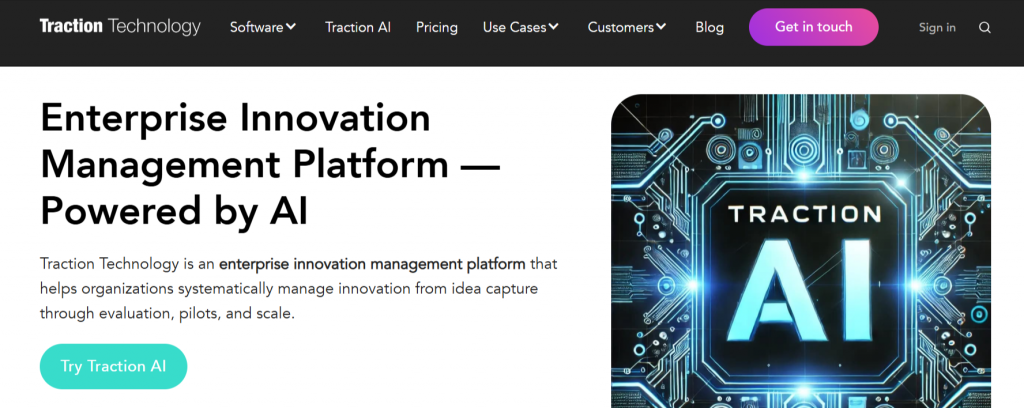
Traction Technology is enterprise innovation management software that connects idea capture, technology scouting, pilot management, and reporting in a single platform. Teams use it to discover, compare, and track emerging technologies instead of spreadsheets.
Source: Traction Technology Homepage
Key Features of Traction Technology for Innovation Management
- AI-powered technology scouting: Traction AI searches a database of over 1 million verified companies to surface real, current vendor and startup matches.
- Dynamic comparison matrix: Evaluates multiple vendors or technologies side by side against configurable, weighted criteria.
- Vendor solicitation management: Handles inbound requests from vendors seeking partnership, keeping external relationships organized alongside internal scouting.
- Configurable innovation funnel: Tracks technologies and partnerships through custom stages, from discovery to decision.
Integrations
It integrates with Microsoft API (Outlook, Teams) for daily workflow. In addition to that, you can integrate it with Crunchbase API for enriched company data and SSO for enterprise identity management.
Best For
Traction Technology is suitable for enterprise teams running external engagement programs, technology scouting, vendor evaluation, and startup relationships. However, Traction itself notes it’s not the strongest fit for organizations whose main need is large-scale employee idea crowdsourcing.
Pricing
Traction Technology’s pricing starts at $4,000/year for a Standard seat, including every module and AI capability, with unlimited View-Only access for other stakeholders. No setup fee.
User Reviews
Source: G2
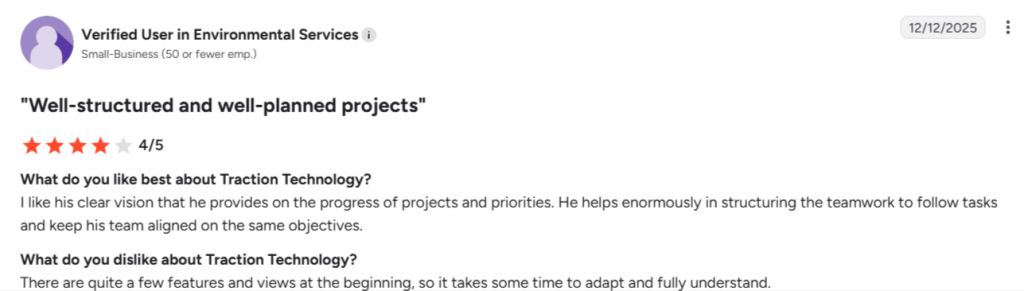
Strengths
- Intuitive platform that simplifies vendor and innovation management.
- Highly customizable, with configurable workflows, scoring, and data fields.
- Strong collaboration tools, including discussion boards and project tracking.
- Transparent, published pricing, rare among competitors on this list.
Limitations
- Interface could benefit from usability improvements; some reviewers note excessive scrolling.
- Reporting features are limited; users want more in-platform analytics and exports.
What Customers Gained from Traction Technology
A national pizza chain used Traction’s AI-powered scouting platform to modernize operations, adopting new automation, mobile, and training solutions. The changes reduced costs, improved delivery speed, and increased customer engagement.
Demo and Free Trial
A demo is available, and a 14-day free trial is offered.
10. Planview IdeaPlace
Planview IdeaPlace is a crowdsourced innovation management platform. It has over 6 million users across 170 countries. Large enterprises use it to turn employee ideas into measurable business outcomes.
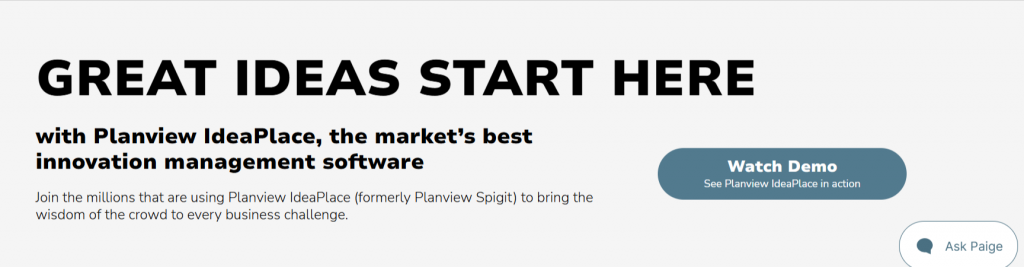
Source: Planview IdeaPlace Homepage
Key Features of Planview IdeaPlace for Innovation Management
- Branching ranking algorithm: Ranks ideas on merit using prior user assessments, reducing bias in which ideas rise to the top.
- Analytics-driven insights: Tracks program-wide participation and outcomes, not just individual idea status, to show real innovation ROI.
- Global, multilingual deployment: Supports 10 languages, built for coordinating innovation programs across countries, not a single office.
- Cross-industry configurability: Adapts to regulated industries like banking, insurance, energy, and pharmaceuticals with industry-specific workflows.
Integrations
Planview positions IdeaPlace as connecting into broader enterprise systems as part of its wider portfolio and project delivery suite.
Best For
Planview is suited for large enterprises, running innovation processes across financial services, manufacturing, healthcare, consumer products, and energy sectors. However, it is not built for small or mid-market teams.
Pricing
The exact pricing is not available on their website. However, according to Gartner, Planview uses a subscription model, typically structured per user, per month or year, with tiered plans based on features and user count.
User Reviews
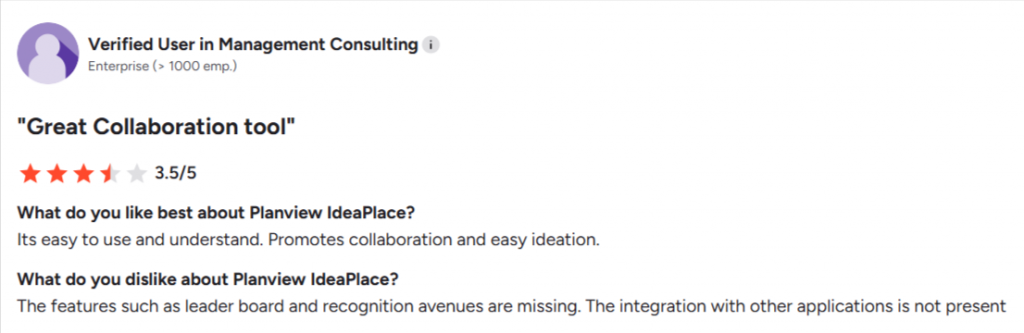
Source: G2
Strengths
- Ideas can move easily from one challenge to another, per reviewer feedback.
- Strong support team, frequently praised for helping institutionalize innovation programs.
- Reports generate quickly, and the review process is straightforward for employees.
Limitations
- Backend can feel clunky and difficult to use, per multiple reviewers.
- Pricing is not very flexible, according to user feedback.
What Customers Gained from Planview IdeaPlace
One large enterprise customer reported in TrustRadius that a single idea surfaced through the platform generated a 27x return on the software’s annual cost.
Demo and Free Trial
A demo is available; no free trial is offered.
11. KaiNexus
KaiNexus is a continuous improvement software built for lean and operationally focused innovation programs. It helps organizations capture, implement, and track improvement ideas company-wide. Teams use it to build a lasting culture of daily, incremental innovation.
Source: KaiNexus Homepage
Key Features of KaiNexus for Innovation Management
- Searchable improvement repository: Preserves past ideas, decisions, and outcomes so teams can find and reuse prior work instead of repeating it.
- Cross-location visibility: Connects teams across multiple sites or departments, giving leadership one view of improvement activity company-wide.
- KPI-linked dashboards: Ties individual improvements directly to performance metrics, not just idea counts, to prove real operational impact.
- Standardization tools: Custom templates help teams apply proven processes consistently as improvement programs scale.
Integrations
Integrates with business intelligence systems for data exchange.
Best For
KaiNexus is a good fit for organizations that follow continuous improvement practices. It is commonly used by hospitals, manufacturers, and other operations-focused organizations. It helps teams run structured improvement programs across different departments.
Pricing
KaiNexus does not have a tier-based pricing plan. If you’re shortlisting KaiNexus, you can get a custom price based on the use cases, templates, users, and other add-ons.
User Reviews
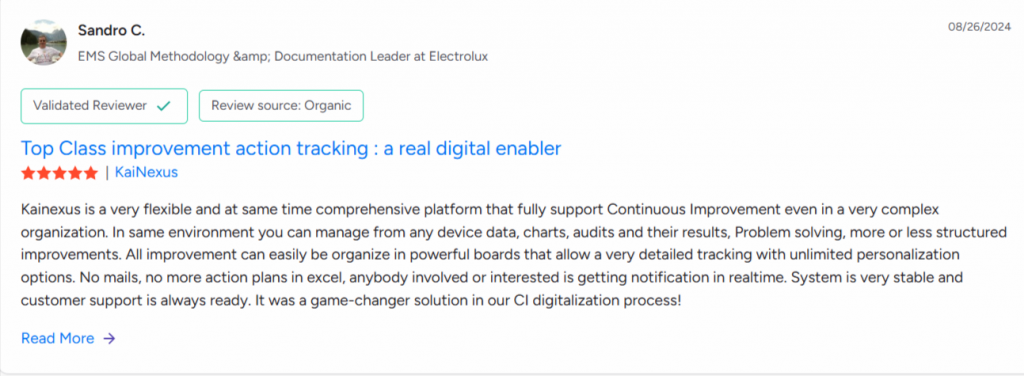
Source: G2
Strengths
- Excellent customer support and quick issue resolution, per reviewers.
- Highly flexible for complex, multi-department workflows.
- Improves transparency and collaboration across teams and locations.
- Intuitive dashboards for tracking progress and metrics.
Limitations
- Interface can feel outdated and harder to navigate for newcomers.
- Customization options for workflows and dashboards are somewhat limited.
What Customers Gained from KaiNexus
St. Clair Hospital used KaiNexus to build a Lean culture and increase transparency across teams. Within 18 months, its Emergency Department rose from the 14th to the 99th percentile in national patient satisfaction, a result it sustained for over five years.
Demo and Free Trial
A free trial is available, no credit card required. No permanent free version is offered.
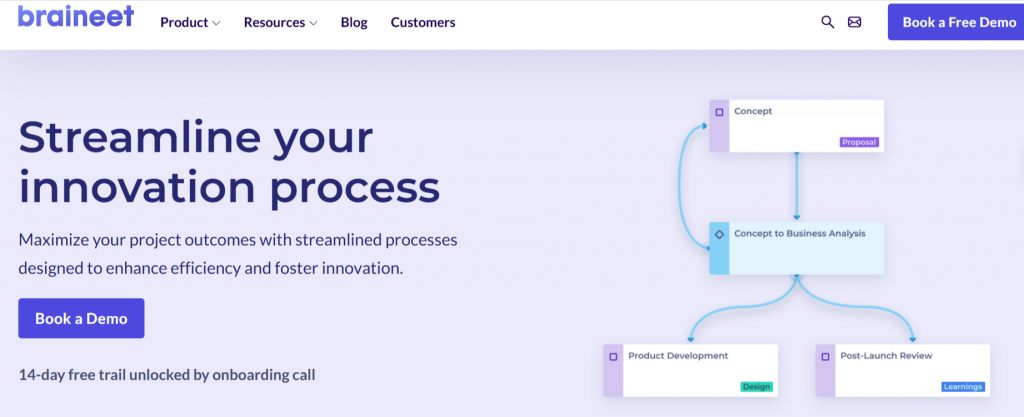
12. Braineet
Braineet is an enterprise innovation management platform built around stage-gate workflows. It centralizes idea pipelines, portfolio tracking, and real-time reporting. Teams use it to turn scattered submissions into measurable, funded projects.
Source: Braineet Homepage
Key Features of Braineet for Innovation Management
- Project portfolio management: Tracks funded initiatives at a group level, giving program managers a clear view across multiple projects, not just individual ideas.
- Configurable stage-gate workflows: Moves ideas through custom-defined phases from concept to implementation, with governance built into every step.
- Innovation Hub: A dedicated collaboration space for cross-department knowledge-sharing, separate from day-to-day idea submission.
- Strategic alignment tools: Connects individual initiatives to broader business goals, helping leaders fund the right projects, not just the most popular ones.
Integrations
You can connect Braineet with Excel and PowerPoint for data sharing and presentation, while maintaining centralized project tracking.
Best For
Innovation and R&D teams managing the full idea-to-impact cycle, along with strategy leaders and executives who need to align innovation spending with business goals.
Pricing
Pricing is not available on their website. However, based on their GetApp profile, their pricing plan starts from €2,000 per user per year. A free plan and free trial are not available.
User Reviews
Source: G2
Strengths
- Easy to use and intuitive, even for non-technical users.
- Streamlines idea capture, tracking, and workflow in one platform.
- Enables simple, visual product and project roadmaps.
Limitations
- No major drawbacks widely reported, though sample review volume is limited.
- UI harmonization across different platform modules could improve, per one reviewer.
What Customers Gained from Braineet
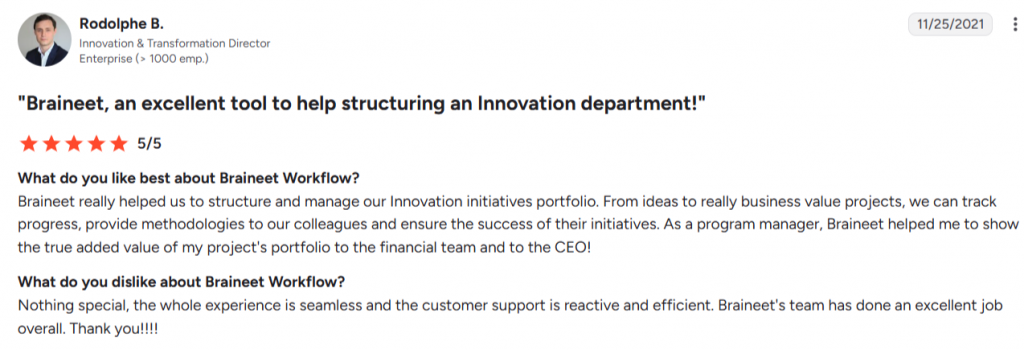
One program manager reported that Braineet helped them show the true added value of their project portfolio to both the finance team and leadership, turning scattered initiatives into a structured, trackable program.
Demo and Free Trial
A free demo is offered; no free trial is available.
13. Sideways 6
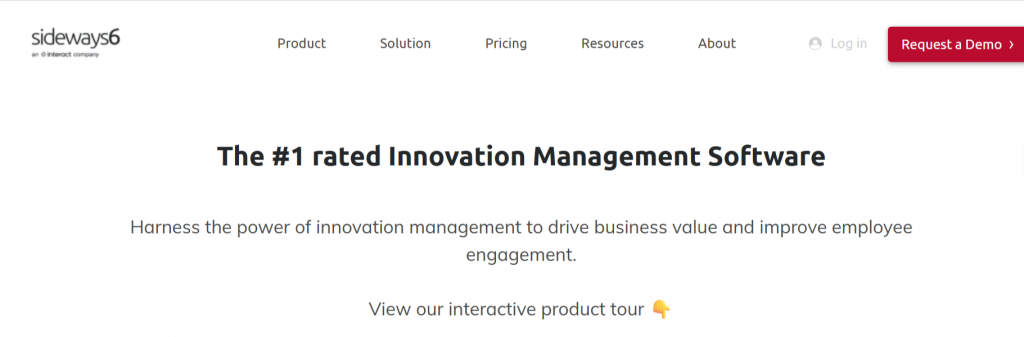
Sideways 6 is an idea management platform built inside Microsoft Teams and Viva Engage. Employees submit and discuss ideas without leaving tools they already use.
Source: Sideways 6 Homepage
Key Features of Sideways 6 for Innovation Management
- Native Microsoft 365 deployment: Ideas live directly inside Teams and Viva Engage, removing the adoption barrier of a separate tool entirely.
- Multi-market program management: Runs the same structured idea program across different countries and business units from one dashboard.
- Impact and ROI reporting: Tracks financial impact per idea, useful for proving a program’s value to leadership at scale.
- Frontline-first design: Built for organizations where most employees don’t sit at a desk, not just office-based teams.
Integrations
Sideways 6 integrates with Microsoft Teams, Viva Engage, Workplace from Meta, and Interact Intranet.
Best For
It is best for large enterprises and multi-location organizations, especially retail, travel, utilities, per G2’s customer data. Pricing shifts noticeably above 500 employees.
Pricing
Sideways6 offers two pricing plans:
- Lite plan: free for up to 10 users, then $3/user/month for 11–500 users.
- Enterprise plan: custom pricing for organizations over 500 employees.
User Reviews
Source: G2
Strengths
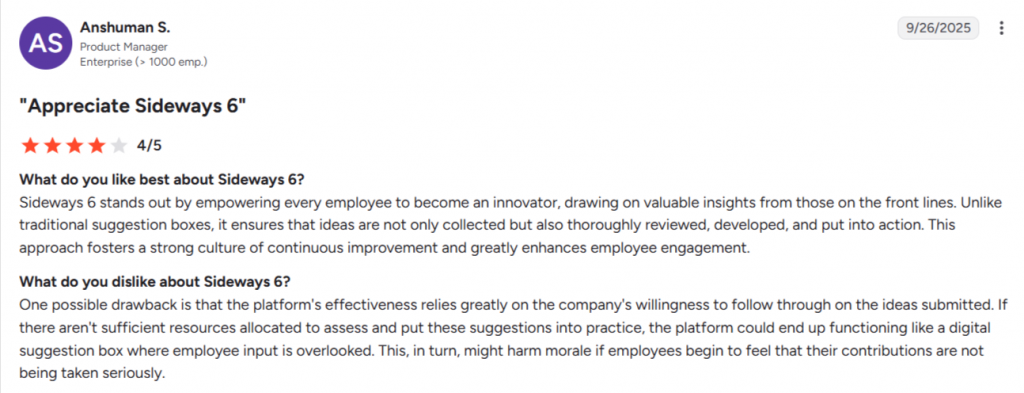
- Encourages strong employee participation and innovation culture.
- Flexible and scalable across different business workflows.
- Responsive onboarding and customer support team.
- Delivers measurable ROI through faster idea management and cost savings.
Limitations
- Search and filtering can be difficult for large idea pools.
- Backend navigation can feel complex for occasional users.
- Lacks advanced automation options like time-based triggers.
What Customers Gained from Sideways 6
Primark uses Sideways 6 to power FWD Th!nk, a company-wide idea program reaching over 80,000 employees across 10 markets. The program has generated over 3,500 ideas with multimillion-pound impact, including one product that exceeded sales forecasts by 130%.
Demo and Free Trial
A demo is available, and the Lite plan offers a 14-day free trial.
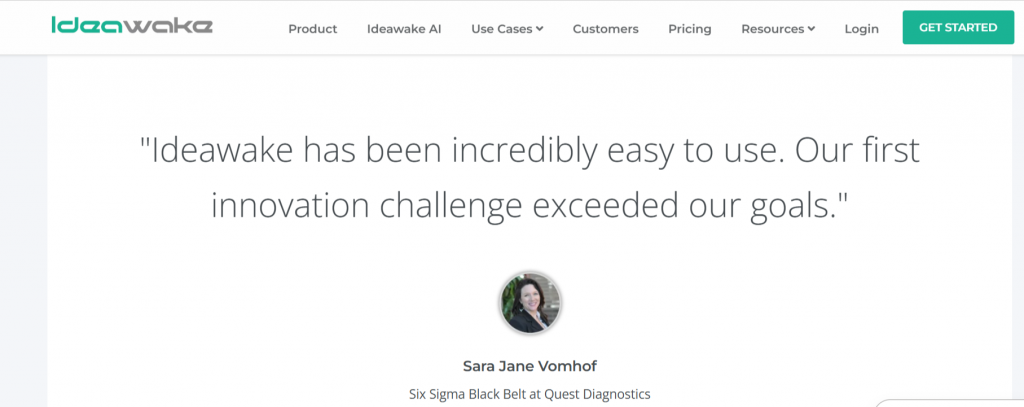
14. Ideawake
Ideawake is a cloud-based innovation platform for medium to large organizations. It manages the full innovation lifecycle, from idea collection through execution. Teams use gamification and incentives to keep participation high.
Source: Ideawake Homepage
Key Features of Ideawake for Innovation Management
- Incentive and gamification programs: Structured rewards keep employee participation high in innovation programs over time, not just during an initial launch period.
- Segmented participation control: Invitations can be scoped to specific departments, customer lists, or stakeholder groups, running multiple programs in parallel.
- ROI-focused reporting: Built specifically to show leadership the return on crowdsourcing investment, not just idea volume.
- Real-time chat and scorecarding: Combines live discussion with structured evaluation, keeping feedback and decisions in one place.
Integrations
IdeaWake integrates with Microsoft Teams, Slack, and Office 365, with customizable APIs and pre-built connectors.
Best For
Medium to large organizations running innovation challenges, continuous improvement, hackathons, and ROI-focused programs.
Pricing
IdeaWake has 3 tiered pricing plans and support plans:
- Flex licensing starts at $500/month.
- Business plans run $300–$2,250/month.
- Enterprise pricing is custom.
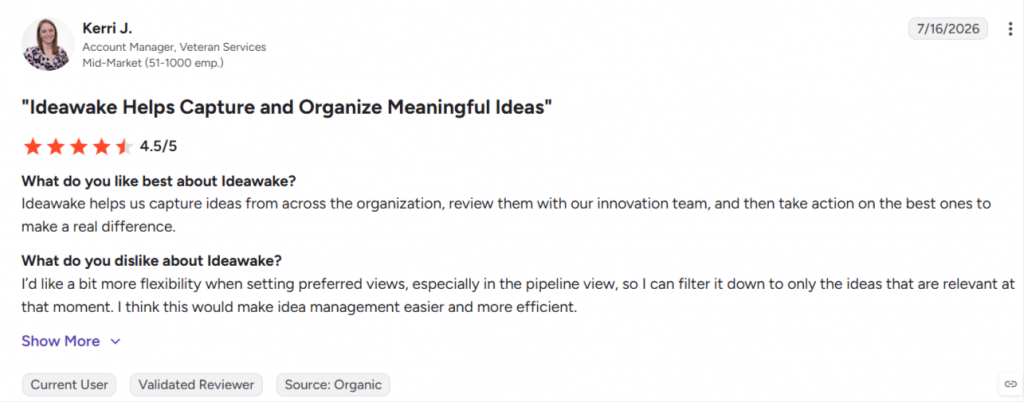
User Reviews
Source G2
Strengths
- Simple, intuitive design with a minimal learning curve.
- High engagement rates through gamification and real-time collaboration.
- Customer support is highly praised for being responsive and flexible.
- Seamless integration with enterprise tools already in use.
Limitations
- Reporting and analytics could be more intuitive, per reviewers.
- Filtering and sorting options within idea lists are somewhat limited.
- Large idea volumes can be hard to manage without clear prioritization tools.
What Customers Gained from Ideawake
Paul Bunyan Communications, a 200-employee broadband cooperative, used Ideawake to replace scattered email-based feedback with a centralized program. Over two years, it launched 5 challenges, gathered 149 ideas, and implemented 14 of them.
Demo and Free Trial
Ideawake offers a 30-minute demo, and new users can access a free trial upon signup.
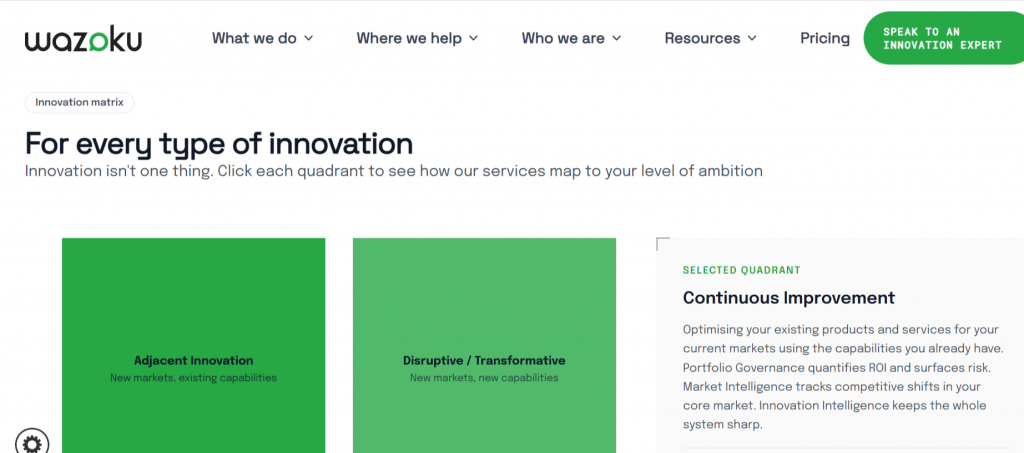
15. Wazoku
Wazoku is an AI-powered innovation platform built around its Challenge-Driven Innovation methodology. It’s designed for open innovation, connecting organizations to external solver networks. Sustainability-focused programs are a particular strength.
Source: Wazoku Homepage
Key Features of Wazoku for Innovation Management
- Challenge-driven innovation methodology: Frames real business problems as structured challenges, aligning solver effort directly with strategic goals.
- Global solver network: Connects organizations to external problem-solvers worldwide, useful when internal expertise alone isn’t enough.
- Sustainability and ESG program support: Purpose-built features for organizations running environmental or social impact innovation initiatives.
- Jen, Wazoku’s agentic AI: Assists with matching challenges to relevant solvers and surfacing patterns across submissions.
Integrations
Wazoku connects with existing enterprise tools without disrupting daily workflows; specific integrations are customized per deployment.
Best For
Large enterprises running challenge-driven, open, employee, and ecosystem-wide innovation programs, particularly those with sustainability mandates.
Pricing
Not publicly disclosed. Custom proposals are built around organizational requirements.
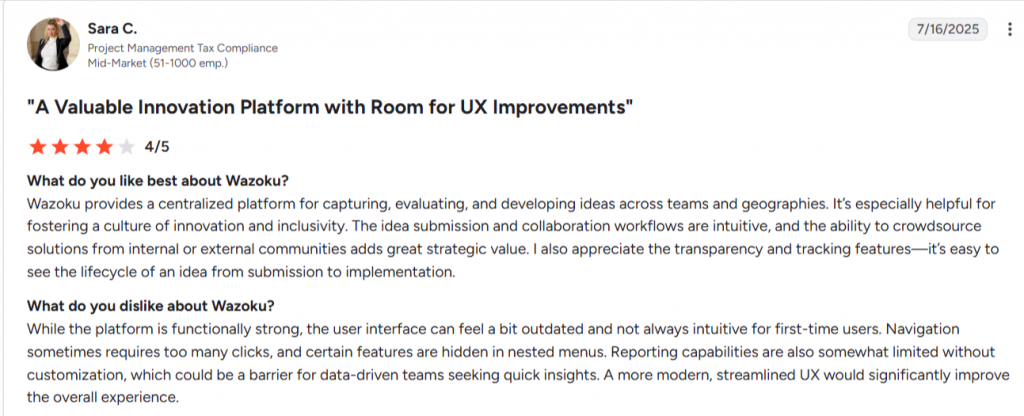
User Reviews
Source: G2
Strengths
- Makes it easy to capture, evaluate, and scale ideas across teams.
- Encourages participation from employees, partners, and customers.
- The Challenge Driven Innovation methodology keeps efforts aligned with business goals.
- Quick, proactive customer service, per reviewers.
Limitations
- Some users find the UI outdated and less intuitive for first-time users.
- Reporting and workflow customization could be more flexible.
- New users may need initial training to fully utilize the platform.
What Customers Gained from Wazoku
Precyse Technologies used Wazoku to solve a major industrial IoT challenge: activating RFID tags from 100 feet away while extending battery life beyond five years. More than 500 global solvers contributed, leading to a passive wake-up technology that improved range and reduced energy use.
Demo and Free Trial
A demo is available upon request; no free trial is offered.
In our analysis, we found 2 other notable innovation tools that are worth mentioning.
Additional Innovation Management Software for Specific Use Cases
Two more platforms didn’t make the top 15, but each solves one specific problem well enough to be worth knowing about.
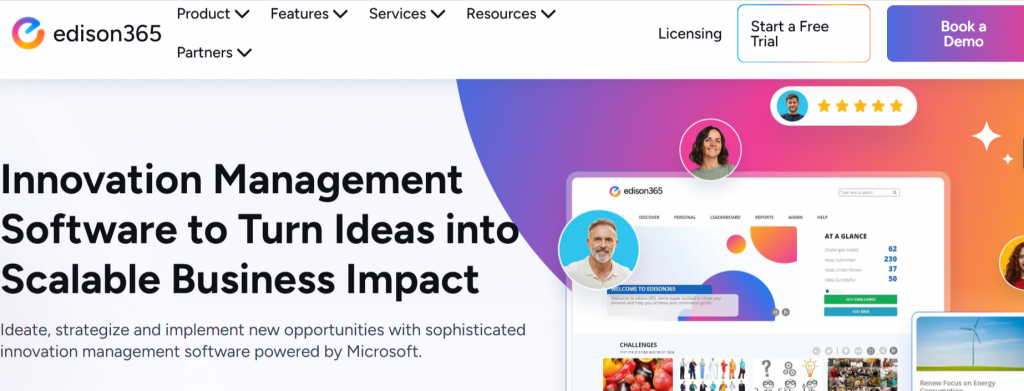
1. Edison365
Edison365 stands out for one specific reason: it’s built natively on Microsoft 365, living directly inside Teams, SharePoint, and Power BI rather than sitting alongside them. That makes it a strong runner-up for organizations already standardized on the Microsoft ecosystem who want innovation management without adding a separate platform to learn.
Source: Edison 365 Homepage
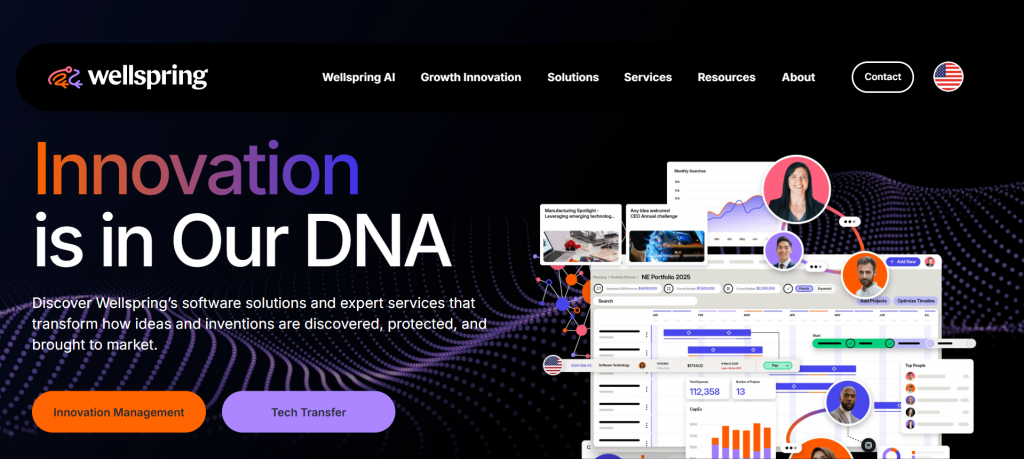
2. Wellspring
Wellspring is worth a look specifically for technology scouting and IP commercialization, used by universities, research institutions, and enterprises managing patent portfolios. It’s a narrower fit than most tools on this list, but a strong one if IP commercialization is a core part of your innovation strategy.
Source: WellSpring Homepage
Both of these solve a specific problem well. The 15 tools above cover different parts of the innovation process. Now, before you commit to any of them, here’s what actually matters.
Final Thoughts
One thing worth saying plainly: don’t skip evaluation just because a demo looked polished.
Ask the vendor to walk through your actual workflow, not their standard pitch. Bring a real idea from your own pipeline and see exactly how it moves through their system. A scripted demo shows what’s possible in theory. Your own use case shows what it’ll actually feel like.
If your workflow ends in a patent, the TIP Tool™ is the strongest fit here. It’s the only platform built to handle the full path: invention disclosure and evaluation upfront, then examiner analysis, prosecutor analysis, and portfolio tracking after filing.
If your organization’s innovation workflow involves patent, try the TIP Tool™ for free or get a personalized demo for the TIP Tool™.
Not every team’s end goal is a patent, though, and the right tool depends on what you’re solving for.
The best software matches where your ideas come from and where they need to end up, not the one with the most features on paper.
Disclaimer: The information in this article/review is sourced from the internet and may not be entirely accurate or up-to-date. We recommend visiting the respective software websites for the most current and reliable information. The opinions expressed here are those of the author and may not reflect the views of Triangle IP. We are not liable for any consequences that may arise from relying on the information provided in this article/review.
Frequently Asked Questions
1. What Is Innovation Management Software?
Innovation management software is a system for capturing, evaluating, and tracking ideas from submission through to a real outcome, a patent, a shipped feature, or an implemented process change. It replaces scattered spreadsheets and email threads with a structured, visible pipeline that shows where every idea stands and who’s responsible for moving it forward.
2. Is There Free Innovation Management Software Available?
Some innovation management platforms offer usable free tiers. The TIP Tool™, Ideanote, and Sideways 6 all have permanent free plans for up to 10 users. Most enterprise-focused tools, Qmarkets, HYPE Innovation, and ITONICS, don’t offer a free tier at all, since they’re built for scale, not testing at zero cost.
3. What are the Biggest Implementation Challenges Companies Face When Rolling Out Innovation Management Software Across Global Teams?
Companies often encounter several obstacles when deploying innovation management software at scale:
- Low adoption across regions because teams see the platform as extra work or lack proper onboarding.
- Inconsistent idea submission practices, leading to uneven data quality across countries and business units.
- Misaligned evaluation criteria, resulting in subjective or siloed decision-making.
- Resistance from middle management, especially when new workflows expose inefficiencies or shift authority.
- Limited integration with existing systems like Jira, PLM tools, SharePoint, or patent management platforms.
- Unclear governance around who reviews, approves, and advances ideas.
- Data silos and fragmentation when global teams store information in different places or formats.
- Cultural differences that influence how openly teams share ideas or challenge norms.
- Lack of standard KPIs to measure innovation performance, making it hard to prove impact.
- Overly complex rollout plans that push too many features at once and overwhelm global teams.
4. What Are the Hidden Costs or Maintenance Requirements Buyers Should Expect Beyond Subscription Fees of the Innovation Management Software?
Even when pricing looks straightforward, extra costs can arise from setup, training, and long-term maintenance. Understanding these early helps teams budget accurately.
The most common hidden costs include:
- Setup and data migration: Importing existing ideas, patents, and portfolios takes time and coordination. Depending on data quality, setup can take one to four weeks.
- Training and adoption: Admins and reviewers often need onboarding sessions. Choosing tools with guided workflows, like TIP Tool™, reduces both time and expense.
- Customization and workflow updates: Tailoring dashboards or evaluation matrices requires some admin effort, especially as your process evolves.
- Integration maintenance: API connections and docketing system syncs may need periodic updates or IT oversight.
By planning for these factors, you can avoid budget surprises and ensure a smooth rollout.
5. Does Ideawake or Planview IdeaPlace (Formerly Spigit) Work Better for Large Enterprises Running Continuous Innovation?
Both serve large enterprises, but differently. Ideawake leans on gamification and incentives to sustain participation over time, well suited to ongoing challenges and hackathons. Planview IdeaPlace uses a branching ranking algorithm to reduce bias in large-scale crowdsourcing and fits regulated industries like banking, insurance, and healthcare especially well. The better fit depends on whether sustained engagement or unbiased large-scale ranking matters more to your program.